Is Apple Cider Safe During Pregnancy? (Updated 2026 Guide)
Updated September 9, 2026
The Answer
Yes choose pasteurized, nonalcoholic apple cider and follow the package storage instructions. This guidance does not extend to hard cider, freshly pressed untreated cider, or concentrated cider supplements.
For ordinary apple cider, the main checks are pasteurization, absence of alcohol, and proper storage not the ingredient grade alone. Some cider related blends contain supplemental ingredients such as algae, elderberry concentrate, or isolated quercetin; their concerns depend on dose, preparation, and product quality and do not establish harm from ordinary apple cider. Added vitamin C does not make cider an immune treatment.
Pregnancy Safe is 100% independent and research driven. No companies pay to promote or sponsor products.
Stress Less This Pregnancy
Check your exact apple cider in the app

✓ What's Safe
- • Choose cider explicitly labeled pasteurized; do not rely on words such as fresh, organic, or natural.
- • Confirm that you are buying nonalcoholic apple juice or cider rather than hard cider.
- • Read the current package label for the exact version, including any added extracts or supplemental ingredients.
- • Follow refrigeration instructions, including those that apply after opening.
- • At an orchard, market, or café, ask whether the cider is pasteurized before ordering.
✗ What to Avoid
- • Avoid freshly pressed untreated or unpasteurized cider during pregnancy.
- • Avoid hard cider and cider drinks with added alcohol.
- • Do not assume hot or mulled cider was made with pasteurized, nonalcoholic cider; confirm the base and additions.
- • Avoid drinking cider that has not been stored according to its package instructions.
- • Do not substitute cider extracts, capsules, or concentrated wellness blends for ordinary cider without checking their ingredients and doses with your prenatal clinician.
Most Common Ingredients in Apple Cider Products
We analyzed 237 apple cider products. Here are the most common ingredients, ranked by how often they appear:
Ingredients to Watch Out For in Apple Cider
These are the most common flagged ingredients across 237 apple cider products we analyzed.
chlorella
Caution
Chlorella is a nutrient dense, freshwater algae rich in vitamins, minerals, and antioxidants, often used as a dietary supplement to support detoxification and immune health.
Is not proven harmful in small second trimester human studies but remains a supplement with limited pregnancy data and product quality or contamination concerns.
Flagged in 1 of 237 products (0%)
elderberry concentrate
Caution
Elderberry concentrate is a potent extract made from elderberries, known for its immune boosting and antioxidant properties.
Has little pregnancy specific safety data for supplement doses and can be toxic if raw, unripe, or made with leaves, stems, bark, or roots.
Flagged in 1 of 237 products (0%)
quercetin
Caution
Quercetin is a natural flavonoid antioxidant found in many fruits and vegetables that may help reduce inflammation and support immune health.
Is generally compatible at normal food amounts but warrants caution as a high dose supplement because pregnancy safety data are lacking and interactions or quality issues are possible.
Flagged in 1 of 237 products (0%)
seaweed extract
Caution
Seaweed extract is a natural ingredient rich in minerals and antioxidants, commonly used to nourish and hydrate the skin or hair.
Can contain highly variable iodine, with high dose brown seaweed or kelp products and hijiki arsenic exposure requiring caution in pregnancy.
Flagged in 1 of 237 products (0%)
spirulina
Caution
Spirulina is a nutrient rich blue green algae known for its high protein, vitamin, and antioxidant content, often used as a dietary supplement.
Has limited pregnancy safety data and product quality concerns because contaminated blue green algae supplements can contain microcystins, heavy metals, or pathogenic bacteria.
Flagged in 1 of 237 products (0%)
Apple Cider Products We've Analyzed
Our catalog contains ratings for 237 apple cider products. These are database grades, not independent safety certifications.
Catalog ingredient grades do not measure current-label completeness, pathogens, preparation, caffeine or clinical pregnancy suitability. These counts include unreviewed records and are not a percentage of independently verified safe products.
Pregnancy Safe Apple Cider Products
Popular options from our catalog, prioritizing A and B ingredient grades, with C grade options used to fill remaining places. Within each group, products are ordered by searches in Pregnancy Safe, not retail sales. Read the cautions and guidance above; grades do not verify a complete current label or guarantee pregnancy safety.
| Grade | Product | Brand |
|---|---|---|
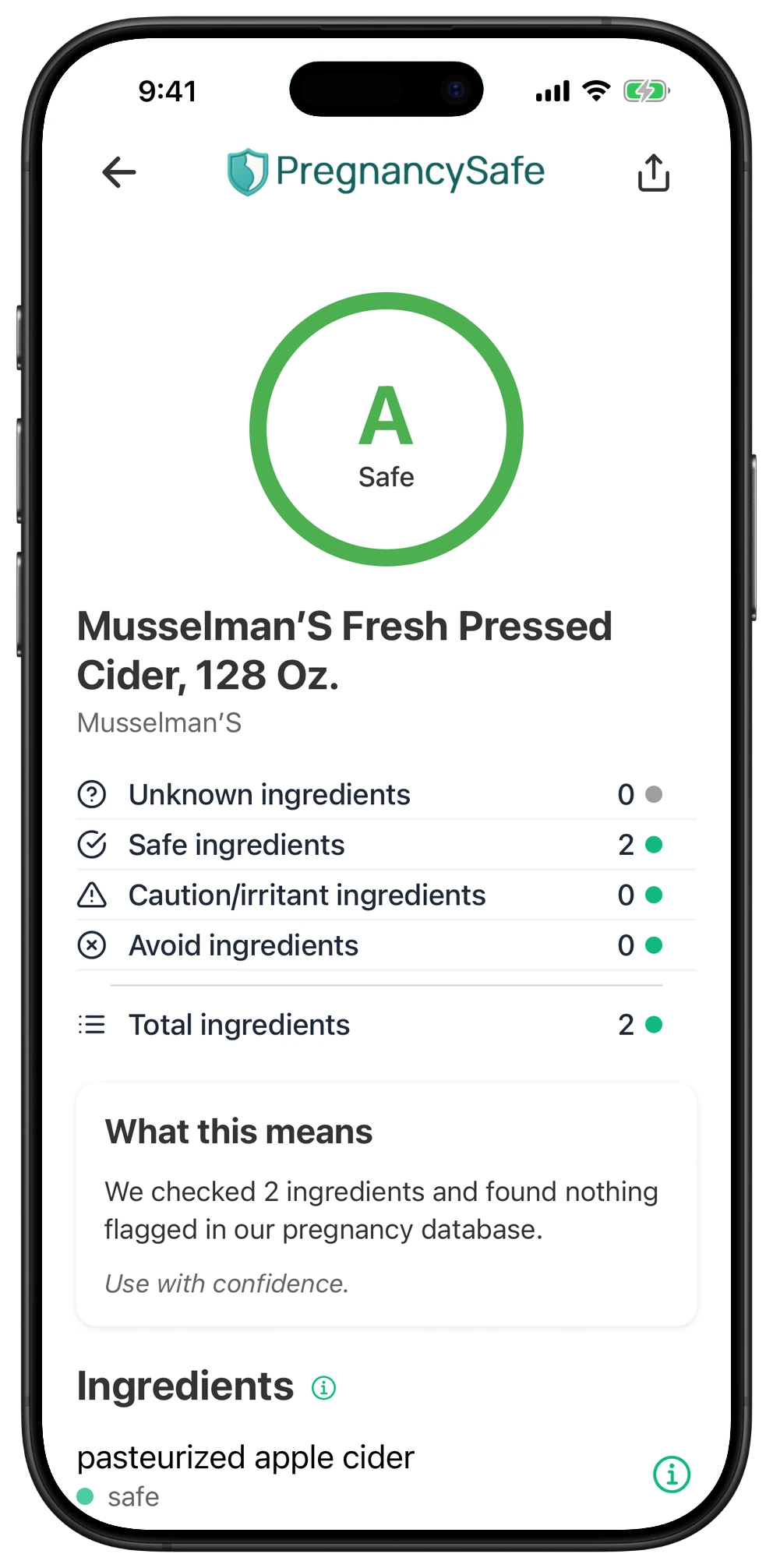
| A | Musselman’S Fresh Pressed Cider, . | Musselman’S |
| A | Martinelli Cider Honeycrisp Organic - - 33.8 Fo | Martinelli'S |
| A | Honey Crisp Apple Cider | Trader Joe'S |
| A | Apple Cider | Ryan Orchards |
| A | Ryan'S, Opal Blend Melange, Apple Cider | Ryan Orchards |
Your Questions Answered
Can pregnant women have apple cider?
Yes, pasteurized, nonalcoholic apple cider can fit into pregnancy nutrition. Check both the pasteurization statement and the type of drink on the actual package. Follow its storage instructions rather than treating an ingredient grade as a safety guarantee.
Can I drink fresh apple cider from an orchard?
Ask whether it has been pasteurized before drinking it. Freshly pressed, organic, or locally made does not establish that cider has been treated. Choose a confirmed pasteurized option rather than untreated cider or one whose processing you cannot verify.
Is hot or mulled apple cider safe during pregnancy?
Choose hot cider made from pasteurized, nonalcoholic cider. Ask about the base drink and any added alcohol when someone else prepares it. The words hot or mulled alone do not confirm pasteurization or the absence of alcohol.
Are apple cider, hard cider, and apple cider vinegar the same?
No these names refer to different preparations. This guidance covers pasteurized, nonalcoholic apple juice or cider, not alcoholic hard cider. Apple cider vinegar and concentrated cider supplements also need separate consideration; advice about the ordinary drink does not automatically apply to them.
Do added greens or immune support ingredients make cider a better pregnancy choice?
Not necessarily; added vitamin C does not establish an immune treatment benefit. Chlorella and spirulina supplements have limited pregnancy evidence and product quality concerns, while seaweed extract requires attention to its type and iodine content. Elderberry concentrate has limited pregnancy safety evidence at supplement doses, and isolated supplemental quercetin differs from the quercetin naturally present in apples. These concerns do not prove that every blend is harmful, but concentrated additions warrant a dose specific discussion with your prenatal clinician.
Does an A grade mean apple cider is verified safe during pregnancy?
No. Our catalog contains 237 products, including 214 with an A ingredient grade, but those counts include unreviewed records. Ingredient grades do not establish pasteurization, proper storage, current label completeness, or clinical pregnancy suitability. Check the current package even when a catalog listing or a high grade is available.
How Do We Score Products for Pregnancy Safety?
We analyze each product's ingredients and category to flag known risks and provide cautionary notices for general category safety concerns.
Grades reflect the ingredient and category information available to us. They don’t verify a complete, current label or account for dose, preparation, or contamination. Read them alongside the guidance above, not as a guarantee of pregnancy safety or proof that every use is harmful.
A - Safe
Excellent choice! All ingredients are considered safe during pregnancy.
What to do: Use with confidence.
B - Likely Safe
Pretty much safe with very minimal risk. Some ingredients may have limited pregnancy studies, but no significant safety concerns have been identified.
What to do: Use with confidence.
C - Limit
Contains ingredients with some pregnancy considerations. Research shows these ingredients may have limited safety data, potential for minor hormonal effects, or require caution based on animal studies.
What to do: Use sparingly and consider safer alternatives when available.
D - Caution
Similar to C grade but contains multiple cautionary ingredients. The combination increases overall concern.
What to do: Try to avoid if that makes you feel better. If you've already used it, no need to panic.
F - Avoid
Contains an ingredient Pregnancy Safe recommends avoiding during pregnancy. This may reflect an established risk or a precaution based on limited evidence; check the ingredient guidance and exposure context.
What to do: Do not use during pregnancy. If you've already used it, don't worry - contact your OBGYN if concerned.
People Also Checked
References
- https://www.fda.gov/food/buy-store-serve-safe-food/selecting-and-serving-produce-safely
- https://www.nhs.uk/pregnancy/keeping-well/foods-to-avoid/
- https://www.ncbi.nlm.nih.gov/books/NBK501822/
- https://pmc.ncbi.nlm.nih.gov/articles/PMC10804112/
- https://pubmed.ncbi.nlm.nih.gov/20013055/
- https://pubmed.ncbi.nlm.nih.gov/17472477/
- https://pubmed.ncbi.nlm.nih.gov/15985279/
- https://pubmed.ncbi.nlm.nih.gov/24635025/
- https://www.fda.gov/food/information-consumers-using-dietary-supplements/questions-and-answers-dietary-supplements
- https://ods.od.nih.gov/factsheets/Pregnancy-HealthProfessional/
- https://pmc.ncbi.nlm.nih.gov/articles/PMC7551278/
- https://www.nccih.nih.gov/health/elderberry
- https://pmc.ncbi.nlm.nih.gov/articles/PMC3941201/
- https://pmc.ncbi.nlm.nih.gov/articles/PMC8026097/
- https://pmc.ncbi.nlm.nih.gov/articles/PMC7961730/
- https://www.cdc.gov/mmwr/preview/mmwrhtml/00000311.htm
- https://pubmed.ncbi.nlm.nih.gov/11518905/
- https://infantrisk.com/content/management-cold-and-flu-during-pregnancy
- https://webprod.hc-sc.gc.ca/nhpid-bdipsn/dbImages/mono_quercetin_english.pdf
- https://pubmed.ncbi.nlm.nih.gov/29127724/
- https://www.drugs.com/npp/quercetin.html
- https://www.mskcc.org/cancer-care/integrative-medicine/herbs/quercetin
- https://www.nccih.nih.gov/health/using-dietary-supplements-wisely
- https://pubmed.ncbi.nlm.nih.gov/36140900/
- https://journals.sagepub.com/doi/10.1177/10507256261445624
- https://ods.od.nih.gov/factsheets/Iodine-HealthProfessional/
- https://www.foodstandards.gov.au/consumer/nutrition/pregnancy/iodine-and-pregnancy
- https://www.foodstandards.gov.au/consumer/prevention-of-foodborne-illness/arseniciodine
- https://inspection.canada.ca/en/food-safety-consumers/fact-sheets/specific-products-and-risks/chemical-hazards/inorganic-arsenic
- https://pubmed.ncbi.nlm.nih.gov/35947162/
- https://pubmed.ncbi.nlm.nih.gov/20919974/
- https://pubmed.ncbi.nlm.nih.gov/30632947/
- https://pmc.ncbi.nlm.nih.gov/articles/PMC8077470/
- https://www.fda.gov/food/natural-toxins-food/blue-green-algae-products-and-microcystins
- https://www.ncbi.nlm.nih.gov/books/NBK548312/
- https://www.ncbi.nlm.nih.gov/books/NBK501849/
- https://pubmed.ncbi.nlm.nih.gov/21793723/
- https://journal.ugm.ac.id/v3/InaJBCS/article/view/23573
- https://doi.org/10.4236/ojog.2017.71016
- https://pubmed.ncbi.nlm.nih.gov/37317149/
- https://pubmed.ncbi.nlm.nih.gov/37368655/
- https://pubmed.ncbi.nlm.nih.gov/23036452/
- https://pubmed.ncbi.nlm.nih.gov/21842336/