Is Balsamic Vinegar Safe During Pregnancy? (Updated 2026 Guide)
Updated September 9, 2026
The Answer
You can generally have balsamic vinegar during pregnancy in ordinary food amounts, such as a drizzle or dressing, rather than vinegar shots or concentrated supplements. Our catalog contains 67 A grade and 2 B+-grade entries, but these ingredient grades are not independent pregnancy safety guarantees.
The main distinction is how you use balsamic vinegar: ordinary condiment use is different from drinking vinegar shots or taking concentrated supplements. Wine vinegar is not a glass of wine, and common ingredients such as grape must, sugar, salt and routine additives do not by themselves establish fetal harm. Check the exact label, follow storage and preparation instructions, and account for your allergies or individualized diabetes or sodium advice.
Pregnancy Safe is 100% independent and research driven. No companies pay to promote or sponsor products.
Stress Less This Pregnancy
Check your exact balsamic vinegar in the app
✓ What's Safe
- • Choose balsamic vinegar intended for culinary use, and use it as a condiment with food.
- • Check whether the bottle contains plain vinegar, flavored vinegar, a dressing or a glaze; these are not interchangeable formulations.
- • Read the complete label on your current package, including ingredients and any allergy information.
- • Follow the exact package instructions for storage and use after opening.
- • If you have diabetes or a prescribed sodium limit, check the nutrition label against your care team's advice.
✗ What to Avoid
- • Avoid treating vinegar shots or concentrated supplements as equivalent to a drizzle of vinegar on food.
- • Avoid assuming a balsamic glaze or flavored dressing has the same ingredients as plain balsamic vinegar.
- • Avoid ingredients that trigger your known allergies, including additions in flavored varieties.
- • Avoid ignoring storage or preparation instructions because the product is vinegar.
- • Avoid choosing solely by an A grade; it does not verify the current label, contamination status or suitability for your individual pregnancy.
Most Common Ingredients in Balsamic Vinegar Products
We analyzed 69 balsamic vinegar products. Here are the most common ingredients, ranked by how often they appear:
Balsamic Vinegar Products We've Analyzed
Our catalog contains ratings for 69 balsamic vinegar products. These are database grades, not independent safety certifications.
Catalog ingredient grades do not measure current-label completeness, pathogens, preparation, caffeine or clinical pregnancy suitability. These counts include unreviewed records and are not a percentage of independently verified safe products.
Pregnancy Safe Balsamic Vinegar Products
Popular options from our catalog, prioritizing A and B ingredient grades, with C grade options used to fill remaining places. Within each group, products are ordered by searches in Pregnancy Safe, not retail sales. Read the cautions and guidance above; grades do not verify a complete current label or guarantee pregnancy safety.
| Grade | Product | Brand |
|---|---|---|
| A | Casa Barelli Fig Glaze Balsamic Vinegar Of Modena | Casa Barelli |
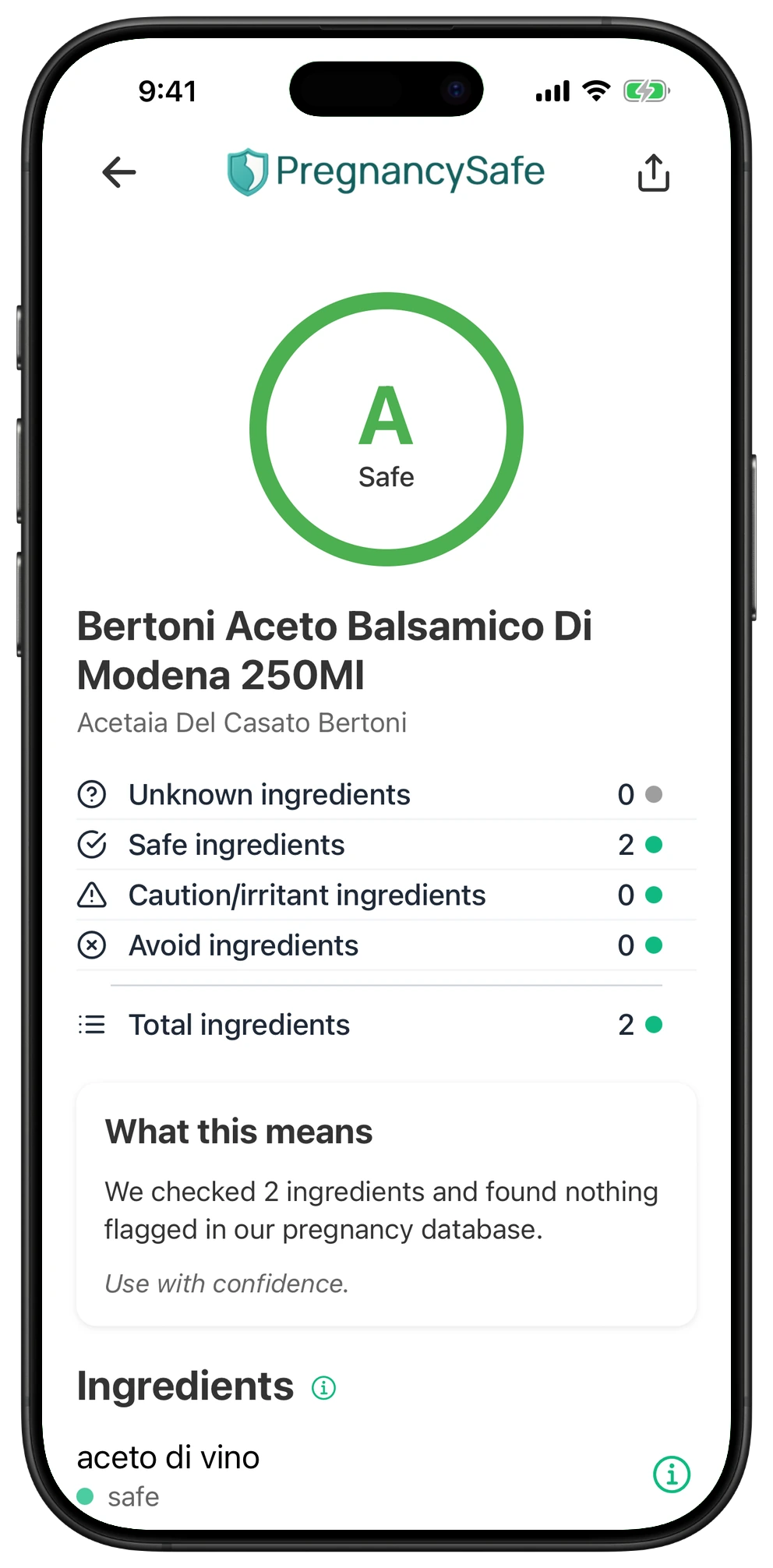
| A | Bertoni Aceto Balsamico Di Modena | Acetaia Del Casato Bertoni |
| A | Classic Original With Balsamic Vinegar Of Modena, Classic Original | De Nigris |
| A | Bronze Eagle De Nigris Balsamic Vinegar Of Modena | De Nigris |
| A | De Nigris Platinum Eagle Balsamic Vinegar | De Nigris |
Your Questions Answered
Can you have balsamic vinegar when pregnant?
You can generally use balsamic vinegar in ordinary food amounts during pregnancy, such as in a dressing or as a drizzle. That guidance does not extend to drinking vinegar shots or taking concentrated supplements. Follow the instructions on your bottle and any dietary advice specific to your pregnancy.
What vinegar is pregnancy safe?
For balsamic vinegar, ordinary culinary use is the relevant context, rather than concentrated or supplemental use. Choose a food product with a clear label and follow its storage and preparation instructions. Do not assume that every vinegar based drink, supplement or mixed dressing has the same formulation or considerations.
Does wine vinegar mean balsamic vinegar is like drinking wine?
No. Wine vinegar in a condiment is not the same exposure as drinking a glass of wine. Its name alone is not a reason to treat ordinary balsamic vinegar use as alcoholic beverage consumption. Check the full label if you are buying a mixed sauce or dressing rather than vinegar itself.
How much balsamic vinegar can I have during pregnancy?
Use it in ordinary food amounts, such as a drizzle on a meal or an ingredient in dressing. There is no pregnancy specific numerical limit established here, so a precise daily allowance would be misleading. Do not extend this guidance to shots or concentrated supplements. If you need to manage carbohydrate or sodium intake, fit the actual serving into your individualized dietary advice.
Is balsamic glaze the same as balsamic vinegar during pregnancy?
No; a glaze, flavored vinegar and plain balsamic vinegar can have different formulations. Read the ingredients and nutrition label for the exact version you plan to eat. Sugar, salt or routine additives alone do not establish fetal harm, but they may matter for your individual dietary needs. Use the product as a condiment and follow its own storage instructions.
Do A grades mean every balsamic vinegar has been verified safe?
No. Our catalog contains 69 entries: 67 graded A and 2 graded B+. These are ingredient grades, not confirmation that every current package has been independently checked. They do not measure pathogens, contaminants, preparation or individual clinical suitability, so you should still read your bottle's label.
How Do We Score Products for Pregnancy Safety?
We analyze each product's ingredients and category to flag known risks and provide cautionary notices for general category safety concerns.
Grades reflect the ingredient and category information available to us. They don’t verify a complete, current label or account for dose, preparation, or contamination. Read them alongside the guidance above, not as a guarantee of pregnancy safety or proof that every use is harmful.
A - Safe
Excellent choice! All ingredients are considered safe during pregnancy.
What to do: Use with confidence.
B - Likely Safe
Pretty much safe with very minimal risk. Some ingredients may have limited pregnancy studies, but no significant safety concerns have been identified.
What to do: Use with confidence.
C - Limit
Contains ingredients with some pregnancy considerations. Research shows these ingredients may have limited safety data, potential for minor hormonal effects, or require caution based on animal studies.
What to do: Use sparingly and consider safer alternatives when available.
D - Caution
Similar to C grade but contains multiple cautionary ingredients. The combination increases overall concern.
What to do: Try to avoid if that makes you feel better. If you've already used it, no need to panic.
F - Avoid
Contains an ingredient Pregnancy Safe recommends avoiding during pregnancy. This may reflect an established risk or a precaution based on limited evidence; check the ingredient guidance and exposure context.
What to do: Do not use during pregnancy. If you've already used it, don't worry - contact your OBGYN if concerned.
People Also Checked
See our full guide to vinegar during pregnancy.