Best Pregnancy Safe Protein Powder (Updated 2026 Guide)
Updated September 9, 2026
The Answer
Protein powder may fit your pregnancy diet if you need supplemental protein, but check the exact formula and serving amount with your clinician or dietitian. Our catalog contains 4,976 products with grades ranging from A to F; those grades do not establish pregnancy suitability.
Ordinary dietary protein and concentrated supplement blends are different: added creatine or isolated amino acids have limited pregnancy safety evidence at supplemental doses. Check added vitamins against your prenatal, review stimulants, botanicals and allergens, and look for credible quality testing. Testing is not pregnancy certification, and an unassessed powder should not replace meals or prescribed prenatal nutrients.
Pregnancy Safe is 100% independent and research driven. No companies pay to promote or sponsor products.
Stress Less This Pregnancy
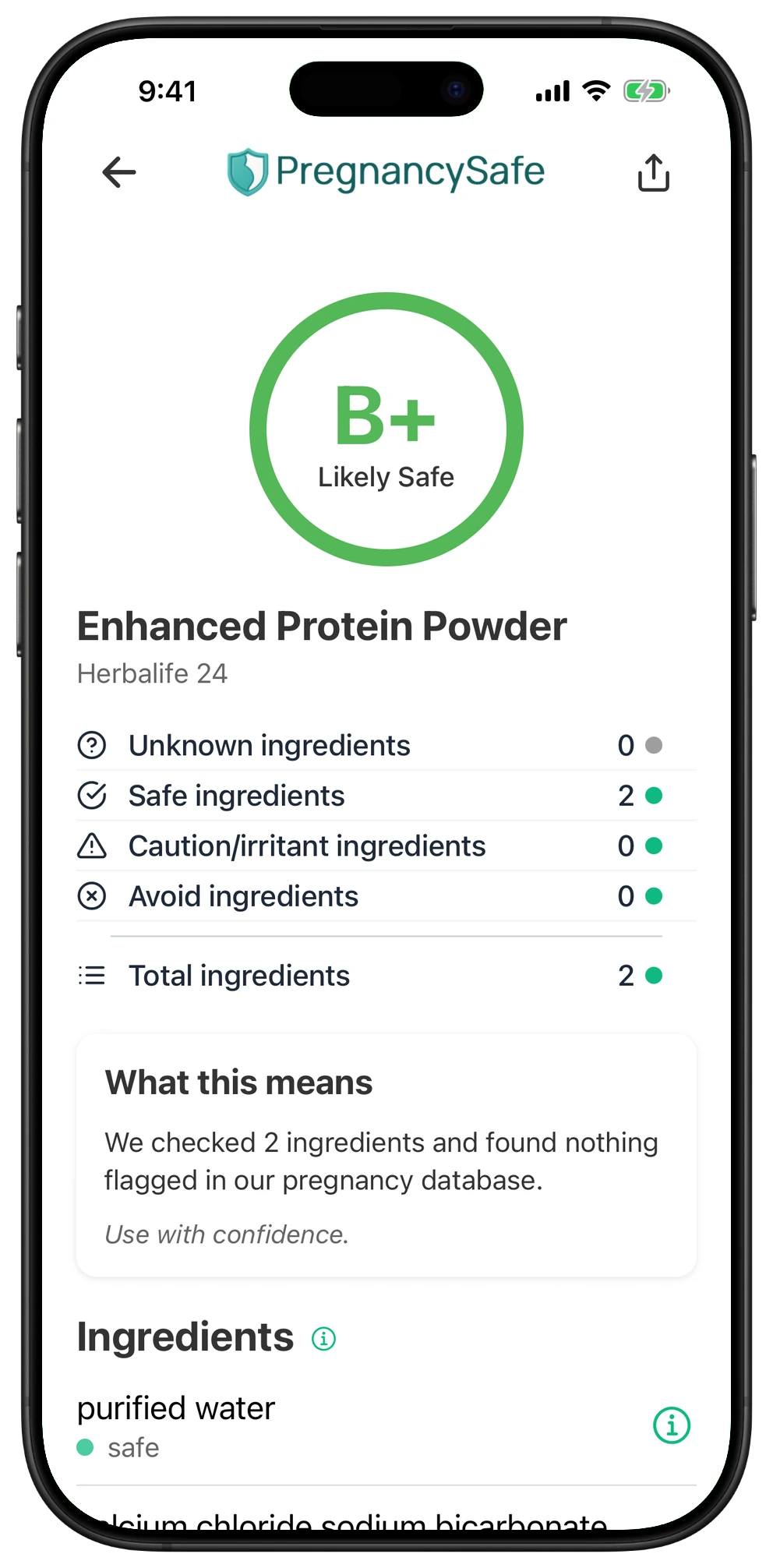
Check your exact protein powder in the app

✓ What's Safe
- • Choose a clearly identified protein source and check the allergen statement against your dietary needs.
- • Read the complete label for your exact flavor and version, including serving size, protein amount and added supplement doses.
- • Prefer a straightforward protein formula without added workout, sleep or botanical blends that you do not need.
- • Compare added vitamins and minerals with your prenatal and other supplements before combining them.
- • Look for credible quality testing information that explains what was tested; do not treat a testing seal as pregnancy certification.
- • Ask your clinician or dietitian whether supplementation fills a dietary gap, especially with poor intake, kidney disease or dietary restrictions.
✗ What to Avoid
- • Avoid starting powders with added creatine or creatine monohydrate without clinician guidance; supplemental doses have limited pregnancy safety evidence.
- • Avoid choosing concentrated added branched chain amino acids, l tryptophan or tryptophan without review; their natural presence within dietary protein is not the same concern.
- • Avoid assuming spirulina or organic spirulina makes a powder pregnancy ready; review its need and contaminant testing with your clinician.
- • Minimize industrial trans fat from partially hydrogenated oils. Check the amount and ingredient list rather than treating a trans fat nutrition panel entry as proof of meaningful exposure.
- • Limit frequent use of heavily colored powders containing fd c red 40 or fd c blue 1 if an otherwise suitable dye free option meets your needs; ordinary regulated exposure is not established fetal harm.
- • Avoid using an A grade, an organic claim or an incomplete ingredient record as a substitute for checking the exact label and serving amount.
Most Common Ingredients in Protein Powder Products
We analyzed 4,976 protein powder products. Here are the most common ingredients, ranked by how often they appear:
Ingredients to Watch Out For in Protein Powder
These are the most common flagged ingredients across 4,976 protein powder products we analyzed.
trans fat
Caution
Trans fat is a type of unsaturated fat artificially created through hydrogenation, known to increase bad cholesterol levels and raise the risk of heart disease.
Mainly raise concern when partially hydrogenated and high in artificial trans fat; fully hydrogenated oils are mostly a saturated fat limit rather than the same trans fat issue.
For protein powder, check the stated amount and whether partially hydrogenated oils are ingredients; a nutrition panel mention alone does not establish meaningful intake. Minimize industrial trans fat. Fully hydrogenated oils are different and mainly raise saturated fat considerations.
Flagged in 1367 of 4,976 products (27%)
creatine monohydrate
Caution
Creatine monohydrate is a popular supplement that helps increase muscle strength, power, and performance during high intensity exercise.
Has limited human pregnancy safety data at supplemental doses despite reassuring early findings.
Creatine monohydrate is a supplemental form of creatine sometimes added to workout protein blends. Human pregnancy evidence at supplemental doses remains limited despite reassuring early findings. Review its dose and need with your clinician rather than treating it like creatine naturally present in food.
Flagged in 107 of 4,976 products (2%)
fd c red 40
Caution
FD&C Red 40 is a synthetic red dye commonly used to add vibrant color to foods, beverages, and cosmetics.
Has limited human pregnancy data and is allowed at regulated food additive levels, but child neurobehavior concerns and high dose animal findings make frequent high dye intake worth limiting.
This name refers to FD&C Red 40, also called Allura Red AC, a red color additive. Pregnancy specific evidence is limited; child behavior concerns and high dose animal findings do not establish fetal harm from ordinary regulated intake. Choosing an otherwise suitable dye free powder can reduce frequent exposure.
Flagged in 97 of 4,976 products (2%)
branched chain amino acids
Caution
Branched chain amino acids are essential amino acids leucine, isoleucine, and valine that play a key role in muscle growth, recovery, and energy production.
Is necessary within normal dietary protein but lacks direct pregnancy safety evidence as a concentrated supplement and carries pregnancy cautions for added free form amounts.
Leucine, isoleucine and valine naturally present in protein are necessary dietary amino acids. Check whether the powder lists its natural amino acid profile or adds concentrated free form BCAAs. The latter have insufficient direct pregnancy safety evidence and warrant clinician review.
Flagged in 93 of 4,976 products (2%)
spirulina
Caution
Spirulina is a nutrient rich blue green algae known for its high protein, vitamin, and antioxidant content, often used as a dietary supplement.
Has limited pregnancy safety data and product quality concerns because contaminated blue green algae supplements can contain microcystins, heavy metals, or pathogenic bacteria.
Spirulina is blue green algae added to some protein and greens blends. Pregnancy studies are limited, and contaminated algae products can contain microcystins, heavy metals or pathogenic bacteria. Review supplement use and quality testing with your clinician; spirulina does not replace prescribed prenatal iron or folate.
Flagged in 60 of 4,976 products (1%)
organic spirulina
Caution
Organic spirulina is a nutrient dense blue green algae supplement rich in protein, vitamins, and antioxidants, supporting overall health and energy.
Has limited pregnancy safety data and product quality concerns because contaminated blue green algae supplements can contain microcystins, heavy metals, or pathogenic bacteria.
Organic spirulina is spirulina with an organic designation, not a different ingredient with established pregnancy safety. In protein blends, the same limited pregnancy evidence and algae contamination concerns apply. The organic claim does not replace credible contaminant testing or clinician review.
Flagged in 51 of 4,976 products (1%)
l tryptophan
Caution
Is necessary in normal foods but isolated L tryptophan or 5-HTP supplements have limited pregnancy safety data and serotonergic interaction and quality concerns.
L tryptophan naturally present within the powder's protein is different from separately added supplemental L tryptophan. Isolated supplementation has limited pregnancy evidence and can interact with serotonin raising medicines. Check its form and dose with your clinician, particularly in sleep or mood blends.
Flagged in 48 of 4,976 products (1%)
creatine
Caution
Creatine is a naturally occurring compound that helps supply energy to muscles during high intensity exercise.
Has limited human pregnancy safety data at supplemental doses despite reassuring early findings.
Creatine is an energy related compound found in meat and fish and added to some sports protein powders. Ordinary dietary exposure is not equivalent to concentrated supplemental intake. Pregnancy safety evidence for added supplement doses remains limited, so review the amount and purpose with your clinician.
Flagged in 47 of 4,976 products (1%)
How Do Protein Powder Products Stack Up?
Our catalog contains ratings for 4,976 protein powder products. These are database grades, not independent safety certifications.
Ingredient grades cannot establish dose, preparation, label completeness, efficacy or pregnancy suitability. An A score is not an endorsement, and counts include unreviewed catalog records.
Your Questions Answered
Are any protein powders safe for pregnancy?
A protein powder may be suitable when it addresses a dietary need, but the category cannot receive a blanket safety guarantee. Review the exact ingredients, serving amount, allergens and quality testing with your clinician or dietitian. An A grade alone does not establish suitability, so no individual powder is endorsed here.
Can I drink a protein shake if I am pregnant?
A shake may fit your diet after you check its formula and whether you need the extra protein. A basic protein drink is different from a blend containing added creatine, stimulants or botanicals. Include its added vitamins and minerals when reviewing your prenatal and other supplements. Do not use an unassessed shake to replace meals or prescribed prenatal nutrients.
How much protein powder should I take during pregnancy?
There is no single powder serving appropriate for everyone. The amount depends on your food intake, the protein per serving and your medical or dietary needs. Ask your clinician or dietitian whether you need supplemental protein and what amount fits your diet, especially if you have kidney disease or difficulty eating.
Should I avoid protein powder that lists amino acids?
Not automatically: amino acids naturally present in protein are different from concentrated, separately added supplements. Branched chain amino acids and tryptophan are normal components of dietary protein. The concern is limited pregnancy evidence for isolated supplemental doses, with additional medication interaction concerns for supplemental L tryptophan. Check whether the label describes the protein's amino acid profile or lists added free form ingredients.
Does third party testing mean a protein powder is pregnancy safe?
No. Credible testing can provide useful quality information, but it is not pregnancy certification. Check what the testing covers rather than assuming it answers every contamination or ingredient question. Your need for the powder, its serving amount and its added ingredients still require consideration.
Are organic protein powders or powders with spirulina better choices?
An organic label alone does not establish pregnancy suitability. Organic spirulina is still spirulina, with limited pregnancy safety evidence and quality concerns involving possible microcystins, heavy metals or bacteria in contaminated products. That does not mean every spirulina containing powder is contaminated. Review algae supplements with your clinician rather than choosing them for a presumed prenatal benefit.
What do the protein powder grades tell me?
Our catalog contains 4,976 products, including 1,629 with an A grade, but these are not counts of independently verified pregnancy safe powders. Ingredient grades cannot establish serving dose, label completeness, preparation, effectiveness or suitability for you. A low grade is not proof that every use is harmful, and an incomplete record is not proof of danger. Use the grade as a starting point for checking the exact label, not as a clinical verdict.
How Do We Score Products for Pregnancy Safety?
We analyze each product's ingredients and category to flag known risks and provide cautionary notices for general category safety concerns.
Grades reflect the ingredient and category information available to us. They don’t verify a complete, current label or account for dose, preparation, or contamination. Read them alongside the guidance above, not as a guarantee of pregnancy safety or proof that every use is harmful.
A - Safe
Excellent choice! All ingredients are considered safe during pregnancy.
What to do: Use with confidence.
B - Likely Safe
Pretty much safe with very minimal risk. Some ingredients may have limited pregnancy studies, but no significant safety concerns have been identified.
What to do: Use with confidence.
C - Limit
Contains ingredients with some pregnancy considerations. Research shows these ingredients may have limited safety data, potential for minor hormonal effects, or require caution based on animal studies.
What to do: Use sparingly and consider safer alternatives when available.
D - Caution
Similar to C grade but contains multiple cautionary ingredients. The combination increases overall concern.
What to do: Try to avoid if that makes you feel better. If you've already used it, no need to panic.
F - Avoid
Contains an ingredient Pregnancy Safe recommends avoiding during pregnancy. This may reflect an established risk or a precaution based on limited evidence; check the ingredient guidance and exposure context.
What to do: Do not use during pregnancy. If you've already used it, don't worry - contact your OBGYN if concerned.
People Also Checked
References
- https://ods.od.nih.gov/factsheets/Pregnancy-HealthProfessional/
- https://www.fda.gov/food/food-additives-petitions/trans-fat
- https://www.fda.gov/food/hfp-constituent-updates/fda-completes-final-administrative-actions-partially-hydrogenated-oils-foods
- https://www.federalregister.gov/documents/2013/11/08/2013-26854/tentative-determination-regarding-partially-hydrogenated-oils-request-for-comments-and-for
- https://www.who.int/news-room/fact-sheets/detail/trans-fat
- https://cdn.realfood.gov/DGA.pdf
- https://www.fda.gov/food/people-risk-foodborne-illness/dietary-advice-and-during-pregnancy
- https://www.rcpi.ie/Portals/0/Document%20Repository/Institute%20of%20Obstetricians%20and%20Gynaecologists/National%20Clinical%20Guidelines/IOG_National%20Clinical%20Guidelines_Nutrition%20in%20pregnancy%20Guideline_2019.pdf
- https://pmc.ncbi.nlm.nih.gov/articles/PMC8027310/
- https://pmc.ncbi.nlm.nih.gov/articles/PMC3192475/
- https://pubmed.ncbi.nlm.nih.gov/38432717/
- https://pmc.ncbi.nlm.nih.gov/articles/PMC12291183/
- https://pubmed.ncbi.nlm.nih.gov/25523279/
- https://pmc.ncbi.nlm.nih.gov/articles/PMC12086928/
- https://pmc.ncbi.nlm.nih.gov/articles/PMC7912953/
- https://pubmed.ncbi.nlm.nih.gov/32549301/
- https://pmc.ncbi.nlm.nih.gov/articles/PMC12702719/
- https://www.hfpappexternal.fda.gov/scripts/fdcc/index.cfm?id=931&set=GRASNotices
- https://webprod.hc-sc.gc.ca/nhpid-bdipsn/atReq?atid=creatine.mono&lang=eng
- https://www.hfpappexternal.fda.gov/scripts/fdcc/index.cfm?id=FDCRed40&set=ColorAdditives
- https://www.ecfr.gov/current/title-21/chapter-I/subchapter-A/part-74/subpart-A/section-74.340
- https://www.fda.gov/food/color-additives-information-consumers/tracking-food-industry-pledges-remove-petroleum-based-food-dyes
- https://www.efsa.europa.eu/en/efsajournal/pub/1327
- https://www.efsa.europa.eu/en/efsajournal/pub/4007
- https://apps.who.int/food-additives-contaminants-jecfa-database/Home/Chemical/2361
- https://oehha.ca.gov/risk-assessment/report/health-effects-assessment-potential-neurobehavioral-effects-synthetic-food-dyes-children
- https://pubmed.ncbi.nlm.nih.gov/6636206/
- https://pubmed.ncbi.nlm.nih.gov/2613118/
- https://pubmed.ncbi.nlm.nih.gov/7940558/
- https://www.canada.ca/en/health-canada/services/food-nutrition/supplemented-foods/list-permitted-food-ingredients.html
- https://www.canada.ca/en/health-canada/services/food-nutrition/legislation-guidelines/guidance-documents/supplemented-foods-regulations.html
- https://ods.od.nih.gov/factsheets/ExerciseAndAthleticPerformance-HealthProfessional/
- https://pmc.ncbi.nlm.nih.gov/articles/PMC4942872/
- https://pubmed.ncbi.nlm.nih.gov/39796608/
- https://pubmed.ncbi.nlm.nih.gov/35043647/
- https://www.fda.gov/food/natural-toxins-food/blue-green-algae-products-and-microcystins
- https://www.ncbi.nlm.nih.gov/books/NBK548312/
- https://www.ncbi.nlm.nih.gov/books/NBK501849/
- https://pubmed.ncbi.nlm.nih.gov/21793723/
- https://journal.ugm.ac.id/v3/InaJBCS/article/view/23573
- https://doi.org/10.4236/ojog.2017.71016
- https://pubmed.ncbi.nlm.nih.gov/37317149/
- https://pubmed.ncbi.nlm.nih.gov/37368655/
- https://pubmed.ncbi.nlm.nih.gov/23036452/
- https://pubmed.ncbi.nlm.nih.gov/21842336/
- https://medlineplus.gov/ency/article/002332.htm
- https://www.ncbi.nlm.nih.gov/books/NBK235221/
- https://pubmed.ncbi.nlm.nih.gov/42137190/
- https://pubmed.ncbi.nlm.nih.gov/23077193/
- https://www.mskcc.org/cancer-care/integrative-medicine/herbs/5-htp-01
- https://medlineplus.gov/ency/article/007272.htm
- https://www.cdc.gov/mmwr/preview/mmwrhtml/00001739.htm
- https://www.fda.gov/food/information-consumers-using-dietary-supplements/questions-and-answers-dietary-supplements
- https://www.drugs.com/mtm/l-tryptophan.html
- https://www.hfpappexternal.fda.gov/scripts/fdcc/index.cfm?id=FDCBlue1&set=ColorAdditives
- https://www.ecfr.gov/current/title-21/chapter-I/subchapter-A/part-74
- https://efsa.onlinelibrary.wiley.com/doi/10.2903/j.efsa.2010.1853
- https://apps.who.int/food-additives-contaminants-jecfa-database/Home/Chemical/3309
- https://pubmed.ncbi.nlm.nih.gov/23208798/
- https://pubmed.ncbi.nlm.nih.gov/24257113/