Best Pregnancy Safe Lipstick (Updated 2026 Guide)
Updated September 9, 2026
The Answer
Choose lipstick by its exact shade’s current label and intended lip use, not a pregnancy safe marketing claim or ingredient score alone. Our catalog contains 328 products, including 97 graded A, but those grades do not establish clinical pregnancy safety or verify contaminant levels.
Ordinary lipstick use involves application to the lips and small incidental ingestion, not intentional consumption or high dose oral exposure. Concerns about phenoxyethanol, bht, aluminum containing ingredients and UV filters often involve limited pregnancy data or evidence from different doses and routes, rather than established harm from lipstick use. Fragrance can cause irritation or allergy; choosing fragrance free lipstick is an optional way to reduce exposure to undisclosed scent mixtures.
Pregnancy Safe is 100% independent and research driven. No companies pay to promote or sponsor products.
Stress Less This Pregnancy
Check your exact lipstick in the app

✓ What's Safe
- • Check the complete current ingredient list for your exact shade, size and formula rather than relying on a product family listing.
- • Choose a product explicitly intended for lips; check multi use sticks for lip use directions.
- • Consider fragrance free formulations, especially if scented lip products irritate your lips.
- • For SPF lip products, check the active filters and directions; consider mineral filter options if you prefer a cautious approach without giving up sun protection.
- • Treat grades as ingredient screening information and seek separate testing information for any contaminant claims.
✗ What to Avoid
- • Avoid fragrance, parfum or fragrance parfum if scented lipstick triggers irritation; these are related scent label terms, not proof of fetal harm.
- • Avoid rejecting lipstick solely because it contains phenoxyethanol or bht: reviewed cosmetic concentrations are different from high dose oral exposures.
- • Avoid treating calcium aluminum borosilicate, aluminum starch octenylsuccinate or aluminum hydroxide as equivalent to high dose aluminum ingestion.
- • Avoid abandoning lip sun protection solely because octinoxate or octisalate appears on a label; compare alternative filters if you prefer.
- • Avoid using lipstick on damaged or irritated lips, and do not share contaminated lip products.
- • Avoid relying on clean, natural or lead free claims without supporting information, or assuming a broad may contain pigment list describes every shade.
Most Common Ingredients in Lipstick Products
We analyzed 328 lipstick products. Here are the most common ingredients, ranked by how often they appear:
Ingredients to Watch Out For in Lipstick
These are the most common flagged ingredients across 328 lipstick products we analyzed.
Caution
Phenoxyethanol is a preservative commonly used in cosmetics and skincare products to prevent microbial growth and extend shelf life.
Has limited direct pregnancy data and possible infant oral exposure concerns from nipple area products, while regulated cosmetic concentrations are generally considered low systemic risk.
This preservative helps protect lipstick against microbial growth. Cosmetic safety reviews support specified concentrations, but direct pregnancy data are limited; nursing infant warnings involving nipple products do not establish harm from ordinary lipstick use.
Flagged in 136 of 328 products (41%)
calcium aluminum borosilicate
Caution
Calcium aluminum borosilicate is a durable, heat resistant glass ceramic material commonly used in cookware and laboratory applications.
Has developmental concern at higher chronic exposures, but regulated vaccine adjuvants and occasional clinician directed antacid use should be considered separately.
Calcium aluminum borosilicate is an aluminum containing compound, not interchangeable with aluminum metal or every aluminum salt. Its caution draws on broader aluminum exposure evidence, which does not establish developmental harm from this ingredient in lipstick at ordinary use levels.
Flagged in 44 of 328 products (13%)
aluminum starch octenylsuccinate
Caution
Aluminum starch octenylsuccinate is a modified starch derivative used as an anti caking and stabilizing agent in food products.
Has developmental concern at higher chronic exposures, but regulated vaccine adjuvants and occasional clinician directed antacid use should be considered separately.
This modified starch ingredient is chemically distinct from other aluminum containing compounds. Broader concerns about high chronic aluminum exposure do not establish risk from its presence in lipstick; direct pregnancy evidence for this exact lip use exposure is uncertain.
Flagged in 27 of 328 products (8%)
fragrance parfum
Caution
A fragrant, concentrated scent used to enhance personal aroma and add a touch of elegance.
Can hide product specific mixtures and has been associated with higher DEP metabolite exposure in some pregnancy studies; fragrance allergens and VOCs may also irritate sensitive skin or airways.
This label wording describes a scent mixture, not a separate hazard from fragrance or parfum. Choosing lipstick without added scent may reduce irritation and undisclosed mixture exposure, but the term does not prove phthalate content or pregnancy harm.
Flagged in 27 of 328 products (8%)
aluminum hydroxide
Caution
Aluminum hydroxide is a compound commonly used as an antacid to neutralize stomach acid and as an adjuvant in vaccines.
Is generally low concern for short term labeled antacid use but needs caution with chronic high dose use, kidney disease, constipation, or medication and iron interactions.
Aluminum hydroxide on a lipstick label should not be assessed as though you were taking an aluminum hydroxide antacid. Concerns involving chronic medicinal doses, kidney disease or oral drug interactions do not establish the same concerns from ordinary lip color use.
Flagged in 19 of 328 products (6%)
bht
Caution
BHT (butylated hydroxytoluene) is a synthetic antioxidant commonly used as a preservative to prevent the oxidation of fats and oils in food products.
Has limited human pregnancy data, with low concern at reviewed cosmetic levels but reproductive and thyroid related findings in high dose oral animal studies.
BHT, or butylated hydroxytoluene, helps prevent oxidation in lipstick. High dose oral animal findings are not equivalent to ordinary lip application with small incidental ingestion; cosmetic reviews support specified concentrations, while direct human pregnancy data remain limited.
Flagged in 17 of 328 products (5%)
fragrance
Caution
A fragrant substance used to add a pleasant aroma to products or environments.
Can hide product specific mixtures and has been associated with higher DEP metabolite exposure in some pregnancy studies; fragrance allergens and VOCs may also irritate sensitive skin or airways.
Fragrance denotes a scent mixture whose individual components may not be disclosed. In lipstick, irritation or allergy is a practical concern; broader fragranced product exposure associations do not prove this formula contains phthalates or harms pregnancy.
Flagged in 16 of 328 products (5%)
octinoxate
Caution
Has measurable dermal absorption and endocrine active signals, with limited direct pregnancy outcome data, so mineral or lower absorption sunscreen filters are preferred when practical.
Octinoxate is a UVB filter also called ethylhexyl methoxycinnamate. Absorption studies and high dose animal findings leave pregnancy specific uncertainty but do not demonstrate harm from ordinary lipstick use; consider a mineral filter SPF lip option if preferred.
Flagged in 16 of 328 products (5%)
How Do Lipstick Products Stack Up?
Our catalog contains ratings for 328 lipstick products. These are database grades, not independent safety certifications.
Catalog ingredient scores are not clinical pregnancy verdicts or independent current-label/contaminant checks. Unreviewed, mixed-route or incompletely sourced records can affect counts. Follow exact product form, active ingredients, exposure and directions rather than choosing solely by grade.
Best Pregnancy Safe Lipstick
Popular options from our catalog, prioritizing A and B ingredient grades, with C grade options used to fill remaining places. Within each group, products are ordered by searches in Pregnancy Safe, not retail sales. Read the cautions and guidance above; grades do not verify a complete current label or guarantee pregnancy safety.
| Grade | Product | Brand |
|---|---|---|
| B+ | Gen Nude Dew In One Cheek & Lip Stick | Bareminerals |
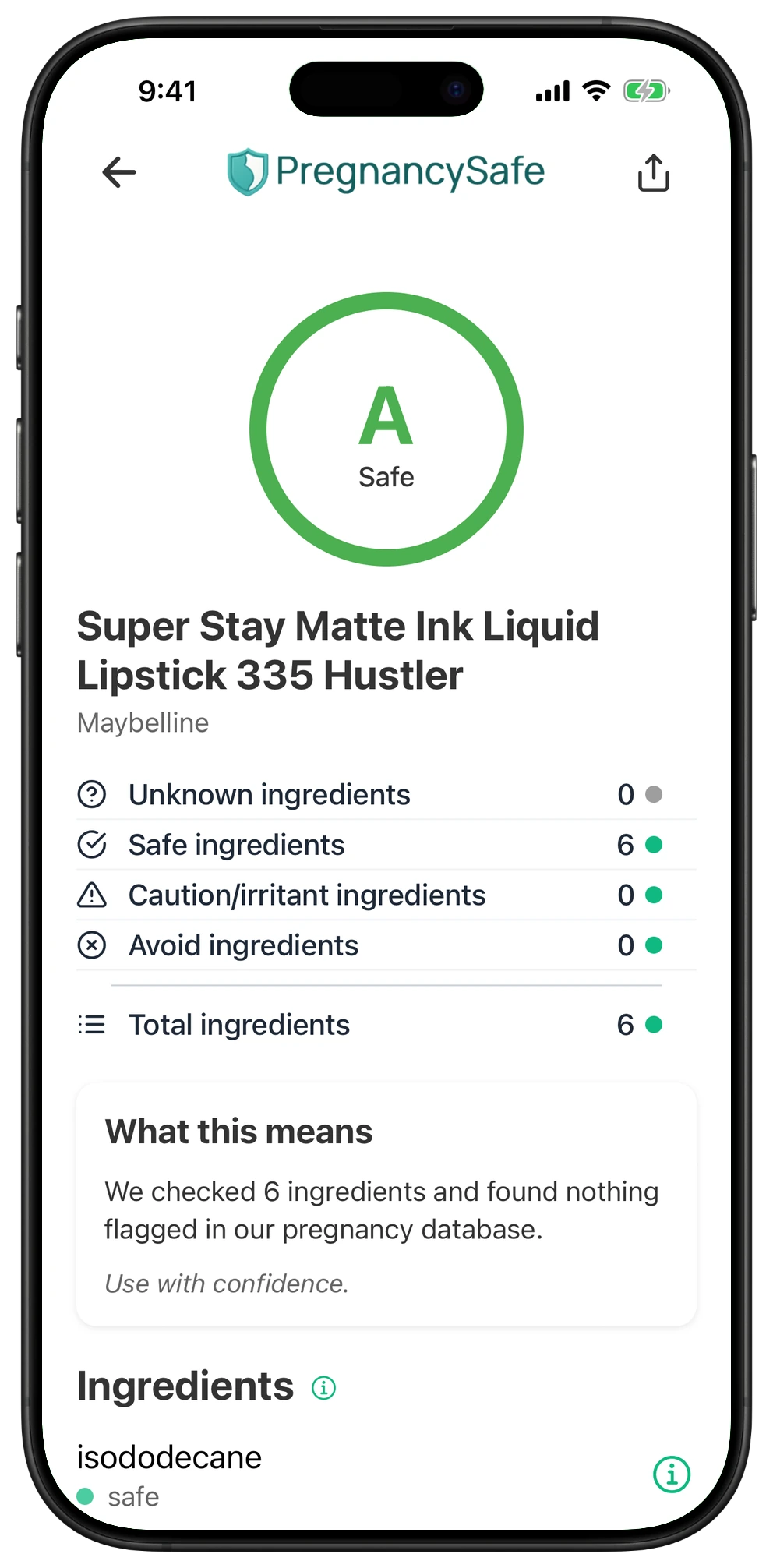
| A | Super Stay Matte Ink Liquid Lipstick 335 Hustler | Maybelline |
| B+ | Mac Macximal Matte Mini Lipstick – Velvet Teddy | Mac |
| B+ | Almost Lipstick Black Honey | Clinique |
| B+ | Almay Color & Care Tint Stick - Cheek & Lip Color - 200 Coral Flush | Almay |
Your Questions Answered
Which lipsticks are safe during pregnancy?
Start with a lipstick intended for lip use and check the full current label for your exact shade. Consider a fragrance free option if your lips are sensitive, and assess any SPF or medicated ingredients separately. No specific shade is recommended here because an exact current formula has not been sufficiently confirmed. That limitation does not mean the products are harmful.
What makeup is safe during pregnancy?
Evaluate the actual formula, where you apply it and how you use it rather than treating an entire brand as pregnancy certified. Ordinary color cosmetics differ from medicated treatments, and topical use differs from intentional ingestion. For lipstick, check shade specific ingredients and stop using a formula that irritates your lips. A clean claim or an A grade cannot establish pregnancy safety.
Does an A grade mean a lipstick is verified safe?
No. Our catalog contains 97 A graded lipstick records, but ingredient scores are not clinical pregnancy verdicts or independent current label checks. Some records have incomplete formula information, and grades do not measure contaminants. A lower grade also does not, by itself, establish that a lipstick is unsafe.
Should I avoid lipstick with phenoxyethanol or BHT?
Neither ingredient is an automatic reason to avoid ordinary lipstick use. Phenoxyethanol preserves formulas, while BHT helps prevent oxidation; safety reviews support their use at specified cosmetic concentrations, although direct pregnancy data are limited. High dose oral animal findings for BHT and nursing infant exposure concerns involving phenoxyethanol are not evidence of the same risk from lipstick. Small incidental ingestion from lip use should still be distinguished from skin only exposure and intentional consumption.
Does lipstick contain unsafe amounts of lead?
You cannot determine lead levels from an ingredient list or a catalog grade. Contaminants require testing, and there is no basis here to say all lipstick contains unsafe lead levels. Natural or clean branding does not establish that a product is free of contaminants. Look for testing evidence behind specific claims rather than assuming a high grade answers this question.
Can I use lipstick with SPF during pregnancy?
Keep lip sun protection in your routine and check the product’s active filters and directions. Octinoxate and octisalate have limited pregnancy specific outcome data, but absorption findings from extensive skin application do not establish harm from lipstick use. A mineral filter lip product is a cautious alternative if you prefer. Pigments such as titanium dioxide on a cosmetic ingredient list do not by themselves establish that the lipstick provides labeled SPF protection.
How Do We Score Products for Pregnancy Safety?
We analyze each product's ingredients and category to flag known risks and provide cautionary notices for general category safety concerns.
Grades reflect the ingredient and category information available to us. They don’t verify a complete, current label or account for dose, preparation, or contamination. Read them alongside the guidance above, not as a guarantee of pregnancy safety or proof that every use is harmful.
A - Safe
Excellent choice! All ingredients are considered safe during pregnancy.
What to do: Use with confidence.
B - Likely Safe
Pretty much safe with very minimal risk. Some ingredients may have limited pregnancy studies, but no significant safety concerns have been identified.
What to do: Use with confidence.
C - Limit
Contains ingredients with some pregnancy considerations. Research shows these ingredients may have limited safety data, potential for minor hormonal effects, or require caution based on animal studies.
What to do: Use sparingly and consider safer alternatives when available.
D - Caution
Similar to C grade but contains multiple cautionary ingredients. The combination increases overall concern.
What to do: Try to avoid if that makes you feel better. If you've already used it, no need to panic.
F - Avoid
Contains an ingredient Pregnancy Safe recommends avoiding during pregnancy. This may reflect an established risk or a precaution based on limited evidence; check the ingredient guidance and exposure context.
What to do: Do not use during pregnancy. If you've already used it, don't worry - contact your OBGYN if concerned.
People Also Checked
References
- https://www.fda.gov/cosmetics/resources-consumers-cosmetics/cosmetics-pregnancy
- https://health.ec.europa.eu/system/files/2021-08/sccs_o_195_0.pdf
- https://ec.europa.eu/growth/tools-databases/cosing/details/28157
- https://journals.sagepub.com/doi/10.3109/10915819009078737
- https://link.springer.com/article/10.1007/s00204-024-03938-5
- https://www.sfda.gov.sa/en/warnings/1156
- https://www.industrialchemicals.gov.au/sites/default/files/Ethanol%2C%202-phenoxy-_Human%20health%20tier%20II%20assessment.pdf
- https://hero.epa.gov/reference/2857875
- https://books.publisso.de/sites/default/files/documents/series/mak/dam/Vol2019/Iss1/Alt006/mb12299kske6319_w.pdf
- https://wwwn.cdc.gov/TSP/ToxProfiles/ToxProfiles.aspx?id=191&tid=34
- https://pmc.ncbi.nlm.nih.gov/articles/PMC9681673/
- https://pmc.ncbi.nlm.nih.gov/articles/PMC10809980/
- https://www.cdc.gov/vaccine-safety/about/adjuvants.html
- https://www.fda.gov/vaccines-blood-biologics/safety-availability-biologics/common-ingredients-fda-approved-vaccines
- https://www.acog.org/womens-health/infographics/vaccines-during-pregnancy
- https://www.fda.gov/cosmetics/cosmetic-ingredients/fragrances-cosmetics
- https://www.fda.gov/cosmetics/cosmetic-ingredients/phthalates-cosmetics
- https://www.fda.gov/cosmetics/cosmetic-ingredients/allergens-cosmetics
- https://pmc.ncbi.nlm.nih.gov/articles/PMC3110684/
- https://pmc.ncbi.nlm.nih.gov/articles/PMC4016195/
- https://pmc.ncbi.nlm.nih.gov/articles/PMC4097177/
- https://pmc.ncbi.nlm.nih.gov/articles/PMC8453372/
- https://pmc.ncbi.nlm.nih.gov/articles/PMC10999525/
- https://www.epa.gov/indoor-air-quality-iaq/volatile-organic-compounds-impact-indoor-air-quality
- https://www.ncbi.nlm.nih.gov/books/NBK573943/
- https://pmc.ncbi.nlm.nih.gov/articles/PMC9439837/
- https://pmc.ncbi.nlm.nih.gov/articles/PMC2821234/
- https://dailymed.nlm.nih.gov/dailymed/drugInfo.cfm?setid=27848ae0-3b2f-4bfe-8856-4b8de419091e
- https://pubmed.ncbi.nlm.nih.gov/39249590/
- https://pubmed.ncbi.nlm.nih.gov/7565498/
- https://www.ncbi.nlm.nih.gov/books/NBK526049/
- https://health.ec.europa.eu/system/files/2022-08/sccs_o_257.pdf
- https://pubmed.ncbi.nlm.nih.gov/37751543/
- https://pubmed.ncbi.nlm.nih.gov/12396675/
- https://pmc.ncbi.nlm.nih.gov/articles/PMC13151845/
- https://www.ecfr.gov/current/title-21/chapter-I/subchapter-B/part-172/subpart-B/section-172.115
- https://www.ecfr.gov/current/title-21/chapter-I/subchapter-B/part-182/subpart-D/section-182.3173
- https://www.fda.gov/news-events/press-announcements/fda-finalizes-food-chemical-safety-post-market-assessment-program-launches-reassessment-bht-ada
- https://health.ec.europa.eu/document/download/3166a978-06de-4526-b25e-8d5a66943a2e_en?filename=sccs_o_294.pdf
- https://www.tga.gov.au/sites/default/files/2025-04/safety-review-seven-active-sunscreen-ingredients.pdf
- https://www.fda.gov/drugs/understanding-over-counter-medicines/questions-and-answers-fda-posts-deemed-final-order-and-proposed-order-over-counter-sunscreen
- https://pubmed.ncbi.nlm.nih.gov/31961417/
- https://pubmed.ncbi.nlm.nih.gov/15191542/
- https://www.ncbi.nlm.nih.gov/books/NBK581587/
- https://pubmed.ncbi.nlm.nih.gov/32108942/
- https://pubmed.ncbi.nlm.nih.gov/40212279/
- https://health.ec.europa.eu/publications/sccs-opinion-ethylhexyl-methoxycinnamate-ehmc-cas-no-5466-77-383834-59-7-ec-no-226-775-7629-661-9_en
- https://www.federalregister.gov/documents/2019/02/26/2019-03019/sunscreen-drug-products-for-over-the-counter-human-use
- https://pubmed.ncbi.nlm.nih.gov/26151237/
- https://pubmed.ncbi.nlm.nih.gov/31195281/
- https://pubmed.ncbi.nlm.nih.gov/35767664/
- https://pubmed.ncbi.nlm.nih.gov/15833384/
- https://pubmed.ncbi.nlm.nih.gov/21059369/
- https://www.fda.gov/drugs/understanding-over-counter-medicines/sunscreen-how-help-protect-your-skin-sun
- https://ec.europa.eu/health/scientific_committees/consumer_safety/opinions/sccnfp_opinions_97_04/sccp_out26_en.htm
- https://www.cir-safety.org/sites/default/files/salicy042019FAR.pdf
- https://pmc.ncbi.nlm.nih.gov/articles/PMC6990686/
- https://pmc.ncbi.nlm.nih.gov/articles/PMC11402844/
- https://pmc.ncbi.nlm.nih.gov/articles/PMC5744631/
- https://mothertobaby.org/baby-blog/screening-your-sunscreen-during-pregnancy/
- https://mothertobaby.org/baby-blog/national-safety-month-can-beauty-products-in-my-bathroom-be-bad-for-baby/