Is Bath Salts Safe During Pregnancy? (Updated 2026 Guide)
Updated September 9, 2026
The Answer
Plain, fragrance free Epsom salts can be a reasonable external use comfort option during pregnancy when used as directed in comfortably warm water, subject to your clinician’s restrictions. Our catalog contains 115 products with varied ingredient grades, but those scores do not establish pregnancy safety or replace checking the exact formulation.
Avoiding overheating is a key consideration: keep the bath comfortably warm and get out if you feel dizzy or unwell. Fragrance and essential oils can cause irritation or allergy, while pregnancy evidence for additives such as melatonin is limited and depends on concentration and exposure. Epsom salt baths are not prenatal magnesium supplementation or treatment for preeclampsia; meaningful magnesium absorption through intact skin has not been established.
Pregnancy Safe is 100% independent and research driven. No companies pay to promote or sponsor products.
Stress Less This Pregnancy
Check your exact bath salts in the app
✓ What's Safe
- • Choose a plain, fragrance free soak labeled for external bathing use; Epsom salt and magnesium sulfate refer to the same ingredient.
- • Read the exact package’s ingredients and directions, rather than relying on the brand, product name, or grade.
- • Follow the labeled amount and dilution instructions; there is no validated pregnancy specific cup dose.
- • Use comfortably warm water and end the bath if you feel overheated, dizzy, or unwell.
- • Check with your maternity clinician before soaking if you have broken skin, a high risk pregnancy, or specific bathing restrictions.
✗ What to Avoid
- • Avoid very hot baths or staying in the water when you feel overheated or unwell.
- • Do not drink bath salts or use Epsom salt as a laxative without clinician advice; oral capsules are not bath products.
- • Avoid adding concentrated essential oils yourself, particularly betula lenta bark oil, or applying them undiluted to your skin.
- • Skip fragrance or parfum if scented products irritate your skin or airways; fragrance free is a practical way to reduce unnecessary scent exposure.
- • Avoid choosing melatonin bath blends as a pregnancy sleep treatment; absorption from a bath and pregnancy outcomes are not established.
- • Do not use salvia sclarea oil blends to try to induce labor without your maternity team’s guidance; labor stimulation claims are not established.
Most Common Ingredients in Bath Salts Products
We analyzed 115 bath salts products. Here are the most common ingredients, ranked by how often they appear:
Ingredients to Watch Out For in Bath Salts
These are the most common flagged ingredients across 115 bath salts products we analyzed.
fragrance
Caution
A fragrant substance used to add a pleasant aroma to products or environments.
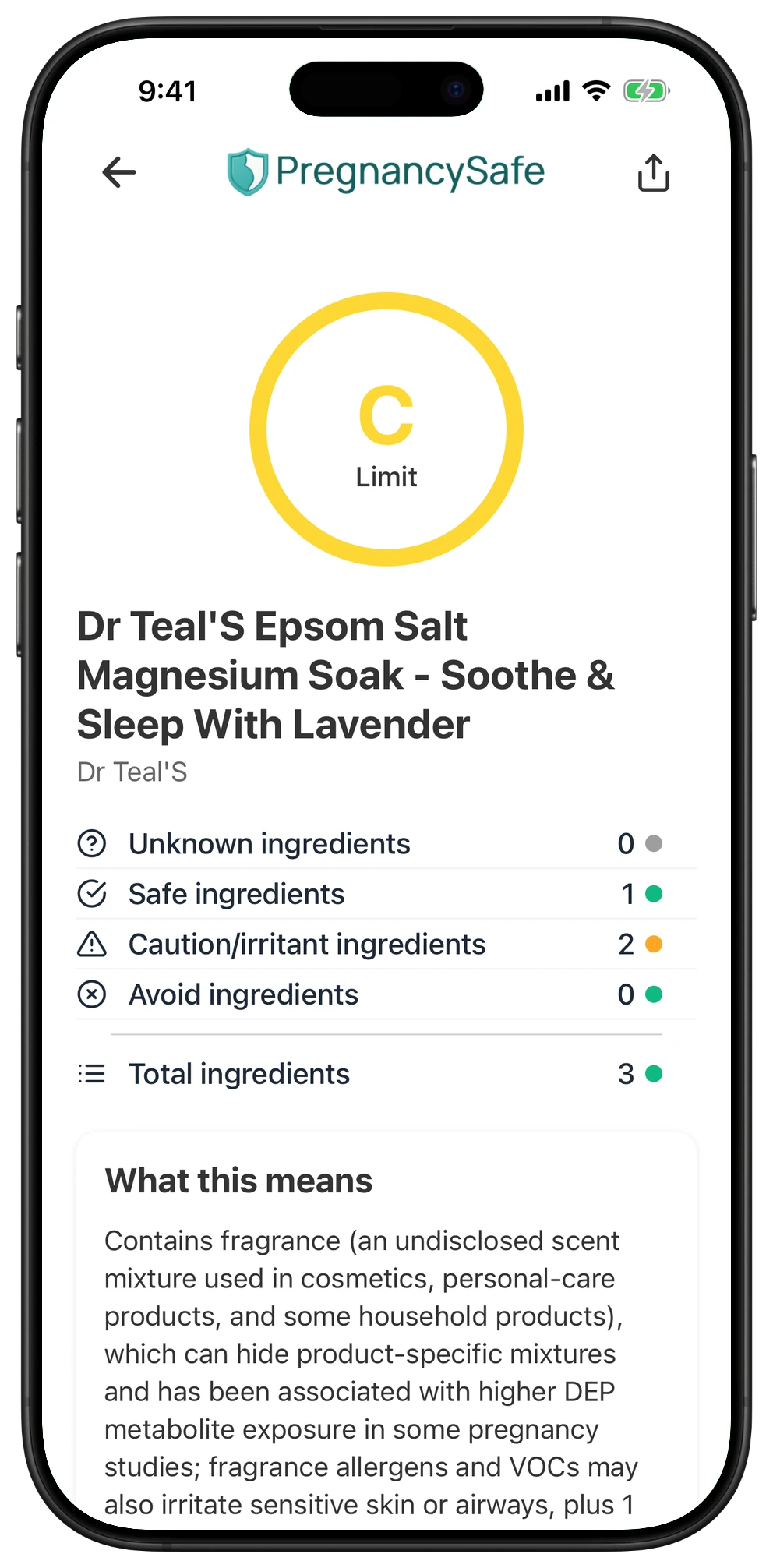
Can hide product specific mixtures and has been associated with higher DEP metabolite exposure in some pregnancy studies; fragrance allergens and VOCs may also irritate sensitive skin or airways.
Flagged in 53 of 115 products (46%)
lavandula angustifolia oil
Caution
Lavandula angustifolia oil is a soothing essential oil derived from lavender flowers, known for its calming, antiseptic, and aromatic properties.
Has limited pregnancy safety data for oral supplement use and should be separated from lower exposure aroma or diluted topical use because toxicity sedation allergy and uncertain endocrine concerns remain.
Flagged in 15 of 115 products (13%)
parfum
Caution
Parfum is a fragrant mixture of essential oils, aroma compounds, and solvents used to impart a pleasant scent.
Can hide product specific mixtures and has been associated with higher DEP metabolite exposure in some pregnancy studies; fragrance allergens and VOCs may also irritate sensitive skin or airways.
Flagged in 8 of 115 products (7%)
rosmarinus officinalis leaf oil
Caution
Rosmarinus officinalis leaf oil is a fragrant essential oil derived from rosemary leaves, commonly used for its aromatic, antioxidant, and invigorating properties.
Has limited pregnancy specific topical data and should be kept to normal dilute cosmetic exposure, while oral or high dose essential oil use is not recommended.
Flagged in 5 of 115 products (4%)
benzyl salicylate
Caution
Benzyl salicylate is a fragrant compound commonly used as a UV filter and scent ingredient in perfumes and cosmetics.
Has limited pregnancy specific human data and weak endocrine mode signals, but regulated low dose cosmetic use has wide safety margins compared with high dose oral salicylates.
Flagged in 4 of 115 products (3%)
melatonin
Caution
Melatonin is a naturally occurring hormone that regulates sleep wake cycles and is commonly used as a supplement to promote restful sleep.
Can be absorbed through skin in amounts that vary by dose and formulation, while pregnancy specific data for topical exposure are lacking.
Flagged in 3 of 115 products (3%)
salvia sclarea oil
Caution
Salvia sclarea oil, also known as clary sage oil, is a fragrant essential oil derived from the leaves and flowering tops of the clary sage plant, commonly used for its calming, balancing, and aromatic properties.
Has sparse pregnancy safety data and traditional labor stimulation claims, so timing, dilution, route, and ingestion matter.
Flagged in 3 of 115 products (3%)
anthemis nobilis flower oil
Caution
Anthemis nobilis flower oil is a soothing, aromatic essential oil derived from chamomile flowers, known for its calming and anti inflammatory properties.
Has limited and mixed pregnancy data with lower concern for occasional tea or food flavoring than for regular high dose oral supplements, tinctures, or essential oils.
Flagged in 2 of 115 products (2%)
Bath Salts Products We've Analyzed
Our catalog contains ratings for 115 bath salts products. These are database grades, not independent safety certifications.
Catalog ingredient scores are not clinical pregnancy verdicts or independent current-label/contaminant checks. Unreviewed, mixed-route or incompletely sourced records can affect counts. Follow exact product form, active ingredients, exposure and directions rather than choosing solely by grade.
Pregnancy Safe Bath Salts Products
Popular options from our catalog, prioritizing A and B ingredient grades, with C grade options used to fill remaining places. Within each group, products are ordered by searches in Pregnancy Safe, not retail sales. Read the cautions and guidance above; grades do not verify a complete current label or guarantee pregnancy safety.
| Grade | Product | Brand |
|---|---|---|
| A | Dr Teal'S Epsom Salt Magnesium Soak - Fragrance-Free | Dr Teal'S |
| A | White Egret Pharmaceutical Grade Bath Epsom Salt | White Egret |
| A | Eurospa Epsom Salts Bath Crystals | Eurospa |
| A | Aromasong Muscle Recovery Bath Soak With Dead Sea Salt | Aromasong |
| A | Magnesium Sulfate (Epsom Salt) 1030 Mg | Dr. Clark Store |
Your Questions Answered
Is it safe to take a bath with Epsom salts while pregnant?
A plain, fragrance free Epsom salt soak can be a reasonable comfort option if you follow its external use directions and any restrictions from your maternity clinician. Keep the water comfortably warm rather than hot, and get out if you feel dizzy or unwell. This is not a guarantee for every bath salt blend, because added ingredients and concentrations differ. Do not drink the salts or treat the bath as a magnesium supplement.
What not to put in the bath when pregnant?
Avoid adding undiluted essential oils or concentrated sweet birch oil, labeled betula lenta bark oil. Concentrated sweet birch oil raises different exposure concerns from trace fragrance amounts in a finished cosmetic. Choosing a fragrance free soak also avoids unnecessary scent mixtures, especially if your skin or airways are sensitive. Melatonin and labor promoting blends are not established pregnancy treatments, so choose a plain soak instead.
How much Epsom salt should I use during pregnancy?
Follow the bathing directions on the exact package rather than a universal cups per bath recipe. No validated pregnancy specific cup dose has been established. Adding more does not establish a greater benefit, and bath salts should not be used to correct magnesium deficiency. Follow any additional restrictions your clinician gives you.
Are lavender bath salts safe during pregnancy?
Lavandula angustifolia oil is lavender essential oil, and dilute bathing exposure is different from swallowing concentrated oil or taking an oral supplement. Small studies of diluted topical or inhaled lavender in later pregnancy have not reported clear pregnancy harms, but they do not establish safety for every bath formulation or trimester. Fragrance allergy and irritation remain practical concerns. A plain, fragrance free soak is the simpler choice if you want to avoid these uncertainties.
Can Epsom salt baths increase magnesium levels or treat preeclampsia?
Meaningful magnesium absorption through intact skin from an Epsom salt bath has not been established. Use the soak for comfort, not as prenatal supplementation or treatment for preeclampsia. Medical magnesium treatment is a different route and dose under clinical supervision. A bath must not replace prescribed treatment or assessment of pregnancy concerns.
Does an A grade mean a bath salt is proven safe during pregnancy?
No. Our catalog contains 19 A grade records, but ingredient scores are not clinical pregnancy verdicts or independent current label and contaminant checks. Some records describe oral products rather than bath soaks, and incomplete information does not prove that a product is harmful. Check the exact product form, ingredients, and directions; a listed product is not a pregnancy safety guarantee.
Are bath salts with melatonin safe during pregnancy?
Pregnancy outcomes after topical melatonin exposure have not been studied, and absorption can vary with concentration, formulation, skin area, and contact time. Findings from leave on lotions or scalp products cannot tell you how much melatonin a diluted bath delivers. Neither negligible exposure nor harm from a bath has been established. Choose a plain soak instead of relying on a melatonin bath blend to treat sleep problems during pregnancy.
How Do We Score Products for Pregnancy Safety?
We analyze each product's ingredients and category to flag known risks and provide cautionary notices for general category safety concerns.
Grades reflect the ingredient and category information available to us. They don’t verify a complete, current label or account for dose, preparation, or contamination. Read them alongside the guidance above, not as a guarantee of pregnancy safety or proof that every use is harmful.
A - Safe
Excellent choice! All ingredients are considered safe during pregnancy.
What to do: Use with confidence.
B - Likely Safe
Pretty much safe with very minimal risk. Some ingredients may have limited pregnancy studies, but no significant safety concerns have been identified.
What to do: Use with confidence.
C - Limit
Contains ingredients with some pregnancy considerations. Research shows these ingredients may have limited safety data, potential for minor hormonal effects, or require caution based on animal studies.
What to do: Use sparingly and consider safer alternatives when available.
D - Caution
Similar to C grade but contains multiple cautionary ingredients. The combination increases overall concern.
What to do: Try to avoid if that makes you feel better. If you've already used it, no need to panic.
F - Avoid
Contains an ingredient Pregnancy Safe recommends avoiding during pregnancy. This may reflect an established risk or a precaution based on limited evidence; check the ingredient guidance and exposure context.
What to do: Do not use during pregnancy. If you've already used it, don't worry - contact your OBGYN if concerned.
People Also Checked
References
- https://www.fda.gov/cosmetics/resources-consumers-cosmetics/cosmetics-pregnancy
- https://mothertobaby.org/fact-sheets/hyperthermia-pregnancy/
- https://www.fda.gov/cosmetics/cosmetic-ingredients/fragrances-cosmetics
- https://www.fda.gov/cosmetics/cosmetic-ingredients/phthalates-cosmetics
- https://www.fda.gov/cosmetics/cosmetic-ingredients/allergens-cosmetics
- https://pmc.ncbi.nlm.nih.gov/articles/PMC3110684/
- https://pmc.ncbi.nlm.nih.gov/articles/PMC4016195/
- https://pmc.ncbi.nlm.nih.gov/articles/PMC4097177/
- https://pmc.ncbi.nlm.nih.gov/articles/PMC8453372/
- https://pmc.ncbi.nlm.nih.gov/articles/PMC10999525/
- https://www.epa.gov/indoor-air-quality-iaq/volatile-organic-compounds-impact-indoor-air-quality
- https://www.nccih.nih.gov/health/lavender
- https://www.mayoclinichealthsystem.org/hometown-health/speaking-of-health/essential-oils-and-pregnancy
- https://pubmed.ncbi.nlm.nih.gov/39685078/
- https://pubmed.ncbi.nlm.nih.gov/41192533/
- https://pubmed.ncbi.nlm.nih.gov/33673548/
- https://pubmed.ncbi.nlm.nih.gov/32147050/
- https://pubmed.ncbi.nlm.nih.gov/31393563/
- https://pubmed.ncbi.nlm.nih.gov/35663791/
- https://uktis.org/monographs/use-of-essential-oils-in-pregnancy/
- https://www.ema.europa.eu/en/medicines/herbal/rosmarini-aetheroleum
- https://www.ema.europa.eu/en/documents/herbal-report/final-assessment-report-rosmarinus-officinalis-l-aetheroleum-rosmarinus-officinalis-l-folium-revision-1_en.pdf
- https://www.cir-safety.org/sites/default/files/rosmar062014FR.pdf
- https://pmc.ncbi.nlm.nih.gov/articles/PMC7956842/
- https://pubmed.ncbi.nlm.nih.gov/8731353/
- https://www.hfpappexternal.fda.gov/scripts/fdcc/index.cfm?id=ROSEMARYOILROSEMARINUSOFFICINALIS&set=FoodSubstances
- https://health.ec.europa.eu/system/files/2023-11/sccs_o_277.pdf
- https://eur-lex.europa.eu/legal-content/EN/TXT/HTML/?uri=OJ%3AL_202600909
- https://pmc.ncbi.nlm.nih.gov/articles/PMC10955127/
- https://pubmed.ncbi.nlm.nih.gov/29410076/
- https://www.cir-safety.org/sites/default/files/bensal042019FR.pdf
- https://health.ec.europa.eu/system/files/2023-06/sccs_o_268.pdf
- https://health.ec.europa.eu/document/download/74635fa7-f577-4852-ae2e-6aa5833fee4f_en
- https://www.medrxiv.org/content/10.64898/2026.05.27.26354234v1
- https://karger.com/pha/article/106/3-4/169/267298/Pharmacokinetics-and-Safety-of-Intravenous
- https://pubmed.ncbi.nlm.nih.gov/9449169/
- https://www.ncbi.nlm.nih.gov/books/NBK583263/?report=printable
- https://pmc.ncbi.nlm.nih.gov/articles/PMC9169489/
- https://pmc.ncbi.nlm.nih.gov/articles/PMC5721455/
- https://pmc.ncbi.nlm.nih.gov/articles/PMC10341564/
- https://pubmed.ncbi.nlm.nih.gov/21735438/
- https://pmc.ncbi.nlm.nih.gov/articles/PMC6428160/
- https://pmc.ncbi.nlm.nih.gov/articles/PMC7602146/
- https://www.cancer.gov/about-cancer/treatment/cam/patient/aromatherapy-pdq
- https://wisdom.nhs.wales/health-board-guidelines/aneurin-bevan-file/guideline-for-aromatherapy-use-in-maternity-care/
- https://www.nccih.nih.gov/health/chamomile
- https://mothertobaby.org/fact-sheets/herbal-products-pregnancy/
- https://www.ema.europa.eu/en/documents/herbal-monograph/final-european-union-herbal-monograph-matricaria-recutita-l-flos-first-version_en.pdf
- https://www.ema.europa.eu/en/documents/herbal-monograph/final-community-herbal-monograph-chamaemelum-nobile-l-all-flos_en.pdf
- https://pubmed.ncbi.nlm.nih.gov/22516883/
- https://pubmed.ncbi.nlm.nih.gov/20872924/
- https://www.ncbi.nlm.nih.gov/books/NBK501808/
- https://www.ecfr.gov/current/title-21/chapter-I/subchapter-B/part-182/subpart-A/section-182.10
- https://www.industrialchemicals.gov.au/sites/default/files/2024-12/EVA00153%20-%20Evaluation%20Statement%20-%2016%20December%202024.pdf
- https://health.ec.europa.eu/system/files/2022-08/sccs_o_255.pdf
- https://www.accessdata.fda.gov/drugsatfda_docs/omuf/monographs/OTC%20Monograph_M017-External%20Analgesic%20Drug%20Products%20for%20OTC%20Human%20Use%2005.02.2023.pdf
- https://www.fda.gov/drugs/drug-safety-and-availability/fda-recommends-avoiding-use-nsaids-pregnancy-20-weeks-or-later-because-they-can-result-low-amniotic
- https://mothertobaby.org/fact-sheets/regular-strength-aspirin/
- https://medlineplus.gov/ency/article/002683.htm
- https://pmc.ncbi.nlm.nih.gov/articles/PMC9412571/
- https://pmc.ncbi.nlm.nih.gov/articles/PMC4786239/