Is Epsom Salt Safe During Pregnancy? (Updated 2026 Guide)
Updated September 9, 2026
The Answer
For an Epsom salt bath during pregnancy, choose a plain external use soak, keep the water comfortably warm, and follow label directions and any clinician restrictions. Our catalog contains 12 A rated records among 25 entries, but ingredient grades do not establish pregnancy safety or distinguish every bath product from oral forms.
Plain Epsom salt is magnesium sulfate used in external comfort soaks, not prenatal magnesium supplementation or treatment for preeclampsia. Avoid overheating and leave the bath if you feel dizzy or unwell; no validated pregnancy specific cup dose or meaningful magnesium absorption through intact skin has been established. Fragrance and added essential oils introduce irritation concerns and exposure specific uncertainty, but oral or high dose herbal evidence does not establish harm from a diluted bath product.
Pregnancy Safe is 100% independent and research driven. No companies pay to promote or sponsor products.
Stress Less This Pregnancy
Check your exact epsom salt in the app

✓ What's Safe
- • Choose plain magnesium sulfate labeled for external soaking, rather than oral capsules or a laxative preparation.
- • Read the exact version’s ingredient list; a plain soak and a scented blend from the same brand may differ.
- • Prefer fragrance free salts if scents irritate your skin or airways, or if you want to reduce unnecessary scent exposure.
- • Follow the package’s soaking amount and preparation directions rather than an online pregnancy specific cup recipe.
- • Keep bathwater comfortably warm and follow any clinician restrictions, especially with broken skin or a high risk pregnancy.
✗ What to Avoid
- • Do not drink bath salts or use Epsom salt as a laxative without clinician advice.
- • Avoid very hot water or staying in a bath when you feel overheated, dizzy, or unwell.
- • Avoid adding undiluted essential oils to your soak or applying them directly to your skin.
- • Skip fragrance containing blends that trigger irritation, allergy, or breathing symptoms.
- • Do not use Epsom salt baths to replace prescribed magnesium, prenatal supplementation, or care for preeclampsia.
- • Avoid choosing solely by an A grade, a “natural” claim, or a familiar product name; check the current label and intended route.
Most Common Ingredients in Epsom Salt Products
We analyzed 25 epsom salt products. Here are the most common ingredients, ranked by how often they appear:
Ingredients to Watch Out For in Epsom Salt
These are the most common flagged ingredients across 25 epsom salt products we analyzed.
fragrance
Caution
A fragrant substance used to add a pleasant aroma to products or environments.
Can hide product specific mixtures and has been associated with higher DEP metabolite exposure in some pregnancy studies; fragrance allergens and VOCs may also irritate sensitive skin or airways.
Flagged in 12 of 25 products (48%)
aloe barbadensis leaf juice
Caution
Aloe barbadensis leaf juice is a soothing, hydrating extract derived from the aloe vera plant's leaves, commonly used in skincare for its moisturizing and healing properties.
Is low concern on skin but oral latex, whole leaf, laxative, supplement, or juice forms may stimulate uterine contractions and cause laxative related fluid or electrolyte imbalance.
Flagged in 1 of 25 products (4%)
anthemis nobilis oil
Caution
Anthemis nobilis oil, also known as Roman chamomile essential oil, is prized for its calming, anti inflammatory, and soothing properties.
Has limited and mixed pregnancy data with lower concern for occasional tea or food flavoring than for regular high dose oral supplements, tinctures, or essential oils.
Flagged in 1 of 25 products (4%)
rosmarinus officinalis leaf oil
Caution
Rosmarinus officinalis leaf oil is a fragrant essential oil derived from rosemary leaves, commonly used for its aromatic, antioxidant, and invigorating properties.
Has limited pregnancy specific topical data and should be kept to normal dilute cosmetic exposure, while oral or high dose essential oil use is not recommended.
Flagged in 1 of 25 products (4%)
salvia sclarea oil
Caution
Salvia sclarea oil, also known as clary sage oil, is a fragrant essential oil derived from the leaves and flowering tops of the clary sage plant, commonly used for its calming, balancing, and aromatic properties.
Has sparse pregnancy safety data and traditional labor stimulation claims, so timing, dilution, route, and ingestion matter.
Flagged in 1 of 25 products (4%)
Epsom Salt Products We've Analyzed
Our catalog contains ratings for 25 epsom salt products. These are database grades, not independent safety certifications.
Catalog ingredient scores are not clinical pregnancy verdicts or independent current-label/contaminant checks. Unreviewed, mixed-route or incompletely sourced records can affect counts. Follow exact product form, active ingredients, exposure and directions rather than choosing solely by grade.
Pregnancy Safe Epsom Salt Products
Popular options from our catalog, prioritizing A and B ingredient grades, with C grade options used to fill remaining places. Within each group, products are ordered by searches in Pregnancy Safe, not retail sales. Read the cautions and guidance above; grades do not verify a complete current label or guarantee pregnancy safety.
| Grade | Product | Brand |
|---|---|---|
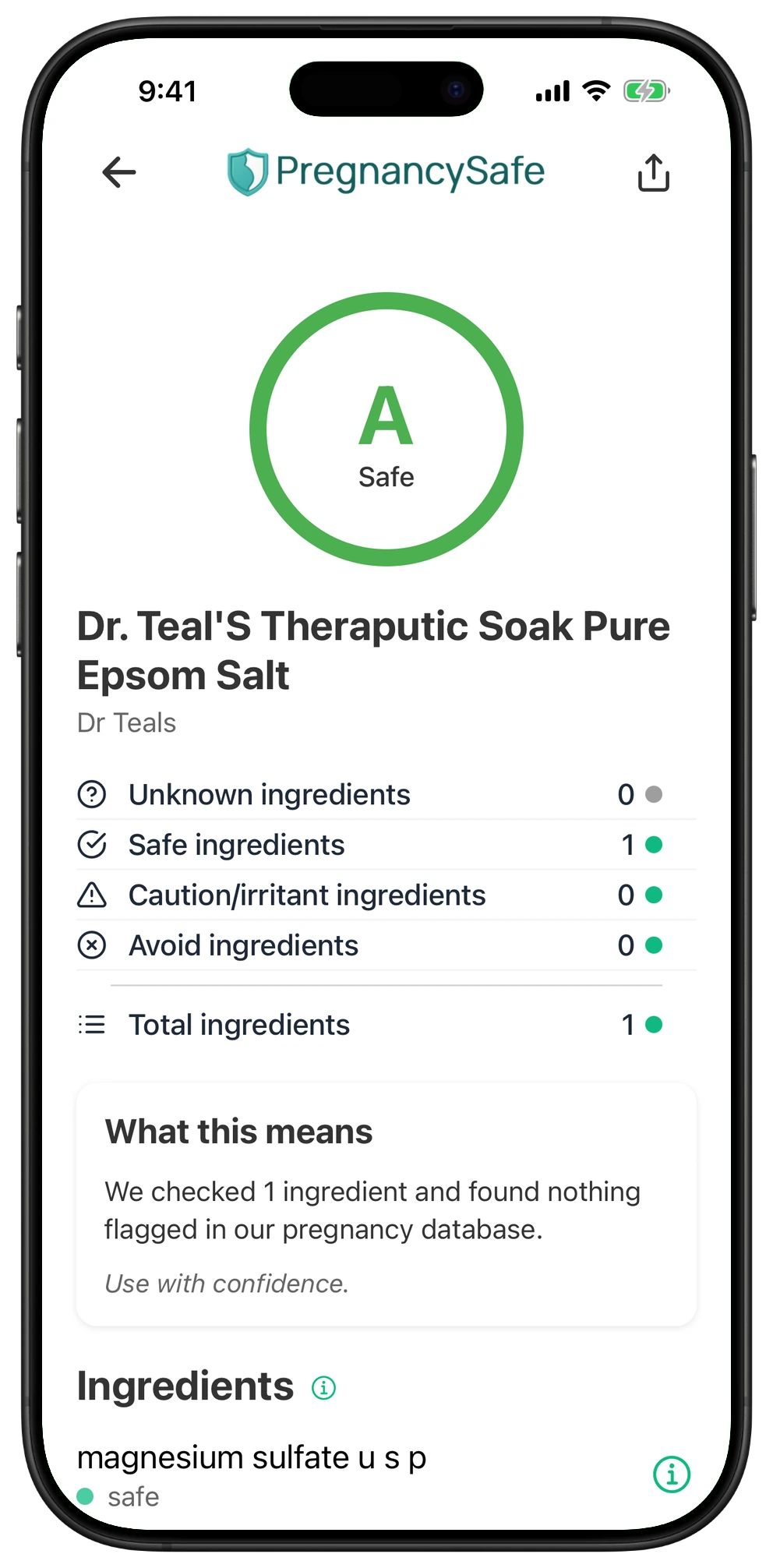
| A | Dr. Teal'S Theraputic Soak Pure Epsom Salt | Dr Teals |
| A | Epsom Salt - - Up&Up™ | Up&Up |
| A | Equate Multi-Purpose Epsom Salt 500 Gr. | Equate |
| A | Westlab Reviving Epsom Salt | Westlab |
| A | Topcare Epsom Salt | Topcare |
Your Questions Answered
Can you take an Epsom salt bath while pregnant?
Plain Epsom salt soaks are external use comfort products, not a proven pregnancy treatment. If you use one, choose a product labeled for soaking, follow its directions, and keep the water comfortably warm. Get out if you feel dizzy, overheated, or unwell. Follow your maternity clinician’s restrictions, particularly if you have broken skin or high risk pregnancy concerns.
What not to put in the bath when pregnant?
Avoid adding undiluted essential oils, and skip ingredients that have previously irritated your skin or airways. Plain, fragrance free magnesium sulfate keeps the formulation simpler than scented or botanical blends. Fragrance is an undisclosed mixture, but its presence does not mean every product contains phthalates or that occasional use is proven harmful. Do not add oral capsules or other products that lack bath use directions.
How much Epsom salt should I put in a pregnancy bath?
There is no validated pregnancy specific cup dose. Follow the exact product’s external soaking directions rather than treating a general online recipe as a pregnancy safety limit. Adding more salt is not an established way to increase benefits or deliver magnesium to your body. Any individual restrictions from your clinician take priority.
Are scented Epsom salts or essential oil blends safe during pregnancy?
The exact ingredients, concentration, and way you use the product matter more than the scent name. Fragrance can trigger irritation or allergy, making a fragrance free soak a reasonable simpler choice. Pregnancy evidence for many essential oils is limited, but findings from swallowing concentrated oils or medicinal herbs do not establish harm from diluted bath exposure. Avoid undiluted oils and seek maternity guidance before using clary sage oil specifically for labor stimulation.
Can Epsom salt baths increase magnesium levels or treat pregnancy swelling?
Meaningful magnesium absorption through intact skin has not been established, so do not count a soak toward your magnesium intake. A comfort bath is not treatment for preeclampsia, and the presence of magnesium sulfate does not make it equivalent to medically administered magnesium. Do not assume pregnancy swelling can be treated with bath salts. Discuss concerning swelling with your maternity clinician rather than relying on a soak.
Can I drink Epsom salt for constipation during pregnancy?
Do not drink bath salts or use Epsom salt as a laxative without clinician advice. External soaking and oral dosing are different exposures, and bath use guidance does not establish an oral dose. Some products sold in this broader category are oral capsules rather than bath salts, so check the form and directions carefully. Ask your clinician or pharmacist about an appropriate pregnancy constipation treatment.
How Do We Score Products for Pregnancy Safety?
We analyze each product's ingredients and category to flag known risks and provide cautionary notices for general category safety concerns.
Grades reflect the ingredient and category information available to us. They don’t verify a complete, current label or account for dose, preparation, or contamination. Read them alongside the guidance above, not as a guarantee of pregnancy safety or proof that every use is harmful.
A - Safe
Excellent choice! All ingredients are considered safe during pregnancy.
What to do: Use with confidence.
B - Likely Safe
Pretty much safe with very minimal risk. Some ingredients may have limited pregnancy studies, but no significant safety concerns have been identified.
What to do: Use with confidence.
C - Limit
Contains ingredients with some pregnancy considerations. Research shows these ingredients may have limited safety data, potential for minor hormonal effects, or require caution based on animal studies.
What to do: Use sparingly and consider safer alternatives when available.
D - Caution
Similar to C grade but contains multiple cautionary ingredients. The combination increases overall concern.
What to do: Try to avoid if that makes you feel better. If you've already used it, no need to panic.
F - Avoid
Contains an ingredient Pregnancy Safe recommends avoiding during pregnancy. This may reflect an established risk or a precaution based on limited evidence; check the ingredient guidance and exposure context.
What to do: Do not use during pregnancy. If you've already used it, don't worry - contact your OBGYN if concerned.
People Also Checked
References
- https://www.fda.gov/cosmetics/resources-consumers-cosmetics/cosmetics-pregnancy
- https://mothertobaby.org/fact-sheets/hyperthermia-pregnancy/
- https://www.fda.gov/cosmetics/cosmetic-ingredients/fragrances-cosmetics
- https://www.fda.gov/cosmetics/cosmetic-ingredients/phthalates-cosmetics
- https://www.fda.gov/cosmetics/cosmetic-ingredients/allergens-cosmetics
- https://pmc.ncbi.nlm.nih.gov/articles/PMC3110684/
- https://pmc.ncbi.nlm.nih.gov/articles/PMC4016195/
- https://pmc.ncbi.nlm.nih.gov/articles/PMC4097177/
- https://pmc.ncbi.nlm.nih.gov/articles/PMC8453372/
- https://pmc.ncbi.nlm.nih.gov/articles/PMC10999525/
- https://www.epa.gov/indoor-air-quality-iaq/volatile-organic-compounds-impact-indoor-air-quality
- https://www.nccih.nih.gov/health/aloe-vera
- https://webprod.hc-sc.gc.ca/nhpid-bdipsn/dbImages/mono_aloe--oral_english.pdf
- https://www.ema.europa.eu/en/documents/herbal-monograph/final-european-union-herbal-monograph-aloe-barbadensis-mill-and-aloe-various-species-mainly-aloe-ferox-mill-and-its-hybrids-folii-succus-siccatus_en.pdf
- https://www.utep.edu/herbal-safety/populations/herbs-to-avoid-during-pregnancy.html
- https://www.federalregister.gov/documents/2002/05/09/02-11510/status-of-certain-additional-over-the-counter-drug-category-ii-and-iii-active-ingredients
- https://pubmed.ncbi.nlm.nih.gov/33164294/
- https://pubmed.ncbi.nlm.nih.gov/28139161/
- https://journals.sagepub.com/doi/10.1080/10915810701351186
- https://www.nccih.nih.gov/health/chamomile
- https://mothertobaby.org/fact-sheets/herbal-products-pregnancy/
- https://www.ema.europa.eu/en/documents/herbal-monograph/final-european-union-herbal-monograph-matricaria-recutita-l-flos-first-version_en.pdf
- https://www.ema.europa.eu/en/documents/herbal-monograph/final-community-herbal-monograph-chamaemelum-nobile-l-all-flos_en.pdf
- https://pubmed.ncbi.nlm.nih.gov/22516883/
- https://pubmed.ncbi.nlm.nih.gov/20872924/
- https://www.ncbi.nlm.nih.gov/books/NBK501808/
- https://www.ecfr.gov/current/title-21/chapter-I/subchapter-B/part-182/subpart-A/section-182.10
- https://uktis.org/monographs/use-of-essential-oils-in-pregnancy/
- https://www.ema.europa.eu/en/medicines/herbal/rosmarini-aetheroleum
- https://www.ema.europa.eu/en/documents/herbal-report/final-assessment-report-rosmarinus-officinalis-l-aetheroleum-rosmarinus-officinalis-l-folium-revision-1_en.pdf
- https://www.cir-safety.org/sites/default/files/rosmar062014FR.pdf
- https://pmc.ncbi.nlm.nih.gov/articles/PMC7956842/
- https://pubmed.ncbi.nlm.nih.gov/8731353/
- https://www.hfpappexternal.fda.gov/scripts/fdcc/index.cfm?id=ROSEMARYOILROSEMARINUSOFFICINALIS&set=FoodSubstances
- https://pmc.ncbi.nlm.nih.gov/articles/PMC5721455/
- https://pmc.ncbi.nlm.nih.gov/articles/PMC10341564/
- https://pubmed.ncbi.nlm.nih.gov/21735438/
- https://pmc.ncbi.nlm.nih.gov/articles/PMC6428160/
- https://pmc.ncbi.nlm.nih.gov/articles/PMC7602146/
- https://www.cancer.gov/about-cancer/treatment/cam/patient/aromatherapy-pdq
- https://www.mayoclinichealthsystem.org/hometown-health/speaking-of-health/essential-oils-and-pregnancy
- https://wisdom.nhs.wales/health-board-guidelines/aneurin-bevan-file/guideline-for-aromatherapy-use-in-maternity-care/