Is Almond Milk Safe During Pregnancy? (Updated 2026 Guide)
Updated September 9, 2026
The Answer
Yes an appropriately treated and properly stored almond milk can be part of your pregnancy diet unless you are allergic to almonds. Choose by processing, storage instructions and nutrition rather than ingredient grades, which are mostly B+ in our catalog.
The main considerations are safe processing and storage, almond allergy, and whether your chosen beverage supplies the nutrients you need. Protein and fortification vary, so do not assume almond milk matches dairy for calcium, iodine or vitamin D. Added probiotic strains and lavender oil need exposure specific consideration; limited pregnancy evidence does not establish harm from ordinary food amounts.
Pregnancy Safe is 100% independent and research driven. No companies pay to promote or sponsor products.
Stress Less This Pregnancy
Check your exact almond milk in the app

✓ What's Safe
- • Choose a beverage labeled as pasteurized or otherwise treated for food safety; ask the manufacturer if its processing is unclear.
- • Check the exact carton for refrigeration instructions and how long to keep it after opening.
- • Compare calcium and vitamin D amounts per serving, especially if almond milk regularly replaces dairy.
- • Check protein and iodine separately rather than assuming a fortified beverage supplies both.
- • Read the current ingredient and allergen labels, including on flavored or probiotic versions.
✗ What to Avoid
- • Avoid almond milk if you have an almond allergy.
- • Avoid raw or untreated almond beverages when you cannot confirm a food safety treatment; homemade does not automatically mean safer.
- • Do not leave opened almond milk unrefrigerated contrary to its label or keep it beyond the stated storage period.
- • Avoid treating an unfortified almond beverage as a nutritionally equivalent replacement for dairy.
- • Do not add concentrated lavender oil to your drink; concentrated oral exposure differs from tiny amounts used as food flavoring.
- • Avoid choosing solely by an A grade or a short ingredient list; neither verifies food safety or nutritional adequacy.
Most Common Ingredients in Almond Milk Products
We analyzed 344 almond milk products. Here are the most common ingredients, ranked by how often they appear:
Ingredients to Watch Out For in Almond Milk
These are the most common flagged ingredients across 344 almond milk products we analyzed.
bacillus coagulans gbi 306086
Caution
Bacillus coagulans GBI-306086 is a probiotic spore forming bacterium known for supporting digestive health and maintaining gut balance.
Has strain specific safety with limited pregnancy specific data and includes species that can cause foodborne illness or carry toxin genes.
Flagged in 1 of 344 products (0%)
Caution
Lavender oil is a fragrant essential oil derived from lavender flowers, known for its calming, soothing, and aromatic properties.
Has limited pregnancy safety data for oral supplement use and should be separated from lower exposure aroma or diluted topical use because toxicity sedation allergy and uncertain endocrine concerns remain.
Flagged in 1 of 344 products (0%)
Almond Milk Products We've Analyzed
Our catalog contains ratings for 344 almond milk products. These are database grades, not independent safety certifications.
Grades are ingredient scores, not clinical verdicts or measurements of pathogens, dose, preparation or current package contents. Cohorts include unreviewed catalog records and counts are not independently verified safe-product totals.
Pregnancy Safe Almond Milk Products
Popular options from our catalog, prioritizing A and B ingredient grades, with C grade options used to fill remaining places. Within each group, products are ordered by searches in Pregnancy Safe, not retail sales. Read the cautions and guidance above; grades do not verify a complete current label or guarantee pregnancy safety.
| Grade | Product | Brand |
|---|---|---|
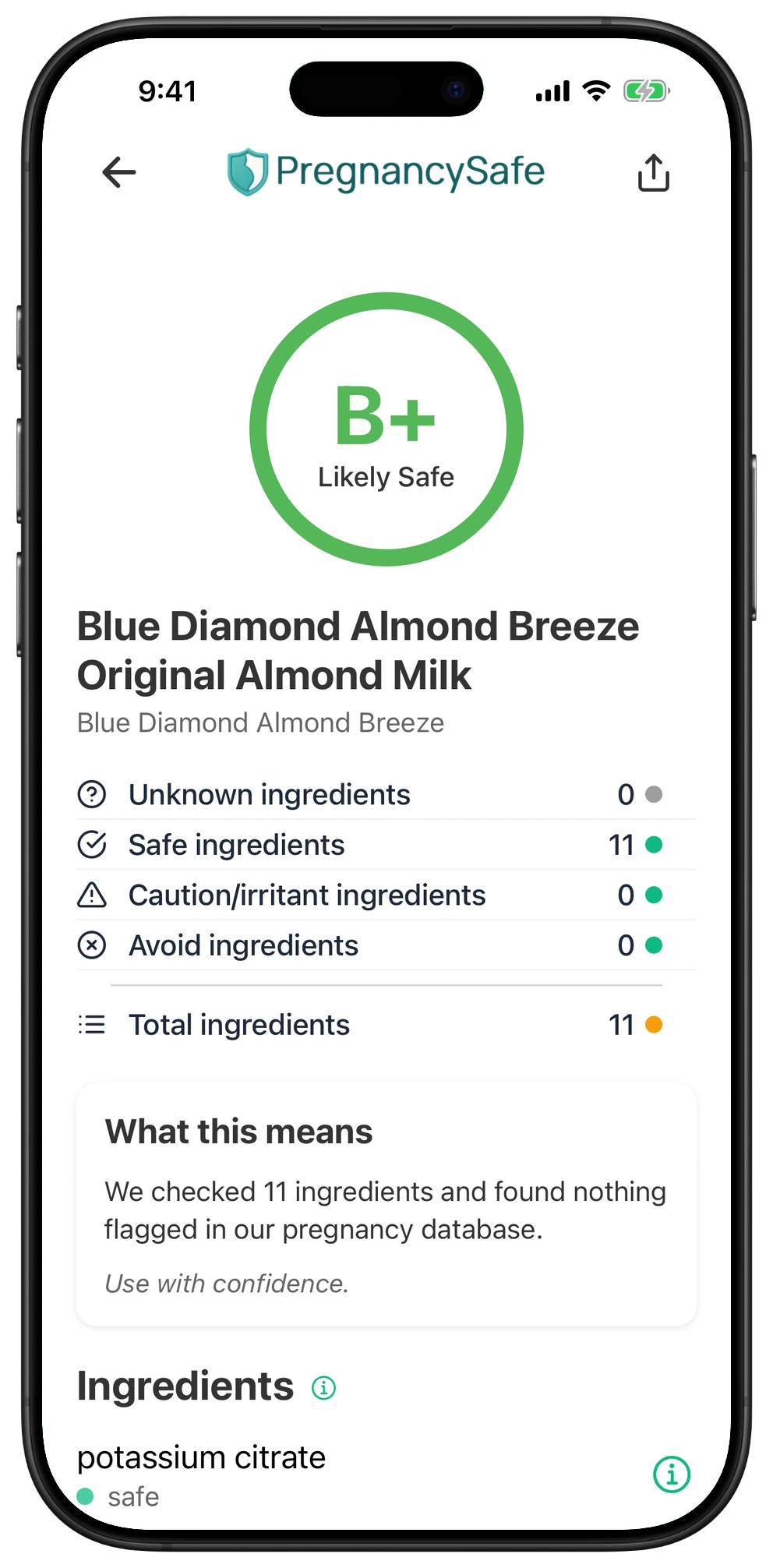
| B+ | Blue Diamond Almond Breeze Original Almond Milk | Blue Diamond Almond Breeze |
| B+ | Almond Breeze Vanilla Almond Milk | Almond Breeze |
| B+ | Almond Breeze Unsweetened Original Almond Milk | Almond Breeze |
| B+ | Blue Diamond Almond Breeze Reduced Sugar Vanilla Almond Milk | Blue Diamond Almond Breeze |
| A | Unsweetened Almond Milk | Malk |
Your Questions Answered
Is almond milk good to drink while pregnant?
Almond milk can fit your pregnancy diet if it is appropriately treated, stored correctly and suitable for your allergies. Its nutritional contribution depends on the exact formulation. Check protein, calcium, vitamin D and iodine rather than assuming every almond beverage provides the same benefits.
Can almond milk replace dairy milk during pregnancy?
You can use almond milk in place of dairy in drinks and meals, but nutritional equivalence is not guaranteed. Protein and fortification vary, and calcium or vitamin D fortification does not mean iodine is also included. If almond milk is your main milk alternative, check how your overall diet covers those nutrients. A prenatal clinician or dietitian can help you identify gaps.
How much almond milk can I drink during pregnancy?
There is no single pregnancy specific amount established here for every almond milk formulation. Consider the serving size, its nutrient content and what it replaces in your diet. Drinking more of an unfortified beverage will not necessarily cover the nutrients you would otherwise obtain from dairy. Check any added probiotic or botanical ingredients separately rather than assuming all formulations are interchangeable.
Is homemade almond milk safer than store bought?
Homemade almond milk is not automatically safer because it has fewer ingredients. Blending almonds with water does not itself provide a validated food safety treatment. During pregnancy, choose an appropriately treated beverage and follow its storage instructions. Homemade versions also should not be assumed to provide the fortification found in some packaged options.
Should I avoid gums or added vitamins in almond milk?
Gums and vitamin fortification are not automatically harmful during pregnancy. A shorter ingredient list is not proof that a beverage is clinically safer or nutritionally better. Calcium and vitamin D fortification may be useful when replacing dairy, but check the actual amounts on the label. Choose according to your nutritional needs and tolerances rather than label length alone.
What about almond milk with probiotics or lavender oil?
Bacillus coagulans gbi 306086 is a named probiotic ingredient, but pregnancy specific evidence for this strain is limited; findings about other Bacillus species do not prove it causes the same harms. Quality controlled food use differs from high dose supplements or contaminated products. For lavender oil, tiny food flavoring exposure is different from swallowing concentrated essential oil, and aromatherapy findings do not establish oral pregnancy safety. Ask your clinician about added probiotics or concentrated botanical ingredients if you are considering regular use, particularly if you are immunocompromised.
Does an A grade mean almond milk is verified safe for pregnancy?
No grades are ingredient scores, not pregnancy safety guarantees. Our catalog contains 344 almond milk products: 53 graded A, 289 graded B+ and 2 graded C+. Those counts are not independently verified safe product totals, and grades do not measure pathogens, storage, serving amounts or current package contents. Check the exact carton and its nutrition and handling instructions regardless of grade.
How Do We Score Products for Pregnancy Safety?
We analyze each product's ingredients and category to flag known risks and provide cautionary notices for general category safety concerns.
Grades reflect the ingredient and category information available to us. They don’t verify a complete, current label or account for dose, preparation, or contamination. Read them alongside the guidance above, not as a guarantee of pregnancy safety or proof that every use is harmful.
A - Safe
Excellent choice! All ingredients are considered safe during pregnancy.
What to do: Use with confidence.
B - Likely Safe
Pretty much safe with very minimal risk. Some ingredients may have limited pregnancy studies, but no significant safety concerns have been identified.
What to do: Use with confidence.
C - Limit
Contains ingredients with some pregnancy considerations. Research shows these ingredients may have limited safety data, potential for minor hormonal effects, or require caution based on animal studies.
What to do: Use sparingly and consider safer alternatives when available.
D - Caution
Similar to C grade but contains multiple cautionary ingredients. The combination increases overall concern.
What to do: Try to avoid if that makes you feel better. If you've already used it, no need to panic.
F - Avoid
Contains an ingredient Pregnancy Safe recommends avoiding during pregnancy. This may reflect an established risk or a precaution based on limited evidence; check the ingredient guidance and exposure context.
What to do: Do not use during pregnancy. If you've already used it, don't worry - contact your OBGYN if concerned.
People Also Checked
See our full guide to milk during pregnancy.
References
- https://www.nhs.uk/pregnancy/keeping-well/foods-to-avoid/
- https://ods.od.nih.gov/factsheets/Pregnancy-HealthProfessional/
- https://www.fda.gov/food/buy-store-serve-safe-food/what-you-need-know-about-juice-safety
- https://pmc.ncbi.nlm.nih.gov/articles/PMC8308823/
- https://pmc.ncbi.nlm.nih.gov/articles/PMC5759212/
- https://pmc.ncbi.nlm.nih.gov/articles/PMC6811671/
- https://www.efsa.europa.eu/en/topics/topic/qualified-presumption-safety-qps
- https://www.fda.gov/files/food/published/GRAS-Notice-000660---Bacillus-coagulans-GBI-30--6086.pdf
- https://www.bccdc.ca/health-info/diseases-conditions/bacillus-cereus
- https://www.fda.gov/food/people-risk-foodborne-illness/food-safety-booklet-pregnant-women-their-unborn-babies-and-children-under-five
- https://www.nccih.nih.gov/health/lavender
- https://www.mayoclinichealthsystem.org/hometown-health/speaking-of-health/essential-oils-and-pregnancy
- https://pubmed.ncbi.nlm.nih.gov/39685078/
- https://pubmed.ncbi.nlm.nih.gov/41192533/
- https://pubmed.ncbi.nlm.nih.gov/33673548/
- https://pubmed.ncbi.nlm.nih.gov/32147050/
- https://pubmed.ncbi.nlm.nih.gov/31393563/
- https://pubmed.ncbi.nlm.nih.gov/35663791/