Is Calcium Carbonate Safe During Pregnancy?
Updated September 14, 2026
The Answer
Yes, calcium carbonate in food, supplements, or antacids is safe during pregnancy when used as directed and within recommended total calcium limits.
The key distinction is recommended use versus chronic excessive intake: calcium from food, supplements, and antacids all counts toward your total.
MotherToBaby reports that directed use within recommended calcium amounts is not expected to increase miscarriage, birth defect, preterm birth, or low birth weight risk.
Already used it? If you have already taken calcium carbonate, check the product’s pregnancy specific directions and your calcium intake from food, supplements, and antacids. If you have repeatedly exceeded the directions or are unsure about your total, ask your clinician or pharmacist to review your intake.
Pregnancy Safe is 100% independent and research driven. No companies pay to promote or sponsor products.
Stressless Pregnancy
Check your exact product with calcium carbonate in the app

What Is Calcium Carbonate?
You may also see it listed as: CaCO3, carbonic acid calcium salt, E170
Calcium carbonate is an inorganic calcium salt used to provide dietary calcium and neutralize stomach acid. You may find it in calcium supplements, chewable antacid tablets for heartburn and acid indigestion, supplement powders, and foods as a calcium source or additive.
What Other Ingredients Should You Look Out for in Products With Calcium Carbonate?
A product's full ingredient list determines whether it's pregnancy-safe or not. These ingredients also appear in some of the calcium carbonate products we analyzed and may deserve a closer look.
Erythrosine
CautionLook for FD&C Red No. 3, also called erythrosine or E127, on antacid labels; human pregnancy outcome data for this dye are very limited. Check whether the formula includes it if you want to reduce unnecessary intake, without treating its presence as proof of pregnancy harm.
Flagged in 1 product (16.7%) in this analysis.
Does the Form or Amount of Calcium Carbonate Matter During Pregnancy?
For antacids, check the strength and pregnancy specific maximum on your exact label rather than relying on a tablet count alone. Supplement and antacid use must also stay within recommended total calcium limits. Chronic excessive intake can cause high blood calcium, kidney problems, and milk alkali syndrome; neonatal complications have also been reported in case reports.
What Products Contain Calcium Carbonate?
Pregnancy Safe has looked at 11,206 products that have calcium carbonate as an ingredient. The category and grade breakdowns below use 6 products whose names mention Calcium Carbonate or another name for it.
What Types of Products Contain Calcium Carbonate?
Products You May Have That Contain Calcium Carbonate
| Grade | Product | Brand | Type |
|---|---|---|---|
| A | Cvs Ultra Strength Antacid Tablets Calcium Carbonate 1000 Mg Peppermint 480 Chew Tablets | Cvs | Antacid |
| A | Equate Extra Strength Antacid Calcium Carbonate Tablets | Equate | Antacid |
| A | Extra Strength Calcium Carbonate 750 Mg Antacid Tropical Fruit Chewable Tablets | — | Antacid |
| A | Calcium Carbonate Pure Powder | Now | Calcium Supplement |
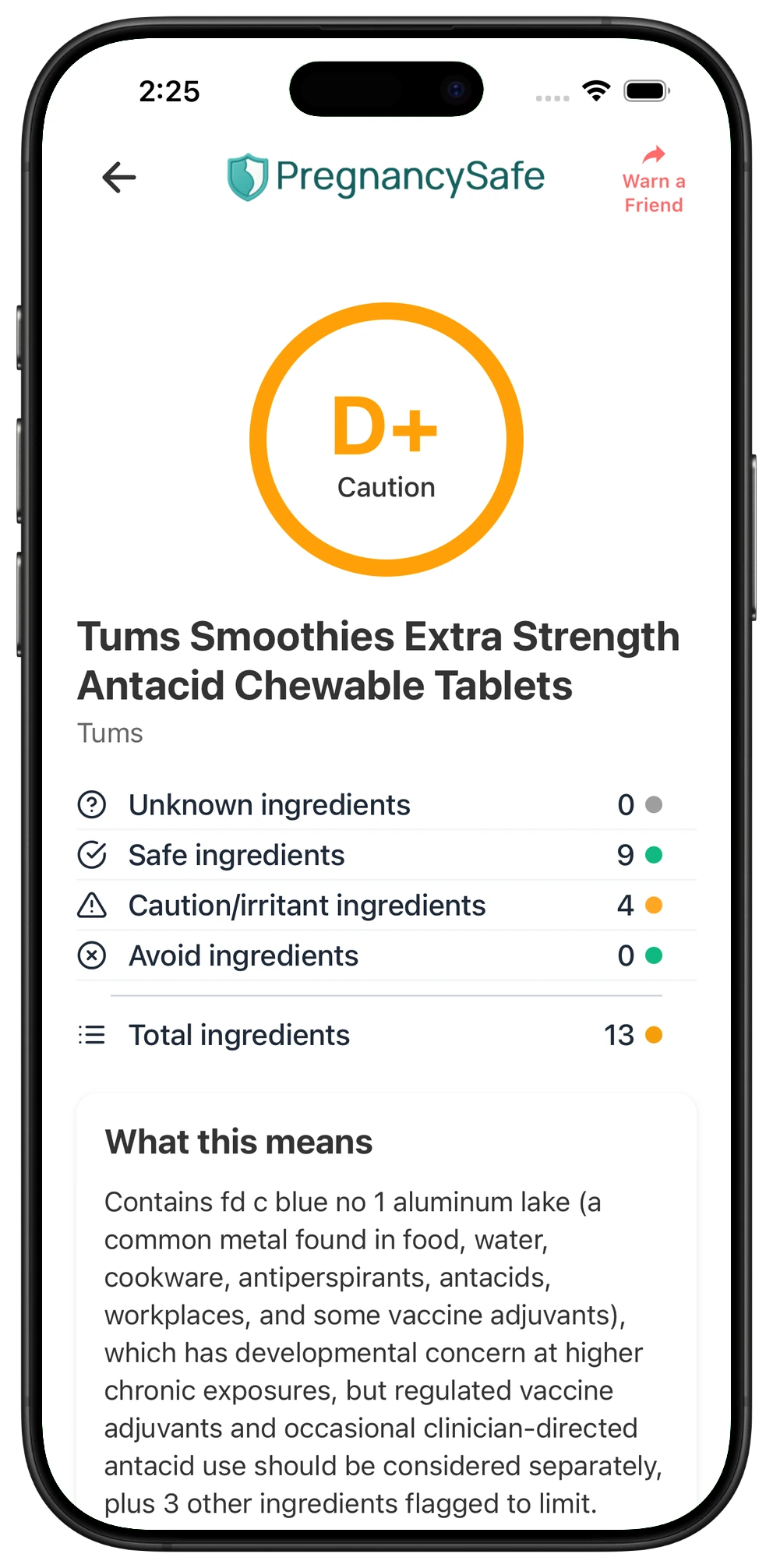
| D+ | Tums Calcium Carbonate Tablets | Tums | Antacid |
| A | Calcium (Carbonate) 500 Mg | Webber Naturals | Dietary Supplement |
| C+ | Cinnamon Toast Crunch | General Mills | Breakfast Cereal |
| B+ | Honey Nut Cheerios | General Mills | Cereal |
How Do Products Containing Calcium Carbonate Score?
It can be helpful to see how products containing calcium carbonate generally score during pregnancy. This does not tell you whether your exact product is safe, but it gives you a general idea of what we found. In this breakdown of 6 products, 83% receive an A grade. An A grade means the complete formula is considered safe during pregnancy.
Frequently Asked Questions About Calcium Carbonate During Pregnancy
How much calcium carbonate can I take while pregnant?
Follow the directions for your exact supplement or antacid, including any pregnancy specific maximum. Your calcium from food, supplements, and antacids must also remain within recommended total calcium limits; there is no single tablet count that applies to every product.
Can I take two Tums at once during pregnancy?
That depends on the strength and directions of the exact product. Check its pregnancy specific instructions rather than assuming two tablets is an appropriate dose. Calcium carbonate’s safety does not establish the safety of every complete formula.
Can calcium carbonate help with pregnancy heartburn?
Calcium carbonate neutralizes stomach acid and is used for heartburn and acid indigestion. Its use as an antacid is compatible with pregnancy within the product’s directions and recommended total calcium limits.
Does calcium carbonate in food count toward my calcium intake?
Yes. Calcium carbonate is used as a dietary calcium source in foods, and that calcium counts alongside calcium from supplements and antacids.
What happens if I take too much calcium carbonate?
Chronic excessive intake can cause high blood calcium, kidney problems, and milk alkali syndrome. Neonatal complications have also been described in case reports. These concerns are distinct from normal use within label and total calcium limits.
Does calcium supplementation help prevent pre eclampsia?
WHO recommends calcium supplementation to reduce pre eclampsia risk in populations with low dietary calcium intake. That recommendation does not mean everyone should add a calcium supplement or take extra antacids.
How Do We Score Products for Pregnancy Safety?
We analyze each product's ingredients and category to flag known risks and provide cautionary notices for general category safety concerns.
A - Safe
Excellent choice! All ingredients are considered safe during pregnancy.
What to do: Use with confidence.
B - Likely Safe
Pretty much safe with very minimal risk. Some ingredients may have limited pregnancy studies, but no significant safety concerns have been identified.
What to do: Use with confidence.
C - Limit
Contains ingredients with some pregnancy considerations. Research shows these ingredients may have limited safety data, potential for minor hormonal effects, or require caution based on animal studies.
What to do: Use sparingly and consider safer alternatives when available.
D - Caution
Similar to C grade but contains multiple cautionary ingredients. The combination increases overall concern.
What to do: Try to avoid if that makes you feel better. If you've already used it, no need to panic.
F - Avoid
Contains an ingredient Pregnancy Safe recommends avoiding during pregnancy. This may reflect an established risk or a precaution based on limited evidence; check the ingredient guidance and exposure context.
What to do: Do not use during pregnancy. If you've already used it, don't worry - contact your OBGYN if concerned.
Sources
- https://dailymed.nlm.nih.gov/dailymed/drugInfo.cfm?setid=3988e3f8-b276-43a0-bdd3-01ddd422c986
- https://mothertobaby.org/fact-sheets/calcium-carbonate-pregnancy/
- https://ods.od.nih.gov/factsheets/Calcium-HealthProfessional/
- https://www.ncbi.nlm.nih.gov/books/NBK582615/
- https://www.who.int/tools/elena/interventions/calcium-pregnancy
- https://www.fda.gov/industry/color-additives/fdc-red-no-3
- https://www.federalregister.gov/documents/2025/01/16/2025-00830/color-additive-petition-from-center-for-science-in-the-public-interest-et-al-request-to-revoke-color
- https://efsa.onlinelibrary.wiley.com/doi/10.2903/j.efsa.2011.1854
- https://pubmed.ncbi.nlm.nih.gov/2824305/
- https://pubmed.ncbi.nlm.nih.gov/2177442/
- https://pubmed.ncbi.nlm.nih.gov/8296313/
- https://pubmed.ncbi.nlm.nih.gov/8386132/
- https://pmc.ncbi.nlm.nih.gov/articles/PMC9368057/