Is Sage Safe During Pregnancy?
Updated September 14, 2026
The Answer
Sage in normal food seasoning amounts is generally low concern during pregnancy, although direct human pregnancy data are limited. Medicinal sage teas, extracts, supplements, and essential oil warrant avoidance or clinician review, not the same reassurance as culinary use.
The key distinction is normal food seasoning versus medicinal or concentrated sage preparations.
EMA and Health Canada do not recommend medicinal sage leaf products during pregnancy because safety is not established; concentrated thujone in sage essential oil adds concern because it is neurotoxic at high doses.
Already used it? If you have used a medicinal sage tea, extract, supplement, or essential oil, ask your clinician to review the preparation and amount used. Normal seasoning in a meal is a different, generally low concern exposure.
Pregnancy Safe is 100% independent and research driven. No companies pay to promote or sponsor products.
Stressless Pregnancy
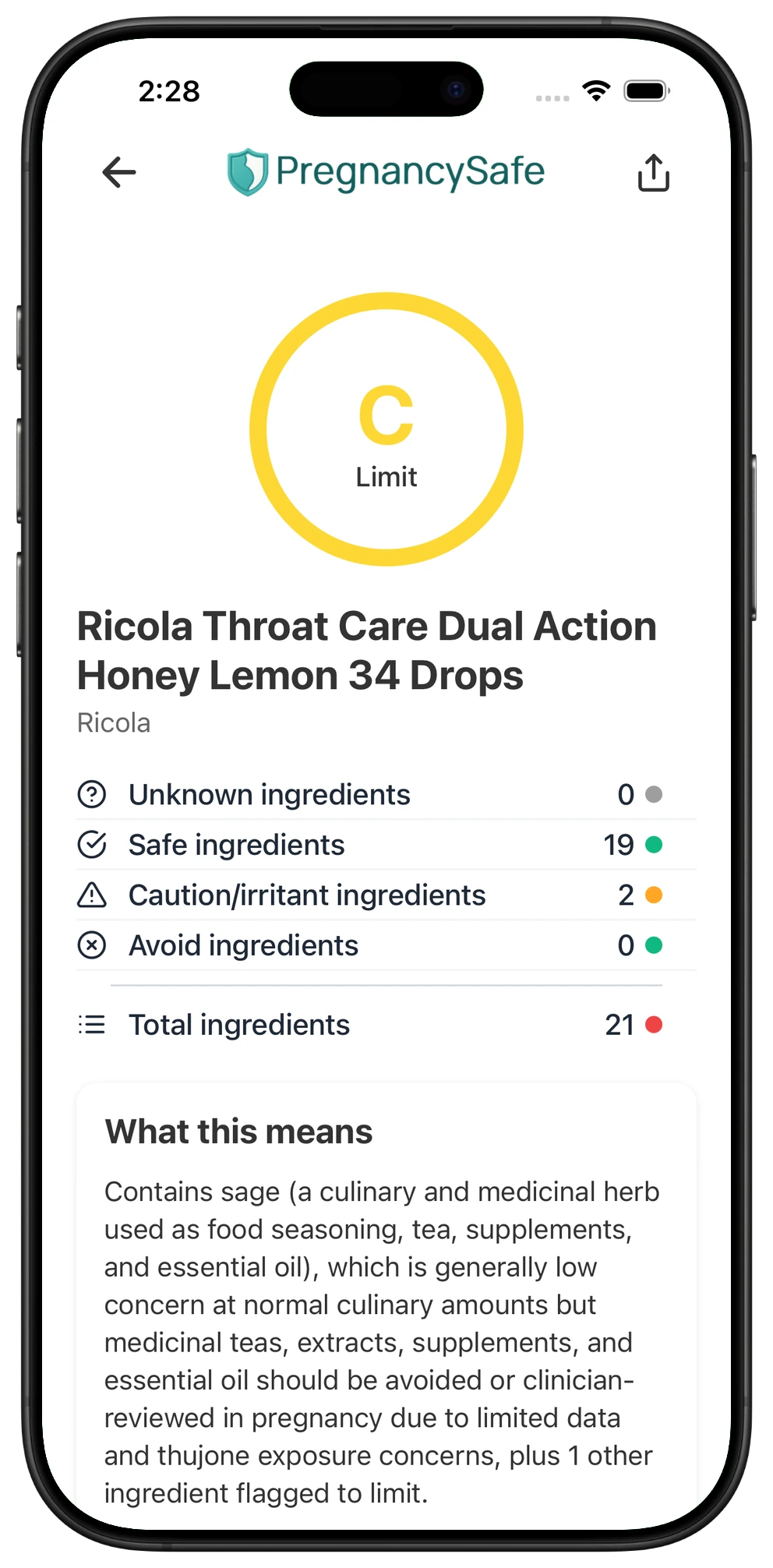
Check your exact product with sage in the app

What Is Sage?
You may also see it listed as: common sage, Salvia officinalis
Sage is Salvia officinalis, a fragrant, gray green herb with an earthy, slightly peppery flavor. It seasons foods such as stuffing, sausage, ravioli, and sauces and is also sold as tea, extracts, supplements, and essential oil. Sage derived extracts and oils also appear in shampoos, body washes, and skincare.
What Other Ingredients Should You Look Out for in Products With Sage?
A product's full ingredient list determines whether it's pregnancy-safe or not. These ingredients also appear in some of the sage products we analyzed and may deserve a closer look.
Rosemary Oil
CautionLook for “rosemary leaf oil” in essential oil blends and shampoo, and check whether it is concentrated or part of a dilute finished cosmetic. Pregnancy specific studies are lacking; normal low concentration toiletry exposure should not be equated with undiluted, medicinal, or oral oil use.
Flagged in 3 products (3.6%) in this analysis.
Seaweed
CautionIf a ravioli label lists “seaweed,” check which species is used and any available iodine information. Iodine varies greatly by species, so a food ingredient should not automatically be treated like a concentrated kelp supplement.
Flagged in 3 products (3.6%) in this analysis.
High Fructose Corn Syrup
CautionLook for “high fructose corn syrup,” including within bread crumb ingredients in stuffing, and check the added sugar information and how often you eat it. The concern is frequent high added sugar intake, not established birth defect risk from occasional food amounts.
Flagged in 2 products (2.4%) in this analysis.
Kombucha
Caution“Live kombucha culture yeast” in these drinks is a cue to check pasteurization, alcohol control, and caffeine information. Pregnancy data are lacking, and raw, unpasteurized, hard, or home brewed kombucha is more uncertain than pasteurized, alcohol controlled commercial versions.
Flagged in 2 products (2.4%) in this analysis.
Clary Sage Oil
Caution“Clary sage oil” comes from Salvia sclarea, not common sage, so check the botanical name on essential oil blends. Its pregnancy evidence is sparse and largely involves supervised use at term or during labor; review timing, route, and dilution with your maternity clinician rather than assuming it is proven to induce labor.
Flagged in 1 product (1.2%) in this analysis.
Fragrance
Caution“Fragrance” on a shampoo label represents a scent mixture whose individual ingredients may not be disclosed, and it can irritate sensitive skin or airways. If you want to reduce fragrance exposure, check for a fragrance free option; the term alone does not prove phthalate content or pregnancy harm.
Flagged in 1 product (1.2%) in this analysis.
Does the Form or Amount of Sage Matter During Pregnancy?
Normal culinary amounts should not be treated like medicinal tea, supplements, or essential oil, which can concentrate thujone. For skin and hair products, exposure depends on the preparation, concentration, and amount applied. An expert cosmetic panel's favorable assessment covered specified cosmetic uses and concentrations in non sensitizing formulations, not pregnancy specifically, undiluted oil, or unknown DIY mixtures. Direct human pregnancy studies of routine topical sage use were not identified; medicinal skin preparations and concentrated or DIY oils merit greater caution than low concentration finished cosmetics.
What Products Contain Sage?
Pregnancy Safe has looked at 947 products that have sage as an ingredient. The category and grade breakdowns below use 84 products whose names mention Sage or another name for it.
What Types of Products Contain Sage?
Products You May Have That Contain Sage
| Grade | Product | Brand | Type |
|---|---|---|---|
| C+ | Borsari Tuscan Rosemary Sage Salt | Borsari | Seasoning Salt |
| D+ | Hair Loss Dht Blocker Shampoo With Sage & Lemongrass, Biotin | Botanical Green Care | Shampoo |
| C- | Phillip Adam Verbena Sage Hand And Body Wash | Phillip Adam | Body Wash |
| F | Cedar And Sage Shampoo 500Ml | Qi Natural Food | Shampoo |
| F | Bourbon, Sage & Tarragon Bbq Sauce | — | Bbq Sauce |
| C | Butternut Squash Filled Ravioli In A Butter & Sage Sauce | — | Ravioli |
| C+ | Chicken Gravy Seasoned With Sage And Black Pepper, Chicken With Sage And Black Pepper | — | Gravy |
| C+ | Egg & Sage Striped Butternut Squash Italian Style Ravioli, Egg & Sage Striped Butternut Squash | — | Ravioli |
How Do Products Containing Sage Score?
It can be helpful to see how products containing sage generally score during pregnancy. This does not tell you whether your exact product is safe, but it gives you a general idea of what we found. In this breakdown of 84 products, 90% receive a C grade. A C grade means the complete formula has some pregnancy considerations, so use it sparingly and consider a higher scoring alternative when one is available.
Frequently Asked Questions About Sage During Pregnancy
Can I eat sage in stuffing or pasta while pregnant?
Normal amounts used to season food are generally low concern, although direct human pregnancy data are limited. That conclusion concerns the sage seasoning, not the safety of the whole dish.
Can I drink sage tea or take sage supplements?
Medicinal sage teas, extracts, and supplements should be avoided or reviewed with your clinician during pregnancy. EMA and Health Canada do not recommend medicinal sage leaf products because pregnancy safety is not established.
Why is sage essential oil more concerning than the herb?
Essential oil can contain concentrated thujone, which is neurotoxic at high doses. It should not be treated like food seasoning; concentrated or DIY oil preparations warrant particular caution.
What about sage in shampoo, body wash, or skincare?
Low concentration finished cosmetics are different from undiluted sage oil or medicinal preparations. Direct human pregnancy studies of routine topical use were not identified, and general cosmetic safety assessments do not establish pregnancy specific safety.
Does the advice change in the first, second, or third trimester?
The available evidence does not establish different trimester specific advice for sage. In particular, routine topical use lacks direct human pregnancy studies by trimester, so a later trimester should not be assumed to make concentrated preparations safe.
Can I burn sage or breathe in sage smoke while pregnant?
The available sage evidence does not establish pregnancy safety for smudging or smoke inhalation. Reassurance about normal food seasoning or assessed cosmetic formulations cannot be extended to burning sage.
How much sage is considered a normal seasoning amount?
The evidence distinguishes normal culinary seasoning from medicinal or concentrated use but does not establish a pregnancy specific limit in teaspoons, leaves, or grams. It also does not establish a safe medicinal tea or supplement dose.
How Do We Score Products for Pregnancy Safety?
We analyze each product's ingredients and category to flag known risks and provide cautionary notices for general category safety concerns.
A - Safe
Excellent choice! All ingredients are considered safe during pregnancy.
What to do: Use with confidence.
B - Likely Safe
Pretty much safe with very minimal risk. Some ingredients may have limited pregnancy studies, but no significant safety concerns have been identified.
What to do: Use with confidence.
C - Limit
Contains ingredients with some pregnancy considerations. Research shows these ingredients may have limited safety data, potential for minor hormonal effects, or require caution based on animal studies.
What to do: Use sparingly and consider safer alternatives when available.
D - Caution
Similar to C grade but contains multiple cautionary ingredients. The combination increases overall concern.
What to do: Try to avoid if that makes you feel better. If you've already used it, no need to panic.
F - Avoid
Contains an ingredient Pregnancy Safe recommends avoiding during pregnancy. This may reflect an established risk or a precaution based on limited evidence; check the ingredient guidance and exposure context.
What to do: Do not use during pregnancy. If you've already used it, don't worry - contact your OBGYN if concerned.
Sources
- https://journals.sagepub.com/doi/10.1177/10915818261425569
- https://pmc.ncbi.nlm.nih.gov/articles/PMC7956842/
- https://pubmed.ncbi.nlm.nih.gov/19535210/
- https://pubmed.ncbi.nlm.nih.gov/23933314/
- https://webprod.hc-sc.gc.ca/nhpid-bdipsn/dbImages/mono_Sage_Oral_EN.pdf
- https://www.canada.ca/en/environment-climate-change/services/evaluating-existing-substances/draft-assessment-fourteen-terpene-and-terpenoid-substances-group.html
- https://www.ema.europa.eu/en/documents/herbal-monograph/final-european-union-herbal-monograph-salvia-officinalis-l-folium-revision-1_en.pdf
- https://www.ema.europa.eu/en/documents/public-statement/public-statement-salvia-officinalis-l-aetheroleum_en.pdf
- https://www.ema.europa.eu/en/documents/scientific-guideline/public-statement-use-herbal-medicinal-products-containing-thujone-revision-1_en.pdf
- https://www.nccih.nih.gov/health/sage
- https://uktis.org/monographs/use-of-essential-oils-in-pregnancy/
- https://www.ema.europa.eu/en/medicines/herbal/rosmarini-aetheroleum
- https://www.ema.europa.eu/en/documents/herbal-report/final-assessment-report-rosmarinus-officinalis-l-aetheroleum-rosmarinus-officinalis-l-folium-revision-1_en.pdf
- https://www.cir-safety.org/sites/default/files/rosmar062014FR.pdf
- https://pubmed.ncbi.nlm.nih.gov/8731353/
- https://www.hfpappexternal.fda.gov/scripts/fdcc/index.cfm?id=ROSEMARYOILROSEMARINUSOFFICINALIS&set=FoodSubstances
- https://journals.sagepub.com/doi/10.1177/10507256261445624
- https://ods.od.nih.gov/factsheets/Iodine-HealthProfessional/
- https://www.foodstandards.gov.au/consumer/nutrition/pregnancy/iodine-and-pregnancy
- https://www.foodstandards.gov.au/consumer/prevention-of-foodborne-illness/arseniciodine
- https://inspection.canada.ca/en/food-safety-consumers/fact-sheets/specific-products-and-risks/chemical-hazards/inorganic-arsenic
- https://pubmed.ncbi.nlm.nih.gov/35947162/
- https://pubmed.ncbi.nlm.nih.gov/20919974/
- https://pubmed.ncbi.nlm.nih.gov/30632947/
- https://pmc.ncbi.nlm.nih.gov/articles/PMC8077470/
- https://cdn.realfood.gov/DGA.pdf
- https://www.dietaryguidelines.gov/sites/default/files/2021-12/DGA_Pregnancy_FactSheet-508c.pdf
- https://www.acog.org/womens-health/faqs/healthy-eating-during-pregnancy
- https://www.cdc.gov/nutrition/php/data-research/added-sugars.html
- https://www.cdc.gov/diabetes/about/gestational-diabetes.html
- https://www.who.int/publications/i/item/9789241549028
- https://nesr.usda.gov/2025-dietary-guidelines-advisory-committee-systematic-reviews/dietary-patterns_gestational-diabetes
- https://mothertobaby.org/baby-blog/kombucha-pregnancy-answers/
- https://www.cdc.gov/food-safety/foods/pregnant-women.html
- https://www.fda.gov/food/people-risk-foodborne-illness/fruits-veggies-and-juices-food-safety-moms-be
- https://www.cdc.gov/alcohol-pregnancy/about/index.html
- https://www.ttb.gov/kombucha/kombucha-general/print
- https://pubmed.ncbi.nlm.nih.gov/20664420/
- https://www.mdpi.com/2311-5637/10/8/385
- https://www.cdc.gov/mmwr/preview/mmwrhtml/00039742.htm
- https://journals.sagepub.com/doi/10.1177/0885066609332963
- https://www.foodprotection.org/members/fpt-archive-articles/2025-03-determining-critical-food-safety-factors-for-safely-homebrewing-kombucha-a-study-on-microbia/
- https://pmc.ncbi.nlm.nih.gov/articles/PMC5721455/
- https://pmc.ncbi.nlm.nih.gov/articles/PMC10341564/
- https://pubmed.ncbi.nlm.nih.gov/21735438/
- https://pmc.ncbi.nlm.nih.gov/articles/PMC6428160/
- https://pmc.ncbi.nlm.nih.gov/articles/PMC7602146/
- https://www.cancer.gov/about-cancer/treatment/cam/patient/aromatherapy-pdq
- https://www.mayoclinichealthsystem.org/hometown-health/speaking-of-health/essential-oils-and-pregnancy
- https://wisdom.nhs.wales/health-board-guidelines/aneurin-bevan-file/guideline-for-aromatherapy-use-in-maternity-care/
- https://www.fda.gov/cosmetics/cosmetic-ingredients/fragrances-cosmetics
- https://www.fda.gov/cosmetics/cosmetic-ingredients/phthalates-cosmetics
- https://www.fda.gov/cosmetics/cosmetic-ingredients/allergens-cosmetics
- https://pmc.ncbi.nlm.nih.gov/articles/PMC3110684/
- https://pmc.ncbi.nlm.nih.gov/articles/PMC4016195/
- https://pmc.ncbi.nlm.nih.gov/articles/PMC4097177/
- https://pmc.ncbi.nlm.nih.gov/articles/PMC8453372/
- https://pmc.ncbi.nlm.nih.gov/articles/PMC10999525/
- https://www.epa.gov/indoor-air-quality-iaq/volatile-organic-compounds-impact-indoor-air-quality