Is Papaya Enzyme Safe During Pregnancy?
Updated September 14, 2026
The Answer
Papaya enzyme calls for caution during pregnancy: avoid concentrated oral papaya enzyme supplements, rather than treating them like ripe fruit. Ripe, well washed papaya is the low concern food form; oral concerns do not establish a hazard from normal topical cosmetic use.
The key distinction is the form and route: a concentrated enzyme supplement is not equivalent to eating ripe papaya or using a papaya derived cosmetic.
Animal and laboratory studies found uterine or reproductive effects with papaya latex, seed extracts, and concentrated preparations, while limited animal data on ripe fruit intake did not show harm; human pregnancy data remain sparse.
Pregnancy Safe is 100% independent and research driven. No companies pay to promote or sponsor products.
Stressless Pregnancy
Check your exact product with papaya enzyme in the app

What Is Papaya Enzyme?
Papaya enzyme is a papaya derived ingredient used in supplement formulations, including digestive products. You will commonly find it in chewable tablets and enzyme complexes. Papaya derived ingredients also appear in skin and hair products, but fruit extracts, leaf extracts, seed oil, and enzyme preparations are not interchangeable.
What Other Ingredients Should You Look Out for in Products With Papaya Enzyme?
A product's full ingredient list determines whether it's pregnancy-safe or not. These ingredients also appear in some of the papaya enzyme products we analyzed and may deserve a closer look.
Artificial Colors
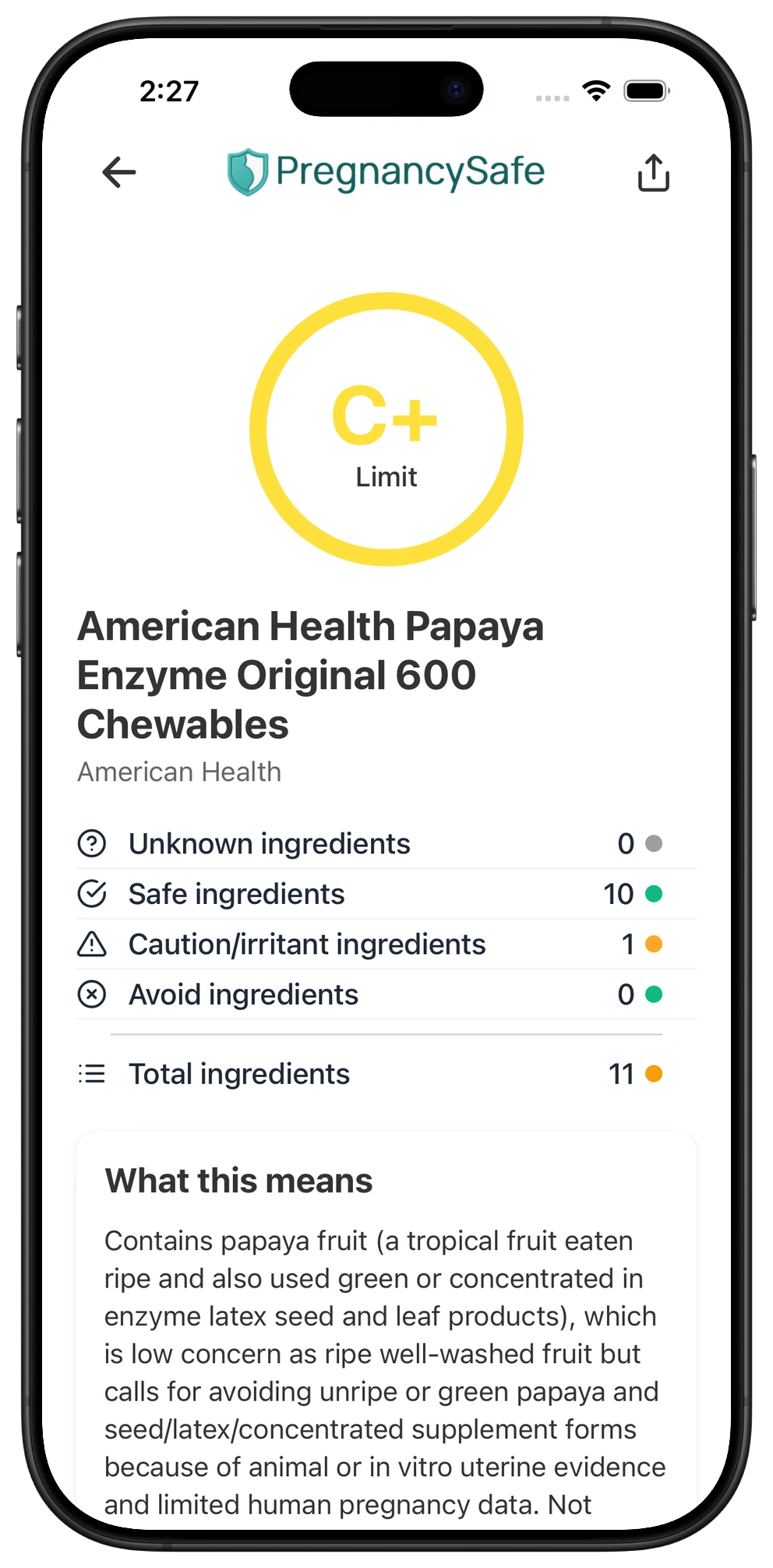
CautionLook for “artificial color,” an additive used to change a supplement’s appearance. Regulated incidental exposure is generally low concern despite limited pregnancy outcome data; check the exact dye, especially if you have a known sensitivity or prefer to avoid nonessential additives.
Flagged in 1 product (4%) in this analysis.
Does the Form or Amount of Papaya Enzyme Matter During Pregnancy?
For oral use, the concern centers on unripe or green papaya, latex, seed extracts, and concentrated medicinal or supplement forms, not ripe, well washed fruit. For topical use, cosmetic reviews found papaya fruit derived ingredients and seed oil safe as used, but these findings do not establish pregnancy safety for every papaya enzyme preparation. Direct pregnancy studies are lacking, leaf extract data were insufficient, and papain rich products have additional uncertainty or allergy concerns. Papain wound treatments and application to broken skin are separate exposures from normal cosmetic use.
What Products Contain Papaya Enzyme?
Pregnancy Safe has looked at 26 products that have papaya enzyme as an ingredient. The category and grade breakdowns below use 25 products whose names mention Papaya Enzyme or another name for it.
What Types of Products Contain Papaya Enzyme?
Products You May Have That Contain Papaya Enzyme
| Grade | Product | Brand | Type |
|---|---|---|---|
| C+ | Chewable Super Papaya Enzyme Plus | American Health | Dietary Supplement |
| C+ | Spring Valley Papaya Enzyme Complex Chewable Tablets 180 Tablets | Spring Valley | Dietary Supplement |
| Varies C (1), C+ (1) | Chewable Original Papaya Enzyme | American Health | Dietary Supplement |
| Varies C (2), C+ (1) | Chewable Papaya Enzyme With Chlorophyll | American Health | Dietary Supplement |
| C | Papaya Enzyme | Gnc Natural Brand | Dietary Supplement |
| C+ | Chewable Super Papaya Enzyme Plus | Good 'N Natural | Dietary Supplement |
| C+ | Papaya Enzyme Chewable | Meijer | Dietary Supplement |
| C | Papaya Enzyme | Natrol | Dietary Supplement |
How Do Products Containing Papaya Enzyme Score?
It can be helpful to see how products containing papaya enzyme generally score during pregnancy. This does not tell you whether your exact product is safe, but it gives you a general idea of what we found. In this breakdown of 25 products, 100% receive a C grade. A C grade means the complete formula has some pregnancy considerations, so use it sparingly and consider a higher scoring alternative when one is available.
Frequently Asked Questions About Papaya Enzyme During Pregnancy
Can I eat ripe papaya even if enzyme supplements call for caution?
Yes, ripe, well washed papaya is the low concern form. Limited pregnancy specific animal data did not show harm from food like intake, although human data are sparse. Wash the fruit and cut away damaged areas before preparing or eating it.
Do papaya enzymes cause contractions or miscarriage?
Crude papaya latex from unripe or semi ripe fruit caused strong contractions in rat uterus studies. Those findings support caution with concentrated oral forms, but they do not establish that a papaya enzyme supplement causes contractions or miscarriage in humans.
Does the supplement warning also apply to papaya enzyme facials?
Not automatically. Oral and laboratory uterine findings do not establish a hazard from normal topical cosmetic use. However, direct pregnancy studies are lacking, and findings for papaya fruit derived cosmetic ingredients should not be extended to every papain rich facial preparation or use on broken skin.
Does a latex allergy matter with papain containing skin products?
Yes. Papain can cause serious allergic reactions, and cross reactivity is a concern for some people with latex allergy. Papain containing wound debridement drugs are also a different exposure from ordinary cosmetics.
Is there a pregnancy safe dose of papaya enzyme tablets?
The available evidence does not establish a pregnancy safe supplement dose. A tablet’s stated strength does not resolve the concerns about concentrated oral preparations or the lack of human pregnancy data.
Does this mean all digestive enzymes should be avoided during pregnancy?
No. These concerns apply to the papaya forms described here and cannot establish the safety of other digestive enzymes. The evidence also does not identify a replacement enzyme or support a “best papaya enzyme” brand for pregnancy.
How Do We Score Products for Pregnancy Safety?
We analyze each product's ingredients and category to flag known risks and provide cautionary notices for general category safety concerns.
A - Safe
Excellent choice! All ingredients are considered safe during pregnancy.
What to do: Use with confidence.
B - Likely Safe
Pretty much safe with very minimal risk. Some ingredients may have limited pregnancy studies, but no significant safety concerns have been identified.
What to do: Use with confidence.
C - Limit
Contains ingredients with some pregnancy considerations. Research shows these ingredients may have limited safety data, potential for minor hormonal effects, or require caution based on animal studies.
What to do: Use sparingly and consider safer alternatives when available.
D - Caution
Similar to C grade but contains multiple cautionary ingredients. The combination increases overall concern.
What to do: Try to avoid if that makes you feel better. If you've already used it, no need to panic.
F - Avoid
Contains an ingredient Pregnancy Safe recommends avoiding during pregnancy. This may reflect an established risk or a precaution based on limited evidence; check the ingredient guidance and exposure context.
What to do: Do not use during pregnancy. If you've already used it, don't worry - contact your OBGYN if concerned.
Sources
- https://pubmed.ncbi.nlm.nih.gov/10837984/
- https://pubmed.ncbi.nlm.nih.gov/12144723/
- https://pubmed.ncbi.nlm.nih.gov/14623029/
- https://pubmed.ncbi.nlm.nih.gov/18468758/
- https://pubmed.ncbi.nlm.nih.gov/25705851/
- https://pubmed.ncbi.nlm.nih.gov/29243540/
- https://pubmed.ncbi.nlm.nih.gov/34040647/
- https://www.cdc.gov/food-safety/foods/pregnant-women.html
- https://www.cir-safety.org/sites/default/files/papaya032021FR.pdf
- https://www.fda.gov/drugs/unapproved-drugs/questions-and-answers-about-fdas-enforcement-action-regarding-unapproved-topical-drug-products
- https://www.fda.gov/food/people-risk-foodborne-illness/fruits-veggies-and-juices-food-safety-moms-be
- https://www.fda.gov/food/color-additives-information-consumers/color-additives-questions-and-answers-consumers
- https://www.fda.gov/food/food-ingredients-packaging/color-additives-information-consumers
- https://www.fda.gov/cosmetics/cosmetic-ingredient-names/color-additives-permitted-use-cosmetics
- https://www.fda.gov/industry/color-additives/fdc-red-no-3
- https://pubmed.ncbi.nlm.nih.gov/35233072/
- https://pubmed.ncbi.nlm.nih.gov/35484553/
- https://pubmed.ncbi.nlm.nih.gov/35106984/