Is White Tea Safe During Pregnancy? (Updated 2026 Guide)
Updated September 9, 2026
The Answer
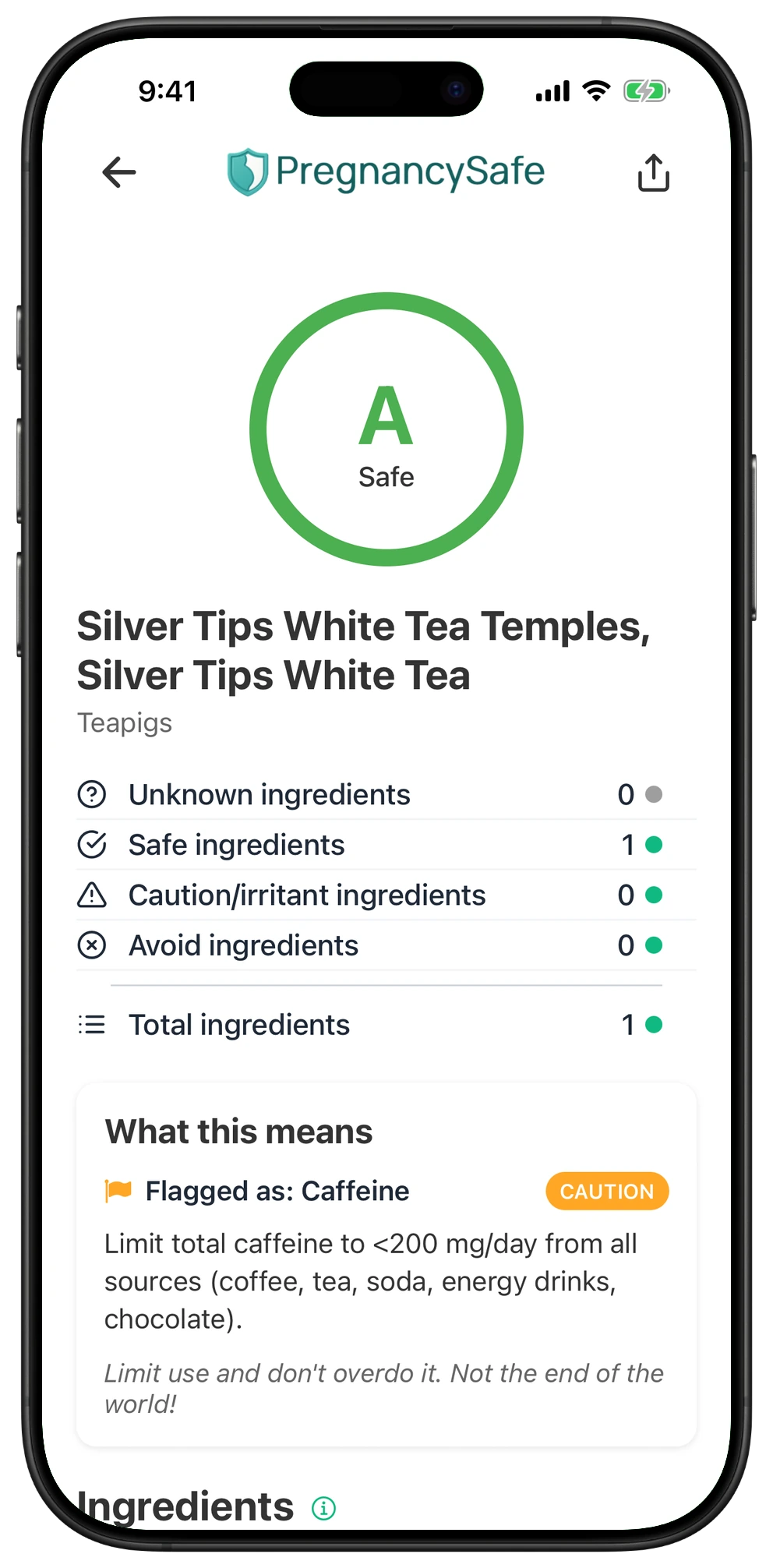
You can drink ordinary brewed white tea during pregnancy while keeping total caffeine below 200 mg per day from all sources. White tea is naturally caffeinated, and its name or leaf type does not reliably tell you how much caffeine your cup contains.
Caffeine is the main pregnancy consideration for white tea: serving size, brew strength, and your other caffeine sources all matter. Ingredient grades do not measure caffeine or certify pregnancy safety. Concentrated white tea extract supplements are not equivalent to brewed tea, and antioxidant content does not establish a pregnancy benefit.
Pregnancy Safe is 100% independent and research driven. No companies pay to promote or sponsor products.
Stress Less This Pregnancy
Check your exact white tea in the app
✓ What's Safe
- • Look for caffeine information for the exact tea and serving size you plan to drink.
- • Choose portions that fit within a total daily caffeine intake below 200 mg, including coffee, other teas, soda, energy drinks, and chocolate.
- • Read the current ingredient list to distinguish plain white tea from blends with additional herbs or extracts.
- • Check servings per bottle when buying ready to drink white tea.
- • Choose ordinary brewed tea rather than assuming concentrated white tea supplements have the same pregnancy considerations.
✗ What to Avoid
- • Avoid treating white tea as a caffeine free herbal infusion.
- • Avoid assuming pale color, a delicate taste, or a particular leaf variety means low caffeine.
- • Avoid a fixed cups per day rule that ignores cup size, brew strength, and other caffeine sources.
- • Avoid counting a multi serving bottle as one serving when calculating caffeine.
- • Avoid using white tea extract supplements as an interchangeable substitute for brewed tea.
- • Avoid relying on antioxidant claims or an A ingredient grade as a pregnancy safety guarantee.
Most Common Ingredients in White Tea Products
We analyzed 4 white tea products. Here are the most common ingredients, ranked by how often they appear:
White Tea Products We've Analyzed
Our catalog contains ratings for 4 white tea products. These are database grades, not independent safety certifications.
Catalog ingredient grades are not pregnancy safety certifications, a check of current labels, or measurements of caffeine, pathogens or handling. Not all candidates were independently reviewed.
Pregnancy Safe White Tea Products
Popular options from our catalog, prioritizing A and B ingredient grades, with C grade options used to fill remaining places. Within each group, products are ordered by searches in Pregnancy Safe, not retail sales. Read the cautions and guidance above; grades do not verify a complete current label or guarantee pregnancy safety.
| Grade | Product | Brand |
|---|---|---|
| A | Silver Tips White Tea Temples, Silver Tips White Tea | Teapigs |
| A | Inko'S Unsweetened Honeysuckle White Tea | Inkos Healthy White Tea |
| A | Inko'S Unsweetened Original White Tea | Inkos Healthy White Tea |
| A | Uncle Lees White Tea | Uncle Lees |
Your Questions Answered
Does white tea have caffeine in it?
Yes, white tea is naturally caffeinated, not a caffeine free herbal infusion. Leaf type alone cannot reliably predict the caffeine in your cup; brew strength and serving size matter. Check information for your exact tea when available and count it toward a daily total below 200 mg.
What teas should you avoid when pregnant?
Avoid drinking amounts of caffeinated tea that bring your total daily caffeine to 200 mg or more. White tea does not need to be excluded solely because it contains caffeine, but the amount matters. Herbal blends need a separate ingredient check rather than being assumed suitable because they are caffeine free. Do not apply guidance for ordinary brewed tea to concentrated extract supplements.
How many cups of white tea can I drink during pregnancy?
There is no reliable universal cup limit because serving sizes and caffeine amounts vary. Start with any caffeine information available for your tea, then account for coffee, other teas, soda, energy drinks, and chocolate. Keep the combined daily total below 200 mg. If the caffeine amount is unknown, do not assume several cups will fit within that limit.
Is white tea lower in caffeine than green or black tea?
You cannot reliably rank your cup's caffeine by tea type alone. White tea should not automatically be treated as the lower caffeine choice. Compare caffeine information for the exact products and serving sizes rather than relying on the words white, green, or black.
Does white tea have special benefits for pregnancy?
White tea's antioxidant content does not establish a benefit for your pregnancy or your baby. It should not be presented as preventing pregnancy complications. If you enjoy it, focus on how its caffeine fits into your day rather than drinking it for an unproven pregnancy benefit.
Do A grades mean every white tea product is verified safe for pregnancy?
No. Our catalog contains four white tea products, all with A ingredient grades, but those grades are not pregnancy safety certifications. They do not measure caffeine, pathogens, or handling, and not every product was independently label reviewed. Check the current label and your total caffeine intake even when a product has an A grade.
How Do We Score Products for Pregnancy Safety?
We analyze each product's ingredients and category to flag known risks and provide cautionary notices for general category safety concerns.
Grades reflect the ingredient and category information available to us. They don’t verify a complete, current label or account for dose, preparation, or contamination. Read them alongside the guidance above, not as a guarantee of pregnancy safety or proof that every use is harmful.
A - Safe
Excellent choice! All ingredients are considered safe during pregnancy.
What to do: Use with confidence.
B - Likely Safe
Pretty much safe with very minimal risk. Some ingredients may have limited pregnancy studies, but no significant safety concerns have been identified.
What to do: Use with confidence.
C - Limit
Contains ingredients with some pregnancy considerations. Research shows these ingredients may have limited safety data, potential for minor hormonal effects, or require caution based on animal studies.
What to do: Use sparingly and consider safer alternatives when available.
D - Caution
Similar to C grade but contains multiple cautionary ingredients. The combination increases overall concern.
What to do: Try to avoid if that makes you feel better. If you've already used it, no need to panic.
F - Avoid
Contains an ingredient Pregnancy Safe recommends avoiding during pregnancy. This may reflect an established risk or a precaution based on limited evidence; check the ingredient guidance and exposure context.
What to do: Do not use during pregnancy. If you've already used it, don't worry - contact your OBGYN if concerned.
People Also Checked
See our full guide to tea during pregnancy.