Best Pregnancy Safe Perfume (Updated 2026 Guide)
Updated September 9, 2026
The Answer
Ordinary occasional perfume use is not established to cause fetal harm; if you choose to wear it, use a small amount with ventilation and stop if it triggers symptoms. Our catalog contains mostly C- and D range ingredient scores, but these are not clinical pregnancy verdicts or a reason to assume every perfume is unsafe.
The main considerations are undisclosed fragrance mixtures, skin allergy or airway irritation, and how much and how often you apply or inhale perfume. Parfum related exposure studies do not prove typical use harms pregnancy, while butylphenyl methylpropional warrants avoidance because of regulatory reproductive toxicity concerns. Evidence from high dose oral animal studies or repeated large area sunscreen application cannot establish the risk of small amounts of perfume.
Pregnancy Safe is 100% independent and research driven. No companies pay to promote or sponsor products.
Stress Less This Pregnancy
Check your exact perfume in the app

✓ What's Safe
- • Check the current ingredient label for the exact perfume and version, rather than relying on scent notes such as musk, woods or citrus.
- • Choose a formula without butylphenyl methylpropional, also called Lilial or BMHCA.
- • Look for ingredient and fragrance allergen disclosures that help you identify substances you already react to.
- • Choose an application format that lets you use a small amount without creating a large spray cloud; format alone does not establish pregnancy safety.
- • Consider skipping perfume and choosing fragrance free everyday toiletries if you want to reduce cumulative fragrance exposure.
✗ What to Avoid
- • Avoid perfume listing butylphenyl methylpropional, Lilial, BMHCA or lysmeral.
- • Avoid repeatedly layering products containing parfum, parfum fragrance or fragrance if your goal is to reduce fragrance exposure; these are related label terms, not proof of phthalate content.
- • Avoid benzyl salicylate if you have a known allergy to it; fragrance allergy is a different concern from fetal harm.
- • Avoid heavy spraying in enclosed spaces, spraying toward your eyes, or continuing use when it causes nausea, headache, asthma symptoms or irritation.
- • Avoid choosing solely by an A grade, a short ingredient list, or clean, natural or alcohol free claims.
- • Avoid treating oral botanical tinctures as perfumes, ingesting fragrance products, or applying perfume to damaged skin.
Most Common Ingredients in Perfume Products
We analyzed 2,130 perfume products. Here are the most common ingredients, ranked by how often they appear:
Ingredients to Watch Out For in Perfume
These are the most common flagged ingredients across 2,130 perfume products we analyzed.
butyl methoxydibenzoylmethane
Caution
Butyl methoxydibenzoylmethane is a chemical compound commonly used as a UVA sunscreen agent to protect the skin from ultraviolet radiation.
Has limited pregnancy specific outcome data and systemic absorption under high use testing, making mineral sunscreen filters the lower uncertainty option when practical.
Also called avobenzone, this UV absorber may appear in perfume formulas. Pregnancy specific outcome data are limited, and absorption findings from repeated large area sunscreen use do not establish harm from small perfume applications. Its presence is a caution, not proof that the perfume harms pregnancy or provides adequate sun protection.
Flagged in 1270 of 2,130 products (60%)
parfum
Caution
Parfum is a fragrant mixture of essential oils, aroma compounds, and solvents used to impart a pleasant scent.
Can hide product specific mixtures and has been associated with higher DEP metabolite exposure in some pregnancy studies; fragrance allergens and VOCs may also irritate sensitive skin or airways.
Parfum is an umbrella label for a perfume's scent mixture, not a single ingredient with a uniform risk. Fragranced product use has been associated with higher DEP metabolite levels in pregnancy studies, but this does not prove every mixture contains phthalates or that ordinary occasional use causes harm. Reduce use if it irritates your skin or airways.
Flagged in 1026 of 2,130 products (48%)
benzyl salicylate
Caution
Benzyl salicylate is a fragrant compound commonly used as a UV filter and scent ingredient in perfumes and cosmetics.
Has limited pregnancy specific human data and weak endocrine mode signals, but regulated low dose cosmetic use has wide safety margins compared with high dose oral salicylates.
Benzyl salicylate is a fragrance allergen and light stabilizer used in perfume. Direct human pregnancy data are lacking, while cosmetic assessments rely on concentration limits and exposure modeling. Normal low dose topical exposure is not equivalent to taking oral salicylate medicines; avoid it if you have a known allergy.
Flagged in 993 of 2,130 products (47%)
ethylhexyl salicylate
Caution
Ethylhexyl salicylate is a UV filter commonly used in sunscreens to protect the skin from harmful ultraviolet rays.
Has limited pregnancy specific safety data and measurable systemic absorption after large area sunscreen use, though normal topical sunscreen exposure is not comparable to oral salicylates.
Also called octisalate, this UVB filter can appear in cosmetic formulas, including perfume. Pregnancy specific outcome data are lacking, and systemic absorption measured after large area sunscreen use does not establish the risk of small perfume applications. It should not be equated with oral aspirin or high dose topical methyl salicylate.
Flagged in 789 of 2,130 products (37%)
ethylhexyl methoxycinnamate
Caution
Ethylhexyl methoxycinnamate is a chemical compound commonly used as a UV filter in sunscreens to protect the skin from harmful ultraviolet rays.
Has measurable dermal absorption and endocrine active signals, with limited direct pregnancy outcome data, so mineral or lower absorption sunscreen filters are preferred when practical.
Also called octinoxate, this UVB filter has limited direct human pregnancy outcome data. Absorption studies and endocrine or developmental findings from high dose animal exposure support uncertainty, not a conclusion that ordinary perfume use causes fetal harm. A perfume application is not interchangeable with the exposures studied in sunscreen testing.
Flagged in 644 of 2,130 products (30%)
parfum fragrance
Caution
A parfum fragrance is a concentrated aromatic blend designed to impart a pleasing and lasting scent when applied to the skin or clothing.
Can hide product specific mixtures and has been associated with higher DEP metabolite exposure in some pregnancy studies; fragrance allergens and VOCs may also irritate sensitive skin or airways.
Parfum fragrance is another label expression for a scent mixture, not a separate chemical from fragrance or parfum. It does not disclose every component or establish phthalate content. In perfume, the practical considerations are mixture uncertainty, cumulative use, and skin or airway sensitivity rather than proven fetal harm from occasional application.
Flagged in 540 of 2,130 products (25%)
fragrance
Caution
A fragrant substance used to add a pleasant aroma to products or environments.
Can hide product specific mixtures and has been associated with higher DEP metabolite exposure in some pregnancy studies; fragrance allergens and VOCs may also irritate sensitive skin or airways.
Fragrance describes the scent blend in perfume and may leave its individual chemicals undisclosed. Some fragranced product exposure studies report higher phthalate metabolite levels, but they cannot establish the contents or pregnancy risk of your specific bottle. Using less or going without perfume can reduce exposure without treating previous normal use as an emergency.
Flagged in 443 of 2,130 products (21%)
bht
Caution
BHT (butylated hydroxytoluene) is a synthetic antioxidant commonly used as a preservative to prevent the oxidation of fats and oils in food products.
Has limited human pregnancy data, with low concern at reviewed cosmetic levels but reproductive and thyroid related findings in high dose oral animal studies.
BHT is an antioxidant that helps stabilize perfume formulas. Direct human pregnancy data are limited, but reviewed cosmetic concentrations are considered low concern. Reproductive findings from high dose oral animal studies should not be presented as evidence that low dose topical perfume exposure causes the same effects.
Flagged in 442 of 2,130 products (21%)
How Do Perfume Products Stack Up?
Our catalog contains ratings for 2,130 perfume products. These are database grades, not independent safety certifications.
Catalog ingredient scores are not clinical pregnancy verdicts or independent current-label/contaminant checks. Unreviewed, mixed-route or incompletely sourced records can affect counts. Follow exact product form, active ingredients, exposure and directions rather than choosing solely by grade.
Best Pregnancy Safe Perfume
Popular options from our catalog, prioritizing A and B ingredient grades, with C grade options used to fill remaining places. Within each group, products are ordered by searches in Pregnancy Safe, not retail sales. Read the cautions and guidance above; grades do not verify a complete current label or guarantee pregnancy safety.
| Grade | Product | Brand |
|---|---|---|
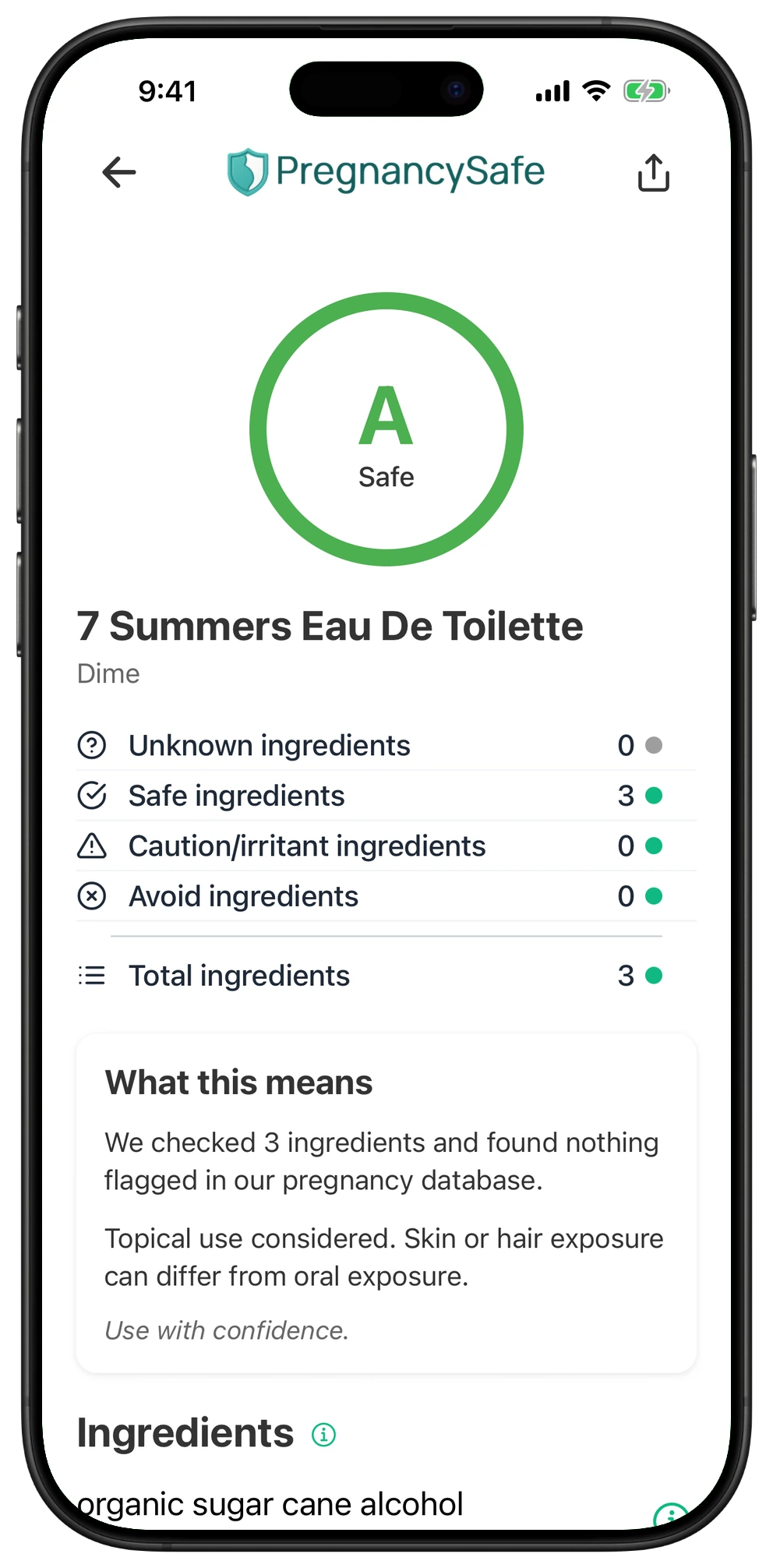
| A | 7 Summers Eau De Toilette | Dime |
| B+ | Clinique Happy Heart Perfume Spray | Clinique Happy Heart |
| A | Cosmopolitan Eau De Juice Pure Sugar Eau De Parfum | Cosmopolitan |
| A | Op Summer Breeze Eau De Parfum Spray | Ocean Pacific |
| B+ | Hypnose By Lancome Perfume For Women | Hypnose By Lancome |
Your Questions Answered
Is perfume safe during pregnancy?
Ordinary occasional topical use is not established to cause fetal harm, but that does not mean every fragrance mixture has been studied in pregnancy. If you wear perfume, use a small amount with ventilation and avoid your eyes or damaged skin. Stop or reduce use if it triggers nausea, headache, irritation or asthma symptoms. Avoid formulas listing butylphenyl methylpropional.
What scents should I avoid when pregnant?
A scent description such as floral, musk or citrus cannot tell you whether a perfume is suitable during pregnancy. Check the actual ingredient label for butylphenyl methylpropional, also known as Lilial or BMHCA, and avoid products containing it. Also avoid scents that trigger your nausea, headaches, skin reactions or asthma. Natural fragrance and essential oil claims do not establish pregnancy safety.
Does perfume smell affect babies?
Smelling perfume during pregnancy does not by itself show that your developing baby has been harmed. Some studies associate fragranced product use with higher levels of a phthalate metabolite, but they do not establish that every perfume contains phthalates or that an occasional smell causes fetal harm. Strong fragrance can still trigger symptoms for you, so reduce exposure and ventilate the space if it bothers you. Direct exposure of a baby after birth is a separate situation and should not be judged from pregnancy exposure evidence.
Are alcohol free or natural perfumes safer during pregnancy?
Neither label is a pregnancy safety guarantee. Normal topical perfume use is not equivalent to drinking alcohol, and removing alcohol does not resolve uncertainty about the fragrance mixture. Botanical ingredients also need to be assessed by their identity, concentration and exposure route. Make sure an alcohol free botanical product is actually intended as a cosmetic perfume rather than an oral tincture.
Does parfum on the label mean a perfume contains phthalates?
No. Parfum, fragrance and parfum fragrance describe scent mixtures rather than a single chemical or a declaration of phthalate content. These terms may leave individual components undisclosed, so they cannot prove either the presence or absence of a particular phthalate. Reducing how many fragranced products you use is an optional exposure reduction step, not an indication that previous ordinary use caused harm.
Can I choose a pregnancy safe perfume by its grade?
Use grades as ingredient screening information, not pregnancy certification. Our catalog contains 2,130 records, including 13 with an A grade, but those are not 13 independently verified safe perfumes. Some records describe scent notes rather than complete cosmetic labels, and some concern oral tinctures rather than perfume. The listed products are catalog comparison options, not independently label verified perfumes; incomplete information is not proof of harm.
How Do We Score Products for Pregnancy Safety?
We analyze each product's ingredients and category to flag known risks and provide cautionary notices for general category safety concerns.
Grades reflect the ingredient and category information available to us. They don’t verify a complete, current label or account for dose, preparation, or contamination. Read them alongside the guidance above, not as a guarantee of pregnancy safety or proof that every use is harmful.
A - Safe
Excellent choice! All ingredients are considered safe during pregnancy.
What to do: Use with confidence.
B - Likely Safe
Pretty much safe with very minimal risk. Some ingredients may have limited pregnancy studies, but no significant safety concerns have been identified.
What to do: Use with confidence.
C - Limit
Contains ingredients with some pregnancy considerations. Research shows these ingredients may have limited safety data, potential for minor hormonal effects, or require caution based on animal studies.
What to do: Use sparingly and consider safer alternatives when available.
D - Caution
Similar to C grade but contains multiple cautionary ingredients. The combination increases overall concern.
What to do: Try to avoid if that makes you feel better. If you've already used it, no need to panic.
F - Avoid
Contains an ingredient Pregnancy Safe recommends avoiding during pregnancy. This may reflect an established risk or a precaution based on limited evidence; check the ingredient guidance and exposure context.
What to do: Do not use during pregnancy. If you've already used it, don't worry - contact your OBGYN if concerned.
People Also Checked
References
- https://www.fda.gov/cosmetics/resources-consumers-cosmetics/cosmetics-pregnancy
- https://www.fda.gov/drugs/understanding-over-counter-medicines/sunscreen-how-help-protect-your-skin-sun
- https://www.fda.gov/drugs/understanding-over-counter-medicines/questions-and-answers-fda-posts-deemed-final-order-and-proposed-order-over-counter-sunscreen
- https://www.aad.org/public/everyday-care/skin-care-secrets/routine/pregnancy-skin-care
- https://www.aad.org/media/stats-sunscreen
- https://mothertobaby.org/baby-blog/screening-your-sunscreen-during-pregnancy/
- https://pmc.ncbi.nlm.nih.gov/articles/PMC6990686/
- https://pubmed.ncbi.nlm.nih.gov/40910486/
- https://pmc.ncbi.nlm.nih.gov/articles/PMC11984416/
- https://pmc.ncbi.nlm.nih.gov/articles/PMC12317922/
- https://www.fda.gov/cosmetics/cosmetic-ingredients/fragrances-cosmetics
- https://www.fda.gov/cosmetics/cosmetic-ingredients/phthalates-cosmetics
- https://www.fda.gov/cosmetics/cosmetic-ingredients/allergens-cosmetics
- https://pmc.ncbi.nlm.nih.gov/articles/PMC3110684/
- https://pmc.ncbi.nlm.nih.gov/articles/PMC4016195/
- https://pmc.ncbi.nlm.nih.gov/articles/PMC4097177/
- https://pmc.ncbi.nlm.nih.gov/articles/PMC8453372/
- https://pmc.ncbi.nlm.nih.gov/articles/PMC10999525/
- https://www.epa.gov/indoor-air-quality-iaq/volatile-organic-compounds-impact-indoor-air-quality
- https://health.ec.europa.eu/system/files/2023-11/sccs_o_277.pdf
- https://eur-lex.europa.eu/legal-content/EN/TXT/HTML/?uri=OJ%3AL_202600909
- https://pmc.ncbi.nlm.nih.gov/articles/PMC10955127/
- https://pubmed.ncbi.nlm.nih.gov/29410076/
- https://www.cir-safety.org/sites/default/files/bensal042019FR.pdf
- https://health.ec.europa.eu/system/files/2023-06/sccs_o_268.pdf
- https://ec.europa.eu/health/scientific_committees/consumer_safety/opinions/sccnfp_opinions_97_04/sccp_out26_en.htm
- https://www.cir-safety.org/sites/default/files/salicy042019FAR.pdf
- https://pmc.ncbi.nlm.nih.gov/articles/PMC11402844/
- https://pmc.ncbi.nlm.nih.gov/articles/PMC5744631/
- https://mothertobaby.org/baby-blog/national-safety-month-can-beauty-products-in-my-bathroom-be-bad-for-baby/
- https://health.ec.europa.eu/document/download/3166a978-06de-4526-b25e-8d5a66943a2e_en?filename=sccs_o_294.pdf
- https://www.tga.gov.au/sites/default/files/2025-04/safety-review-seven-active-sunscreen-ingredients.pdf
- https://pubmed.ncbi.nlm.nih.gov/31961417/
- https://pubmed.ncbi.nlm.nih.gov/15191542/
- https://www.ncbi.nlm.nih.gov/books/NBK581587/
- https://pubmed.ncbi.nlm.nih.gov/32108942/
- https://pubmed.ncbi.nlm.nih.gov/40212279/
- https://health.ec.europa.eu/publications/sccs-opinion-ethylhexyl-methoxycinnamate-ehmc-cas-no-5466-77-383834-59-7-ec-no-226-775-7629-661-9_en
- https://www.federalregister.gov/documents/2019/02/26/2019-03019/sunscreen-drug-products-for-over-the-counter-human-use
- https://pubmed.ncbi.nlm.nih.gov/26151237/
- https://pubmed.ncbi.nlm.nih.gov/31195281/
- https://pubmed.ncbi.nlm.nih.gov/35767664/
- https://pubmed.ncbi.nlm.nih.gov/15833384/
- https://pubmed.ncbi.nlm.nih.gov/21059369/
- https://health.ec.europa.eu/system/files/2022-08/sccs_o_257.pdf
- https://pubmed.ncbi.nlm.nih.gov/37751543/
- https://pubmed.ncbi.nlm.nih.gov/12396675/
- https://pmc.ncbi.nlm.nih.gov/articles/PMC13151845/
- https://www.ecfr.gov/current/title-21/chapter-I/subchapter-B/part-172/subpart-B/section-172.115
- https://www.ecfr.gov/current/title-21/chapter-I/subchapter-B/part-182/subpart-D/section-182.3173
- https://www.fda.gov/news-events/press-announcements/fda-finalizes-food-chemical-safety-post-market-assessment-program-launches-reassessment-bht-ada
- https://www.canada.ca/en/health-canada/services/chemicals-product-safety/lilial.html
- https://www.canada.ca/en/environment-climate-change/services/evaluating-existing-substances/draft-assessment-phenylpropanoids-aldehydes-group.html
- https://health.ec.europa.eu/publications/safety-butylphenyl-methylpropional-p-bmhca-cosmetic-products-submission-ii_en
- https://eur-lex.europa.eu/legal-content/EN/TXT/PDF/?uri=CELEX%3A32021R1902
- https://chem.echa.europa.eu/100.001.173/harmonised/113759
- https://chem.echa.europa.eu/obligation-lists/candidateList
- https://pubmed.ncbi.nlm.nih.gov/32461162/
- https://www.nccih.nih.gov/health/bitter-orange
- https://www.ncbi.nlm.nih.gov/books/NBK501892/
- https://pubmed.ncbi.nlm.nih.gov/21594979/
- https://pubmed.ncbi.nlm.nih.gov/28058460/
- https://www.bfr.bund.de/cm/349/health-assessment-of-sports-and-weight-loss-products-containing-synephrine-and-caffeine.pdf
- https://www.rivm.nl/bibliotheek/rapporten/2017-0069.pdf
- https://www.canada.ca/en/health-canada/services/drugs-health-products/natural-non-prescription/legislation-guidelines/guidance-documents/notice-use-synephrine.html