Is Oysters Safe During Pregnancy? (Updated 2026 Guide)
Updated September 9, 2026
The Answer
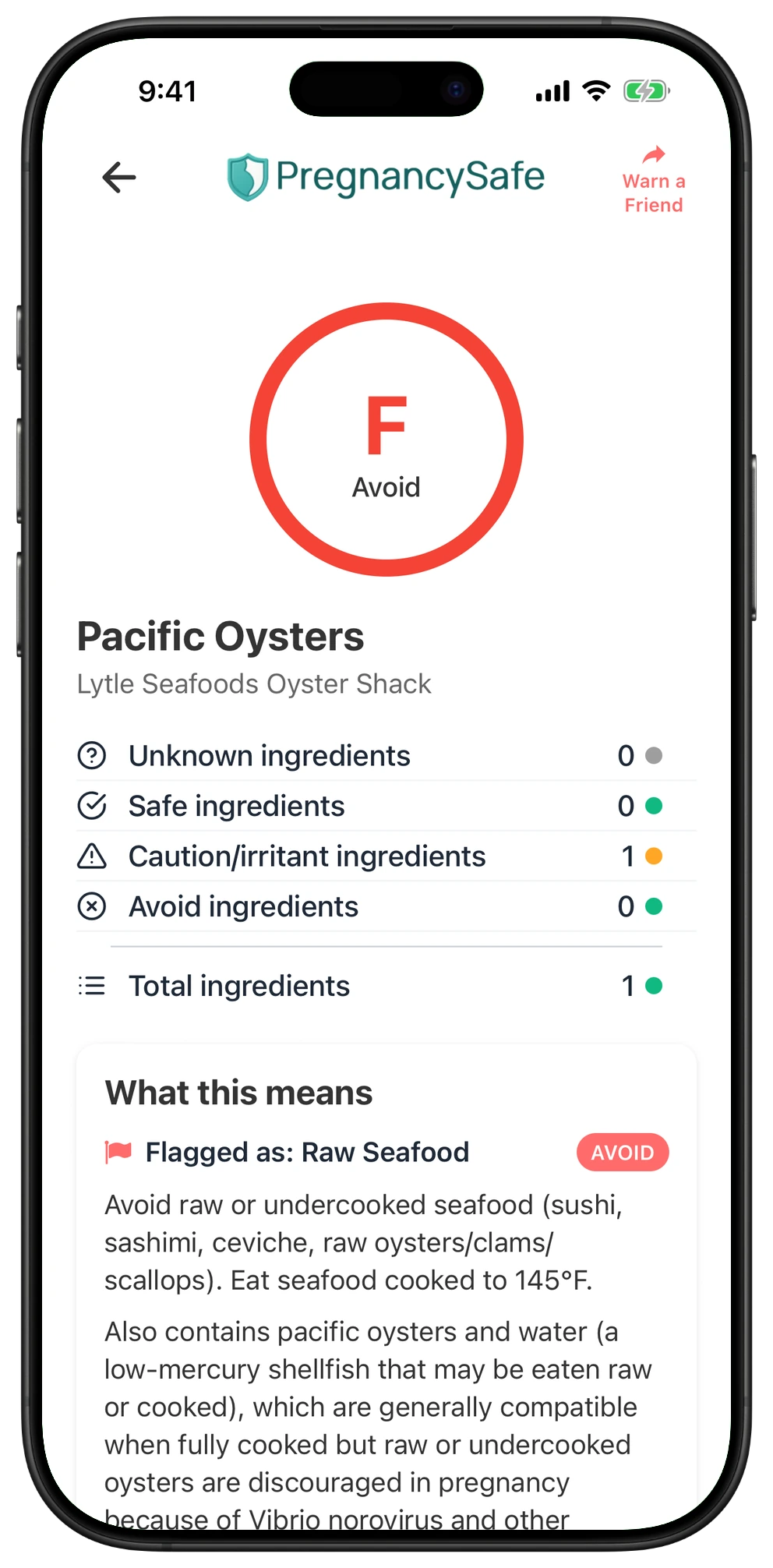
Yes fully cooked oysters can be a low mercury seafood choice during pregnancy, but avoid raw or undercooked oysters because of foodborne infection risks. Commercially canned oysters differ from raw oysters; check the actual package and follow preparation and storage instructions.
The main concern is preparation: raw or undercooked oysters can carry Vibrio bacteria, norovirus and other pathogens, and sauces or alcohol do not sterilize them. Choose properly cooked oysters from regulated harvest sources rather than judging safety by an ingredient grade. Fennel seed used as ordinary seasoning is low concern; concerns about concentrated medicinal fennel preparations do not establish harm from culinary amounts in an oyster dish.
Pregnancy Safe is 100% independent and research driven. No companies pay to promote or sponsor products.
Stress Less This Pregnancy
Check your exact oysters in the app

✓ What's Safe
- • Choose fully cooked oysters; follow cooking instructions and the seafood cooking temperature of 145°F.
- • Buy from reputable sellers using regulated harvest sources, and follow refrigeration and storage instructions.
- • Check canned oyster packaging for processing, preparation and storage directions rather than inferring these from the product name.
- • For smoked oysters, check whether they are commercially canned or refrigerated; the word smoked alone does not establish safe preparation.
- • At restaurants, ask whether the oysters are fully cooked throughout, not simply warmed or briefly grilled.
✗ What to Avoid
- • Avoid raw or undercooked oysters, including raw half shell servings.
- • Do not rely on lemon juice, hot sauce or alcohol to make raw oysters safe.
- • Avoid refrigerated smoked seafood unless it is cooked in a dish; do not treat it as equivalent to commercially canned oysters.
- • Skip oysters when you cannot confirm their harvest source, storage conditions or preparation.
- • Do not use an F grade as proof that cooked or commercially canned oysters are unsafe, or a higher grade as permission to eat them raw.
Most Common Ingredients in Oysters Products
We analyzed 19 oysters products. Here are the most common ingredients, ranked by how often they appear:
Ingredients to Watch Out For in Oysters
These are the most common flagged ingredients across 19 oysters products we analyzed.
oysters
Caution
Oysters are bivalve mollusks with a briny, savory flavor, often enjoyed raw or cooked as a delicacy.
Are generally compatible when fully cooked but raw or undercooked oysters are discouraged in pregnancy because of Vibrio norovirus and other foodborne illness risk.
Flagged in 8 of 19 products (42%)
pacific oysters
Caution
Pacific oysters are briny, plump shellfish known for their delicate flavor and smooth, velvety texture.
Are generally compatible when fully cooked but raw or undercooked oysters are discouraged in pregnancy because of Vibrio norovirus and other foodborne illness risk.
Flagged in 3 of 19 products (16%)
pacific oysters and water
Caution
Fresh Pacific oysters served with pure, mineral rich water.
Are generally compatible when fully cooked but raw or undercooked oysters are discouraged in pregnancy because of Vibrio norovirus and other foodborne illness risk.
Flagged in 3 of 19 products (16%)
whole oysters
Caution
Fresh, briny whole oysters are mollusks with a smooth, firm interior, prized for their delicate flavor and creamy texture.
Are generally compatible when fully cooked but raw or undercooked oysters are discouraged in pregnancy because of Vibrio norovirus and other foodborne illness risk.
Flagged in 2 of 19 products (11%)
Caution
Fennel seed is a aromatic spice with a sweet, licorice like flavor commonly used to enhance savory dishes and digestive remedies.
Is generally low concern at normal culinary amounts but should be avoided as concentrated medicinal tea, essential oil, or supplement during pregnancy because safety data are limited and estrogenic or uterine concerns exist.
Flagged in 1 of 19 products (5%)
raw pacific oysters
Caution
Fresh, briny Pacific oysters are succulent, raw shellfish known for their delicate flavor and smooth, velvety texture.
Are generally compatible when fully cooked but raw or undercooked oysters are discouraged in pregnancy because of Vibrio norovirus and other foodborne illness risk.
Flagged in 1 of 19 products (5%)
smoked oysters
Caution
Smoked oysters are tender, briny shellfish infused with a rich smoky flavor, often enjoyed as a savory snack or gourmet ingredient.
Are generally compatible when fully cooked but raw or undercooked oysters are discouraged in pregnancy because of Vibrio norovirus and other foodborne illness risk.
Flagged in 1 of 19 products (5%)
Oysters Products We've Analyzed
Our catalog contains ratings for 19 oysters products. These are database grades, not independent safety certifications.
Grades are ingredient scores, not clinical verdicts or measurements of pathogens, dose, preparation or current package contents. Cohorts include unreviewed catalog records and counts are not independently verified safe-product totals.
Your Questions Answered
Can you eat oysters during pregnancy?
Yes, when they are fully cooked and properly sourced and stored. Avoid raw or undercooked oysters because they can carry foodborne pathogens. Their low mercury content does not remove the infection risk from eating them raw.
Are canned or smoked oysters safe during pregnancy?
Commercially canned oysters differ from raw oysters and can be an option when you follow the package directions. Smoked oysters require a closer check because smoking alone does not establish how they were processed. Avoid refrigerated smoked seafood unless it is cooked in a dish. Verify the actual package rather than relying on a name or ingredient grade.
How should you cook oysters during pregnancy?
Cook oysters thoroughly, following preparation instructions and the seafood cooking temperature of 145°F. Grilled, baked or fried describes a method, not a guarantee that the oysters are fully cooked throughout. At a restaurant, ask specifically about doneness. Keep sourcing and storage in mind as well as cooking.
Are oysters high in mercury?
No oysters are a low mercury seafood choice, and FDA/EPA fish advice lists them as a Best Choice. They can provide protein, zinc, iodine and omega-3 fats. During pregnancy, the key distinction is still cooked versus raw: low mercury does not mean raw oysters are safe.
What seafood to avoid during pregnancy?
Avoid raw or undercooked seafood, including raw oysters, clams, scallops, sushi, sashimi and ceviche. Acidic marinades do not substitute for cooking. For oysters, choose fully cooked preparations or appropriately processed commercially canned forms and follow storage directions.
What if I accidentally ate raw shrimp while pregnant?
Raw shrimp, like raw oysters, is an exposure to avoid during pregnancy because of foodborne infection risk. Eating it does not establish that you have an infection. If you feel unwell afterward or are concerned about the exposure, contact your pregnancy care team and explain what you ate and when. Choose fully cooked seafood going forward.
Why do so many oyster listings have an F grade?
Our catalog contains 19 listings: 17 graded F and two graded C+. These grades are ingredient scores, not measurements of pathogens, cooking, processing or current package contents. They do not establish that every F graded oyster product is unsafe, and the catalog counts are not independently verified safety totals. Check the actual preparation and package instructions before deciding what to eat.
How Do We Score Products for Pregnancy Safety?
We analyze each product's ingredients and category to flag known risks and provide cautionary notices for general category safety concerns.
Grades reflect the ingredient and category information available to us. They don’t verify a complete, current label or account for dose, preparation, or contamination. Read them alongside the guidance above, not as a guarantee of pregnancy safety or proof that every use is harmful.
A - Safe
Excellent choice! All ingredients are considered safe during pregnancy.
What to do: Use with confidence.
B - Likely Safe
Pretty much safe with very minimal risk. Some ingredients may have limited pregnancy studies, but no significant safety concerns have been identified.
What to do: Use with confidence.
C - Limit
Contains ingredients with some pregnancy considerations. Research shows these ingredients may have limited safety data, potential for minor hormonal effects, or require caution based on animal studies.
What to do: Use sparingly and consider safer alternatives when available.
D - Caution
Similar to C grade but contains multiple cautionary ingredients. The combination increases overall concern.
What to do: Try to avoid if that makes you feel better. If you've already used it, no need to panic.
F - Avoid
Contains an ingredient Pregnancy Safe recommends avoiding during pregnancy. This may reflect an established risk or a precaution based on limited evidence; check the ingredient guidance and exposure context.
What to do: Do not use during pregnancy. If you've already used it, don't worry - contact your OBGYN if concerned.
References
- https://www.fda.gov/food/people-risk-foodborne-illness/eating-out-bringing-food-safety-moms-be
- https://www.fda.gov/food/consumers/advice-about-eating-fish
- https://www.fda.gov/food/people-risk-foodborne-illness/cooking-food-safety-moms-be
- https://www.cdc.gov/listeria/prevention/index.html
- https://www.foodsafety.gov/people-at-risk/pregnant-women
- https://www.fda.gov/food/people-risk-foodborne-illness/meat-poultry-seafood-food-safety-moms-be
- https://www.cdc.gov/vibrio/prevention/index.html
- https://www.cdc.gov/norovirus/about/index.html
- https://hfpappexternal.fda.gov/scripts/fdcc/index.cfm?id=FENNELCOMMON&set=FoodSubstances
- https://www.ema.europa.eu/en/documents/herbal-monograph/final-european-union-herbal-monograph-foeniculum-vulgare-miller-subsp-vulgare-var-dulce-mill-batt-trab-fructus-revision-1_en.pdf
- https://webprod.hc-sc.gc.ca/nhpid-bdipsn/dbImages/mono_fennel-sweet_english.pdf
- https://www.swissmedic.ch/swissmedic/en/home/news/mitteilungen/fencheltee-fuer-schwangere-kinder-unter-4-jahren.html
- https://www.efsa.europa.eu/en/news/have-your-say-estragole-fennel-seed-preparations
- https://www.ncbi.nlm.nih.gov/books/NBK501793/
- https://pubmed.ncbi.nlm.nih.gov/30969204/
- https://pubmed.ncbi.nlm.nih.gov/32733750/
- https://pubmed.ncbi.nlm.nih.gov/23275017/
- https://www.utep.edu/herbal-safety/populations/herbs-to-avoid-during-pregnancy.html