Is Mayonnaise Safe During Pregnancy? (Updated 2026 Guide)
Updated September 9, 2026
The Answer
Yes commercial mayonnaise made with pasteurized eggs can be suitable during pregnancy when stored correctly after opening. Choose based on egg pasteurization and handling, not catalog grades, which mainly fall in the A and B+ ranges.
Your main consideration is egg pasteurization and safe handling, especially with homemade or restaurant mayonnaise. Suitable mayonnaise does not make the surrounding meal safe: CDC advises avoiding premade deli salads during pregnancy. Ingredient concerns also depend on amount and form; ordinary calcium disodium edta is not automatically a fetal toxicity concern, and concentrated herbal supplement evidence should not be applied to normal condiment portions.
Pregnancy Safe is 100% independent and research driven. No companies pay to promote or sponsor products.
Stress Less This Pregnancy
Check your exact mayonnaise in the app

✓ What's Safe
- • Choose commercial mayonnaise whose label or manufacturer confirms the eggs are pasteurized.
- • Check the exact version you are buying rather than assuming every flavor or size has the same formulation.
- • For homemade mayonnaise, use pasteurized eggs and follow safe preparation and cold storage practices.
- • At restaurants, ask whether the mayonnaise is commercially prepared or house made and whether its eggs are pasteurized.
- • Follow the package instructions for refrigeration after opening and storage duration.
✗ What to Avoid
- • Avoid homemade or restaurant mayonnaise made with raw, unpasteurized eggs; if the egg source cannot be confirmed, choose another condiment.
- • Avoid opened mayonnaise that has not been stored according to its refrigeration instructions.
- • Avoid premade deli salads, including chicken, tuna and potato salads, even when their mayonnaise uses pasteurized eggs.
- • Do not assume labels such as organic, gourmet or freshly made confirm egg pasteurization.
- • Do not use an A grade or a short ingredient list as a substitute for checking preparation and storage.
Most Common Ingredients in Mayonnaise Products
We analyzed 899 mayonnaise products. Here are the most common ingredients, ranked by how often they appear:
Ingredients to Watch Out For in Mayonnaise
These are the most common flagged ingredients across 899 mayonnaise products we analyzed.
high fructose corn syrup
Caution
High fructose corn syrup is a sweet, liquid sweetener made from corn starch, commonly used in processed foods and beverages.
Is not a known teratogen at occasional food amounts, but high added sugar intake can displace nutrients and raise gestational diabetes and metabolic concerns.
Flagged in 38 of 899 products (4%)
cold pressed flaxseed oil
Caution
Has limited pregnancy specific safety data; normal food amounts are lower concern but concentrated supplements warrant caution.
Flagged in 5 of 899 products (1%)
kombu seaweed
Caution
Kombu seaweed is a nutrient rich, dark green kelp commonly used in Japanese cuisine to enhance umami flavor and make broths.
Can contain highly variable iodine, with high dose brown seaweed or kelp products and hijiki arsenic exposure requiring caution in pregnancy.
Flagged in 3 of 899 products (0%)
white wine
Avoid
White wine is a crisp, pale yellow alcoholic beverage made from fermented white grapes, often used to enhance the flavor of dishes or enjoyed on its own.
Has no established safe amount in pregnancy and is linked to fetal alcohol spectrum disorders and other adverse pregnancy outcomes.
Flagged in 3 of 899 products (0%)
horseradish
Caution
Horseradish is a pungent root vegetable known for its sharp, spicy flavor often used to add heat to sauces and condiments.
Is generally compatible at normal condiment amounts but should be avoided in medicinal products or large regular doses due to limited pregnancy data and possible uterine and irritant effects.
Flagged in 2 of 899 products (0%)
horseradish mustard powder blend horseradish
Caution
A spicy and tangy blend of horseradish and mustard powder, perfect for adding heat and flavor to dishes.
Is generally compatible at normal condiment amounts but should be avoided in medicinal products or large regular doses due to limited pregnancy data and possible uterine and irritant effects.
Flagged in 2 of 899 products (0%)
organic fennel
Caution
Organic fennel is a fragrant, crunchy vegetable with a mild licorice flavor, often used to add freshness and depth to salads, soups, and dishes.
Is generally low concern at normal culinary amounts but should be avoided as concentrated medicinal tea, essential oil, or supplement during pregnancy because safety data are limited and estrogenic or uterine concerns exist.
Flagged in 2 of 899 products (0%)
organic fenugreek
Caution
Organic fenugreek is a nutrient rich herb known for its aromatic seeds, commonly used to enhance flavor and support digestion.
Is generally lower concern in normal food amounts but medicinal doses are not recommended in pregnancy due to limited data plus uterine stimulant and reproductive toxicity signals.
Flagged in 2 of 899 products (0%)
Mayonnaise Products We've Analyzed
Our catalog contains ratings for 899 mayonnaise products. These are database grades, not independent safety certifications.
Grades are catalog ingredient scores, not measurements of current labels, preparation, pathogens, dose or clinical pregnancy suitability. Unreviewed products remain in the aggregate counts.
Pregnancy Safe Mayonnaise Products
Popular options from our catalog, prioritizing A and B ingredient grades, with C grade options used to fill remaining places. Within each group, products are ordered by searches in Pregnancy Safe, not retail sales. Read the cautions and guidance above; grades do not verify a complete current label or guarantee pregnancy safety.
| Grade | Product | Brand |
|---|---|---|
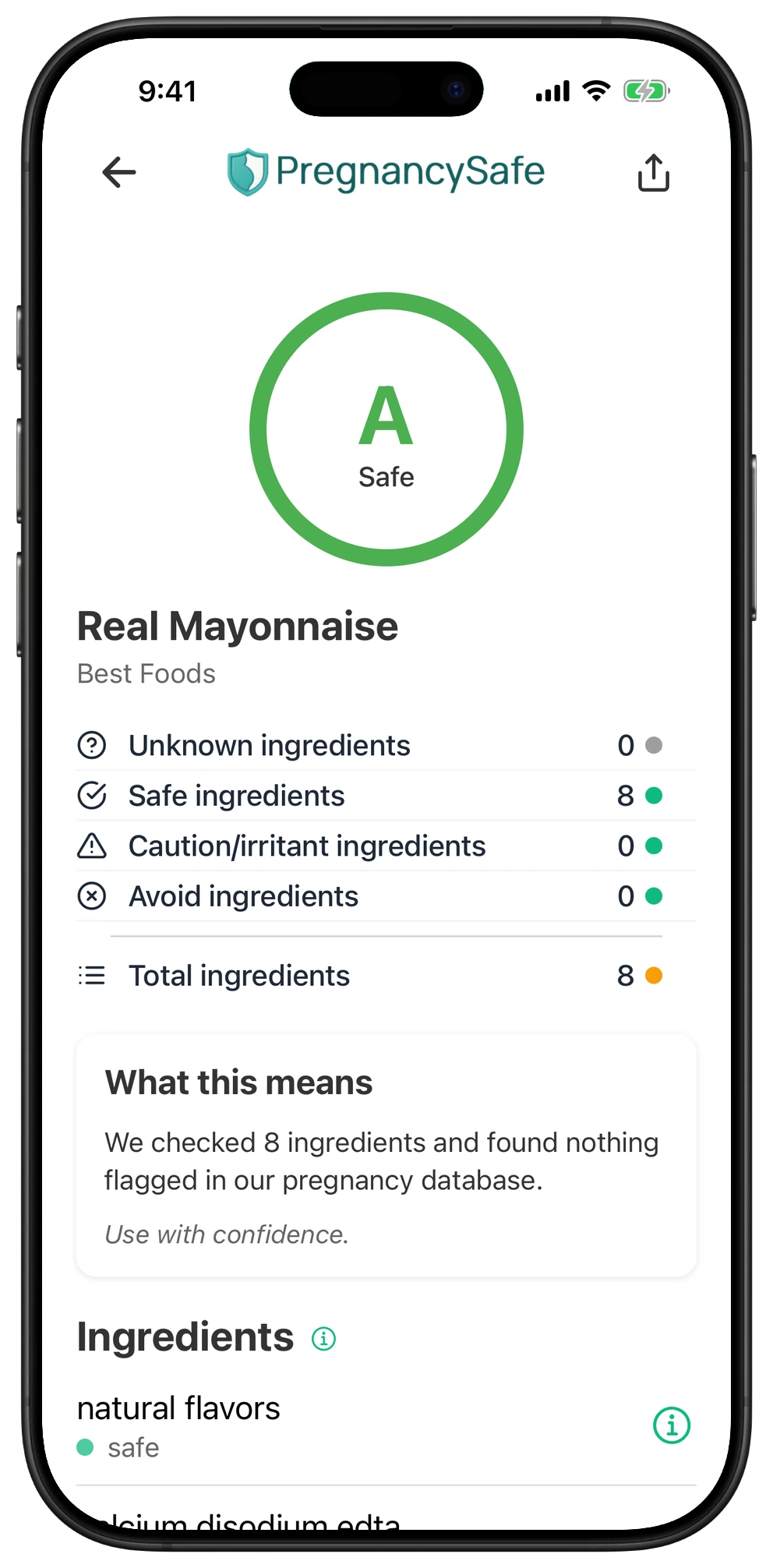
| A | Real Mayonnaise | Best Foods |
| A | Real Mayonnaise | Hellmann'S |
| A | Classic Mayo | Chosen Foods |
| A | Hellmann'S Mayonnaise Real | Hellmann'S |
| A | Hellmans Mayonnaise | Hellmann'S |
Your Questions Answered
Is mayonnaise pasteurized?
The useful question is whether the eggs used to make it are pasteurized. Commercial mayonnaise made with pasteurized eggs can be suitable during pregnancy, but you should confirm the exact product through its label or manufacturer. Homemade and restaurant mayonnaise may use different eggs, so do not assume the same answer applies.
Can I eat homemade or restaurant mayonnaise while pregnant?
Choose mayonnaise made with pasteurized eggs and handled safely. At a restaurant, ask whether it is house made and what eggs are used. If staff cannot confirm pasteurized eggs, choosing another condiment avoids that uncertainty. For homemade mayonnaise, pasteurized eggs do not remove the need for safe preparation and refrigeration.
Can I eat chicken or tuna salad if it contains commercial mayonnaise?
Commercial mayonnaise does not guarantee that the other ingredients or finished salad were handled safely. CDC advises avoiding premade deli salads during pregnancy, including chicken and tuna salads. For food you prepare yourself, consider the safety of every ingredient and its preparation and storage, rather than checking only the mayonnaise.
How should I store mayonnaise during pregnancy?
Follow the exact package instructions, including refrigeration after opening and any stated storage duration. Keep homemade mayonnaise refrigerated and pay attention to how restaurant mayonnaise is stored and served. Pasteurized eggs do not make poor storage harmless.
Should I avoid mayonnaise containing EDTA, herbs or flaxseed oil?
Ordinary calcium disodium edta in mayonnaise is not automatically a fetal toxicity concern. Horseradish, fennel and fenugreek used as culinary flavorings are different exposures from medicinal preparations or concentrated supplements. Cold pressed flaxseed oil in normal food amounts is also a different exposure from capsules or spoonful dose supplementation, for which pregnancy safety evidence is limited. An ingredient flag alone does not establish that a normal serving of mayonnaise is harmful.
What do mayonnaise grades tell me about pregnancy safety?
Our catalog contains 899 mayonnaise products, including 644 graded A and 192 graded B+. These are ingredient scores, not confirmation of current labels, pasteurization, pathogen testing or safe storage. The counts include products that have not received an individual label review, and a lower grade does not automatically mean a product is unsafe during pregnancy. Use the grades as additional ingredient information, not as a clinical safety verdict.
How Do We Score Products for Pregnancy Safety?
We analyze each product's ingredients and category to flag known risks and provide cautionary notices for general category safety concerns.
Grades reflect the ingredient and category information available to us. They don’t verify a complete, current label or account for dose, preparation, or contamination. Read them alongside the guidance above, not as a guarantee of pregnancy safety or proof that every use is harmful.
A - Safe
Excellent choice! All ingredients are considered safe during pregnancy.
What to do: Use with confidence.
B - Likely Safe
Pretty much safe with very minimal risk. Some ingredients may have limited pregnancy studies, but no significant safety concerns have been identified.
What to do: Use with confidence.
C - Limit
Contains ingredients with some pregnancy considerations. Research shows these ingredients may have limited safety data, potential for minor hormonal effects, or require caution based on animal studies.
What to do: Use sparingly and consider safer alternatives when available.
D - Caution
Similar to C grade but contains multiple cautionary ingredients. The combination increases overall concern.
What to do: Try to avoid if that makes you feel better. If you've already used it, no need to panic.
F - Avoid
Contains an ingredient Pregnancy Safe recommends avoiding during pregnancy. This may reflect an established risk or a precaution based on limited evidence; check the ingredient guidance and exposure context.
What to do: Do not use during pregnancy. If you've already used it, don't worry - contact your OBGYN if concerned.
People Also Checked
References
- https://www.cdc.gov/listeria/prevention/index.html
- https://www.nhs.uk/pregnancy/keeping-well/foods-to-avoid/
- https://cdn.realfood.gov/DGA.pdf
- https://www.dietaryguidelines.gov/sites/default/files/2021-12/DGA_Pregnancy_FactSheet-508c.pdf
- https://www.acog.org/womens-health/faqs/healthy-eating-during-pregnancy
- https://www.cdc.gov/nutrition/php/data-research/added-sugars.html
- https://www.cdc.gov/diabetes/about/gestational-diabetes.html
- https://www.who.int/publications/i/item/9789241549028
- https://nesr.usda.gov/2025-dietary-guidelines-advisory-committee-systematic-reviews/dietary-patterns_gestational-diabetes
- https://www.nccih.nih.gov/health/flaxseed-and-flaxseed-oil
- https://webprod.hc-sc.gc.ca/nhpid-bdipsn/dbImages/858
- https://pubmed.ncbi.nlm.nih.gov/16579802/
- https://www.unlockfood.ca/en/Articles/Pregnancy/Keeping-Your-Baby-Healthy-During-Pregnancy.aspx
- https://www.ncbi.nlm.nih.gov/books/NBK501895/
- https://pmc.ncbi.nlm.nih.gov/articles/PMC10353157/
- https://journals.sagepub.com/doi/10.1177/10507256261445624
- https://ods.od.nih.gov/factsheets/Iodine-HealthProfessional/
- https://www.foodstandards.gov.au/consumer/nutrition/pregnancy/iodine-and-pregnancy
- https://www.foodstandards.gov.au/consumer/prevention-of-foodborne-illness/arseniciodine
- https://inspection.canada.ca/en/food-safety-consumers/fact-sheets/specific-products-and-risks/chemical-hazards/inorganic-arsenic
- https://pubmed.ncbi.nlm.nih.gov/35947162/
- https://pubmed.ncbi.nlm.nih.gov/20919974/
- https://pubmed.ncbi.nlm.nih.gov/30632947/
- https://pmc.ncbi.nlm.nih.gov/articles/PMC8077470/
- https://www.cdc.gov/alcohol-pregnancy/about/index.html
- https://www.cdc.gov/fasd/about/index.html
- https://www.acog.org/womens-health/infographics/alcohol-and-pregnancy
- https://www.niaaa.nih.gov/publications/brochures-and-fact-sheets/alcohol-and-your-pregnancy
- https://mothertobaby.org/fact-sheets/alcohol-pregnancy/
- https://pubmed.ncbi.nlm.nih.gov/26482673/
- https://pmc.ncbi.nlm.nih.gov/articles/PMC9543418/
- https://webprod.hc-sc.gc.ca/nhpid-bdipsn/atReq?atid=horseradish.raifort&lang=eng
- https://inchem.org/documents/jecfa/jeceval/jec_71.htm
- https://hfpappexternal.fda.gov/scripts/fdcc/index.cfm?id=ALLYLISOTHIOCYANATE&set=FoodSubstances
- https://pmc.ncbi.nlm.nih.gov/articles/PMC13085108/
- https://pubmed.ncbi.nlm.nih.gov/22129740/
- https://www.drugs.com/npp/horseradish.html
- https://hfpappexternal.fda.gov/scripts/fdcc/index.cfm?id=FENNELCOMMON&set=FoodSubstances
- https://www.ema.europa.eu/en/documents/herbal-monograph/final-european-union-herbal-monograph-foeniculum-vulgare-miller-subsp-vulgare-var-dulce-mill-batt-trab-fructus-revision-1_en.pdf
- https://webprod.hc-sc.gc.ca/nhpid-bdipsn/dbImages/mono_fennel-sweet_english.pdf
- https://www.swissmedic.ch/swissmedic/en/home/news/mitteilungen/fencheltee-fuer-schwangere-kinder-unter-4-jahren.html
- https://www.efsa.europa.eu/en/news/have-your-say-estragole-fennel-seed-preparations
- https://www.ncbi.nlm.nih.gov/books/NBK501793/
- https://pubmed.ncbi.nlm.nih.gov/30969204/
- https://pubmed.ncbi.nlm.nih.gov/32733750/
- https://pubmed.ncbi.nlm.nih.gov/23275017/
- https://www.utep.edu/herbal-safety/populations/herbs-to-avoid-during-pregnancy.html
- https://www.nccih.nih.gov/health/fenugreek
- https://www.ncbi.nlm.nih.gov/books/NBK501779/
- https://www.ema.europa.eu/en/documents/herbal-report/assessment-report-trigonella-foenum-graecum-l-semen-revision-1_en.pdf
- https://www.ema.europa.eu/en/documents/herbal-monograph/european-union-herbal-monograph-trigonella-foenum-graecum-l-semen-revision-1_en.pdf
- https://webprod.hc-sc.gc.ca/nhpid-bdipsn/dbImages/mono_fenugreek--oral_english.pdf
- https://pubmed.ncbi.nlm.nih.gov/32421208/
- https://pubmed.ncbi.nlm.nih.gov/27498339/
- https://pubmed.ncbi.nlm.nih.gov/33722213/