Is Beef Liver Safe During Pregnancy? (Updated 2026 Guide)
Updated September 9, 2026
The Answer
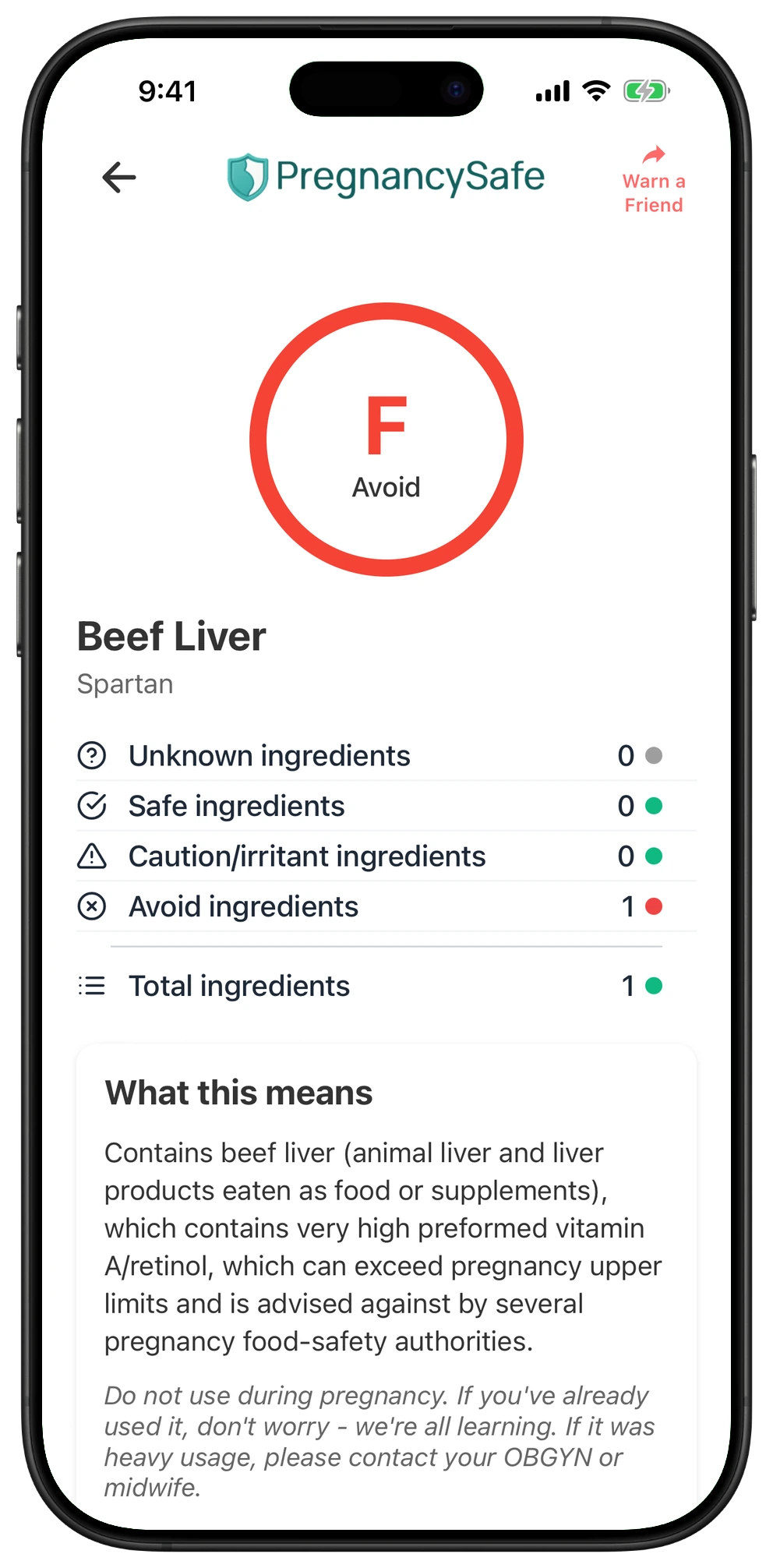
Avoid beef liver and liver supplements during pregnancy because they can contain high levels of preformed vitamin A. An A ingredient grade does not measure that dose or make a liver product recommended during pregnancy.
Beef liver provides iron, B12 and folate, but a single serving can exceed pregnancy upper limits for preformed vitamin A, also called retinol. The concern applies to liver eaten as food and taken orally as powders or capsules; cooking does not remove it. If you already had an isolated serving, seek individualized advice rather than assuming it caused harm.
Pregnancy Safe is 100% independent and research driven. No companies pay to promote or sponsor products.
Stress Less This Pregnancy
Check your exact beef liver in the app
✓ What's Safe
- • Choose non liver sources of iron and B12 rather than using liver as a pregnancy nutrient boost.
- • Check organ meat blends, powders and capsules for liver before eating or taking them.
- • Follow your clinician’s prenatal nutrient plan instead of replacing it with desiccated liver.
- • When discussing supplements with your clinician, bring labels showing the vitamin A form, amount per serving and daily serving size.
- • Distinguish liver from ordinary beef muscle meat and vegetable beta carotene; the liver specific retinol advice does not make those equivalent exposures.
✗ What to Avoid
- • Avoid beef liver meals during pregnancy, including fully cooked liver.
- • Avoid beef liver powder and desiccated or freeze dried liver capsules as self selected prenatal supplements.
- • Avoid liver pâté, liver sausage and blends containing liver rather than treating them as exceptions.
- • Do not rely on organic, grass fed or country of origin claims to establish a lower retinol dose.
- • Do not follow a supposedly safe daily or weekly liver allowance based on an ingredient grade or the weight of liver powder alone.
Most Common Ingredients in Beef Liver Products
We analyzed 20 beef liver products. Here are the most common ingredients, ranked by how often they appear:
Ingredients to Watch Out For in Beef Liver
These are the most common flagged ingredients across 20 beef liver products we analyzed.
beef liver
Avoid
Beef liver is a nutrient rich organ meat known for its high levels of iron, vitamin A, and essential amino acids.
Contains very high preformed vitamin A/retinol, which can exceed pregnancy upper limits and is advised against by several pregnancy food safety authorities.
Flagged in 8 of 20 products (40%)
beef liver powder
Avoid
Beef liver powder is a nutrient rich supplement made from dehydrated, ground beef liver, offering a concentrated source of vitamins, minerals, and protein.
Contains very high preformed vitamin A/retinol, which can exceed pregnancy upper limits and is advised against by several pregnancy food safety authorities.
Flagged in 4 of 20 products (20%)
new zealand beef liver
Avoid
Contains very high preformed vitamin A/retinol, which can exceed pregnancy upper limits and is advised against by several pregnancy food safety authorities.
Flagged in 2 of 20 products (10%)
beef liver dessicated powder
Avoid
Contains very high preformed vitamin A/retinol, which can exceed pregnancy upper limits and is advised against by several pregnancy food safety authorities.
Flagged in 1 of 20 products (5%)
beef liver freeze dried
Avoid
Contains very high preformed vitamin A/retinol, which can exceed pregnancy upper limits and is advised against by several pregnancy food safety authorities.
Flagged in 1 of 20 products (5%)
organic beef liver
Avoid
Organic beef liver is a nutrient dense, rich tasting organ meat sourced from grass fed cattle, known for its high levels of vitamins and minerals.
Contains very high preformed vitamin A/retinol, which can exceed pregnancy upper limits and is advised against by several pregnancy food safety authorities.
Flagged in 1 of 20 products (5%)
Beef Liver Products We've Analyzed
Our catalog contains ratings for 20 beef liver products. These are database grades, not independent safety certifications.
Ingredient grades do not quantify preformed vitamin A dose. High grades do not make liver or liver supplements recommended during pregnancy.
Your Questions Answered
Why avoid beef liver if pregnant?
Beef liver is a concentrated source of preformed vitamin A, or retinol, and a single serving can exceed pregnancy upper limits. Excessive intake of this form of vitamin A can harm fetal development. Its iron, B12 and folate content does not cancel that concern, so choose other nutrient sources during pregnancy.
How much beef liver per day while pregnant?
The practical guidance is to avoid liver during pregnancy, not to set a daily serving target. Retinol content and your intake from other foods and supplements matter, so a universal safe daily or weekly portion is not appropriate. If you have already eaten liver, discuss the amount and timing with your maternity clinician for individualized advice.
Can you take beef liver supplements while pregnant?
Avoid starting beef liver supplements during pregnancy as a source of prenatal nutrients. Desiccated powders and capsules are still liver products, and the milligrams of liver listed on the label do not tell you the preformed vitamin A dose. They are not a substitute for clinician recommended prenatal care; bring the exact label to your clinician if you are already taking them.
Can I eat cooked beef liver while pregnant?
Cooking controls pathogens but does not make the retinol concern disappear. Fully cooked liver therefore remains a food to avoid during pregnancy. Do not treat frying, boiling or another cooking method as a way to establish a safe liver serving.
What if I ate beef liver before I knew I was pregnant?
An isolated serving does not establish that harm occurred. Avoid further liver intake and tell your maternity clinician approximately how much you ate, when you ate it and whether you also used vitamin A or liver supplements. Those details support an individualized assessment rather than a prediction based on the food name alone.
Why do some beef liver products have an A grade?
Our catalog contains 20 products: 3 graded A and 17 graded F. Ingredient grades do not quantify preformed vitamin A dose, so the A count is not a count of verified pregnancy safe liver products. No liver product is presented here as a pregnancy alternative, regardless of grade.
Does avoiding liver mean avoiding all vitamin A or ordinary beef?
No: this advice concerns liver and liver products because of their concentrated preformed vitamin A. Vegetable beta carotene and ordinary beef muscle meat should not be treated as equivalent to liver exposure, nor should all fortified foods be grouped with liver. If you are concerned about your prenatal vitamin, ask your clinician to check its vitamin A form and dose rather than stopping it solely because it lists vitamin A.
How Do We Score Products for Pregnancy Safety?
We analyze each product's ingredients and category to flag known risks and provide cautionary notices for general category safety concerns.
Grades reflect the ingredient and category information available to us. They don’t verify a complete, current label or account for dose, preparation, or contamination. Read them alongside the guidance above, not as a guarantee of pregnancy safety or proof that every use is harmful.
A - Safe
Excellent choice! All ingredients are considered safe during pregnancy.
What to do: Use with confidence.
B - Likely Safe
Pretty much safe with very minimal risk. Some ingredients may have limited pregnancy studies, but no significant safety concerns have been identified.
What to do: Use with confidence.
C - Limit
Contains ingredients with some pregnancy considerations. Research shows these ingredients may have limited safety data, potential for minor hormonal effects, or require caution based on animal studies.
What to do: Use sparingly and consider safer alternatives when available.
D - Caution
Similar to C grade but contains multiple cautionary ingredients. The combination increases overall concern.
What to do: Try to avoid if that makes you feel better. If you've already used it, no need to panic.
F - Avoid
Contains an ingredient Pregnancy Safe recommends avoiding during pregnancy. This may reflect an established risk or a precaution based on limited evidence; check the ingredient guidance and exposure context.
What to do: Do not use during pregnancy. If you've already used it, don't worry - contact your OBGYN if concerned.
People Also Checked
References
- https://www.nhs.uk/pregnancy/keeping-well/foods-to-avoid/
- https://ods.od.nih.gov/factsheets/Pregnancy-HealthProfessional/
- https://www.nhs.uk/conditions/vitamins-and-minerals/vitamin-a/
- https://cot.food.gov.uk/Lay%20Summary%20of%20the%20Statement%20on%20the%20effects%20of%20excess%20Vitamin%20A%20on%20maternal%20health
- https://pubmed.ncbi.nlm.nih.gov/38846679/
- https://ods.od.nih.gov/factsheets/VitaminA-HealthProfessional/
- https://www.canada.ca/en/public-health/services/publications/healthy-living/maternity-newborn-care-guidelines-chapter-3.html
- https://www.pregnancybirthbaby.org.au/foods-to-avoid-when-pregnant
- https://www.thewomens.org.au/images/uploads/fact-sheets/Food_safety_in_pregnancy_260316.pdf