Is Roast Beef Safe During Pregnancy? (Updated 2026 Guide)
Updated September 9, 2026
The Answer
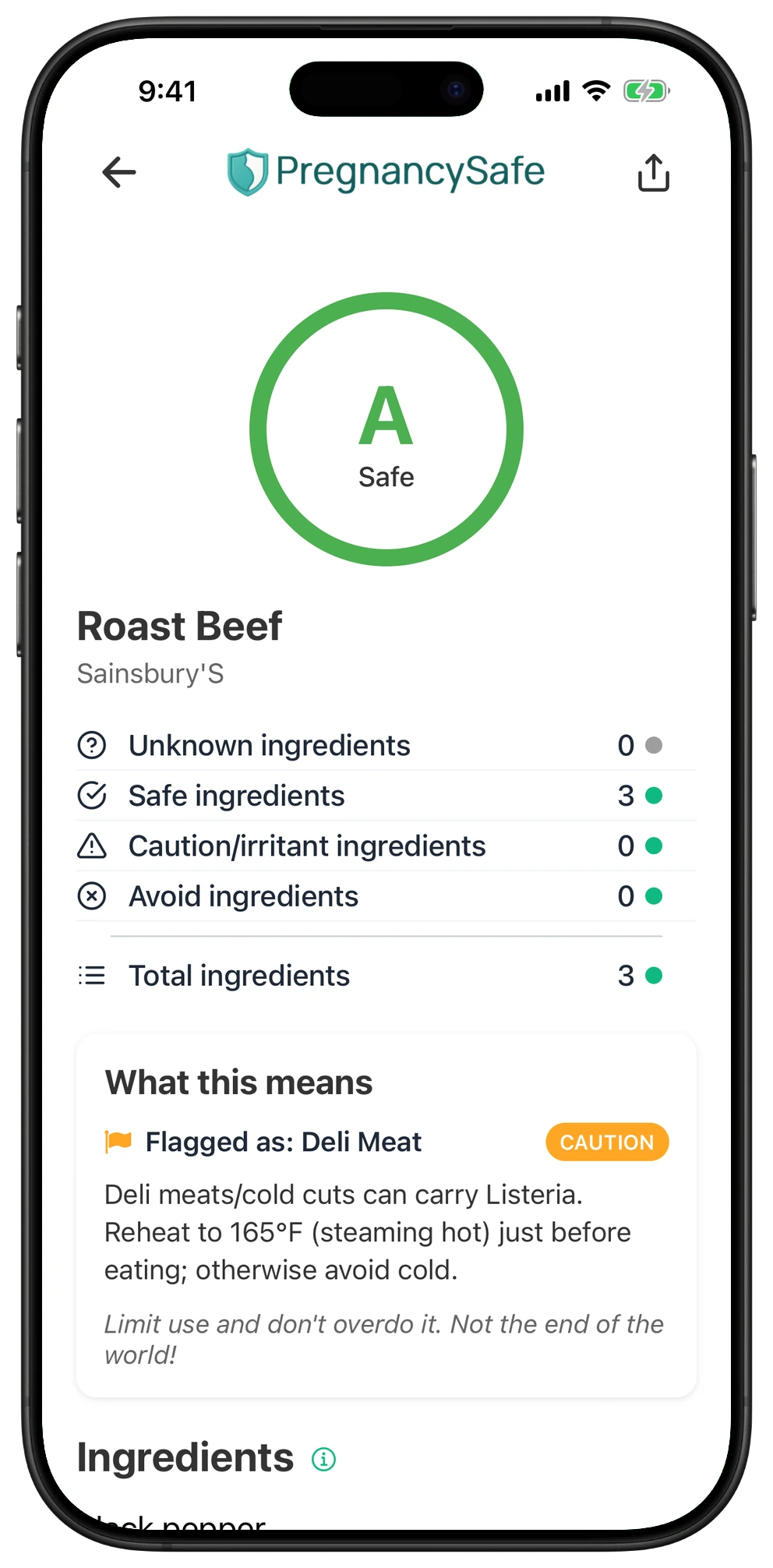
Yes roast beef can be eaten during pregnancy with the right preparation: cook a fresh intact beef roast to at least 145°F and rest it for three minutes. Refrigerated deli roast beef needs extra caution because of Listeria; reheat it to 165°F or steaming hot just before eating, rather than eating it cold.
The main consideration is whether you are cooking a fresh intact roast or reheating refrigerated ready to eat deli slices, which can carry Listeria. Ingredient scores cannot establish safe cooking, storage, or absence of pathogens. Sodium nitrite has limited observational pregnancy evidence at food use exposures, while an ethyl alcohol listing alone does not establish a beverage level alcohol dose in the finished food.
Pregnancy Safe is 100% independent and research driven. No companies pay to promote or sponsor products.
Stress Less This Pregnancy
Check your exact roast beef in the app

✓ What's Safe
- • Check whether the package contains raw beef for cooking or refrigerated ready to eat deli roast beef; they need different preparation.
- • Use a food thermometer to confirm a fresh intact roast reaches at least 145°F, then let it rest for three minutes before carving.
- • Heat refrigerated deli slices to 165°F or steaming hot throughout just before eating.
- • When ordering a sandwich, ask for the roast beef itself to be heated until steaming hot, not just the bread toasted.
- • Follow the current package's refrigeration, storage, and preparation instructions, even when its ingredient grade is A.
✗ What to Avoid
- • Avoid eating refrigerated deli roast beef cold straight from the package or deli counter.
- • Avoid serving a fresh intact roast before it reaches 145°F and completes a three minute rest.
- • Do not use pinkness, brown color, or a 'medium' description instead of a thermometer to judge doneness.
- • Avoid treating lightly warmed deli slices or toasted bread as proof that the meat has reached the reheating target.
- • Do not use branding, an A grade, or a short ingredient list as a substitute for safe heating and storage.
Most Common Ingredients in Roast Beef Products
We analyzed 95 roast beef products. Here are the most common ingredients, ranked by how often they appear:
Ingredients to Watch Out For in Roast Beef
These are the most common flagged ingredients across 95 roast beef products we analyzed.
ethyl alcohol
Avoid
Ethyl alcohol is a colorless, volatile, and flammable organic compound commonly used as a solvent, disinfectant, and in alcoholic beverages.
Has no established safe amount in pregnancy and is linked to fetal alcohol spectrum disorders and other adverse pregnancy outcomes.
Flagged in 3 of 95 products (3%)
sodium nitrite
Caution
Sodium nitrite is a chemical compound commonly used as a preservative and color fixative in processed meats.
Is regulated at low food additive levels, but frequent cured or processed meat intake has limited observational pregnancy concerns; cyanide antidote and contaminated water exposures are separate issues.
Flagged in 1 of 95 products (1%)
Roast Beef Products We've Analyzed
Our catalog contains ratings for 95 roast beef products. These are database grades, not independent safety certifications.
Grades are ingredient scores, not clinical verdicts or measurements of pathogens, dose, preparation or current package contents. Cohorts include unreviewed catalog records and counts are not independently verified safe-product totals.
Pregnancy Safe Roast Beef Products
Popular options from our catalog, prioritizing A and B ingredient grades, with C grade options used to fill remaining places. Within each group, products are ordered by searches in Pregnancy Safe, not retail sales. Read the cautions and guidance above; grades do not verify a complete current label or guarantee pregnancy safety.
| Grade | Product | Brand |
|---|---|---|
| A | Roast Beef | Sainsbury'S |
| B+ | Roast Beef | Tyson |
| B+ | Fully Cooked Roast Beef | Giant Eagle |
| A | Grass-Fed Fully Cooked Seasoned Roast Beef | — |
| A | Seasoned Roast Beef | Trader Joe'S |
Your Questions Answered
Can you eat medium beef when pregnant?
For a fresh intact beef roast, use temperature rather than the word 'medium' to decide whether it is ready. Cook it to at least 145°F and allow a three minute rest before carving. Pinkness alone cannot establish doneness. Refrigerated deli roast beef follows a different rule: reheat it to 165°F or steaming hot before eating.
Can I eat a roast beef sandwich while pregnant?
Yes, but refrigerated deli roast beef should be reheated to 165°F or steaming hot just before you eat it. Ask for the meat itself to be heated thoroughly; toasting the bread alone does not meet that goal. If the deli cannot do that, choose another meal rather than eating the slices cold.
Is freshly cooked roast beef different from deli roast beef?
Yes the preparation you need depends on which form you have. A fresh intact roast needs cooking to at least 145°F followed by a three minute rest. Refrigerated ready to eat deli slices need reheating to 165°F or steaming hot because of the Listeria concern. A package marked 'cooked' does not remove that pregnancy reheating recommendation.
Does an A grade mean roast beef is safe to eat cold?
No. Grades describe ingredients, not pathogen testing, cooking temperature, or storage conditions. Our catalog contains 95 roast beef records, including 31 graded A, but those are not independently verified safe product totals. Even A grade refrigerated deli roast beef should be reheated to 165°F or steaming hot before eating.
Should I worry about sodium nitrite or ethyl alcohol in roast beef?
Sodium nitrite is a regulated curing preservative; pregnancy specific evidence is limited and mostly observational, so occasional food additive exposure should not be equated with high dose exposure. Frequent cured meat intake is a different exposure pattern from an occasional serving. Ethyl alcohol is ethanol, but its presence on a food label does not tell you the amount in the finished serving or establish equivalence to an alcoholic drink. Avoid beverage alcohol during pregnancy, and keep deli meat reheating precautions separate from these ingredient questions.
Which foods help prevent constipation in pregnancy?
Fiber rich foods such as fruits, vegetables, whole grains, beans, nuts, and seeds can help with constipation during pregnancy. Pair your properly prepared roast beef with vegetables, beans, or a whole grain side to add fiber to the meal. About 25 grams of fiber daily is the target in ACOG's pregnancy constipation guidance.
How Do We Score Products for Pregnancy Safety?
We analyze each product's ingredients and category to flag known risks and provide cautionary notices for general category safety concerns.
Grades reflect the ingredient and category information available to us. They don’t verify a complete, current label or account for dose, preparation, or contamination. Read them alongside the guidance above, not as a guarantee of pregnancy safety or proof that every use is harmful.
A - Safe
Excellent choice! All ingredients are considered safe during pregnancy.
What to do: Use with confidence.
B - Likely Safe
Pretty much safe with very minimal risk. Some ingredients may have limited pregnancy studies, but no significant safety concerns have been identified.
What to do: Use with confidence.
C - Limit
Contains ingredients with some pregnancy considerations. Research shows these ingredients may have limited safety data, potential for minor hormonal effects, or require caution based on animal studies.
What to do: Use sparingly and consider safer alternatives when available.
D - Caution
Similar to C grade but contains multiple cautionary ingredients. The combination increases overall concern.
What to do: Try to avoid if that makes you feel better. If you've already used it, no need to panic.
F - Avoid
Contains an ingredient Pregnancy Safe recommends avoiding during pregnancy. This may reflect an established risk or a precaution based on limited evidence; check the ingredient guidance and exposure context.
What to do: Do not use during pregnancy. If you've already used it, don't worry - contact your OBGYN if concerned.
People Also Checked
See our full guide to beef during pregnancy.
References
- https://www.cdc.gov/listeria/outbreaks/delimeats-7-24/index.html
- https://www.cdc.gov/food-safety/foods/pregnant-women.html
- https://www.fda.gov/food/people-risk-foodborne-illness/cooking-food-safety-moms-be
- https://www.cdc.gov/listeria/prevention/index.html
- https://www.acog.org/womens-health/experts-and-stories/ask-acog/what-can-help-with-constipation-during-pregnancy
- https://www.cdc.gov/alcohol-pregnancy/about/index.html
- https://www.cdc.gov/fasd/about/index.html
- https://www.acog.org/womens-health/infographics/alcohol-and-pregnancy
- https://www.niaaa.nih.gov/publications/brochures-and-fact-sheets/alcohol-and-your-pregnancy
- https://mothertobaby.org/fact-sheets/alcohol-pregnancy/
- https://pubmed.ncbi.nlm.nih.gov/26482673/
- https://pmc.ncbi.nlm.nih.gov/articles/PMC9543418/
- https://hfpappexternal.fda.gov/scripts/fdcc/index.cfm?id=SODIUMNITRITE&set=FoodSubstances
- https://www.ecfr.gov/current/title-9/section-424.21
- https://www.ecfr.gov/current/title-21/section-172.175
- https://www.efsa.europa.eu/en/press/news/170615
- https://www.inchem.org/documents/jecfa/jecmono/v50je07.htm
- https://pubmed.ncbi.nlm.nih.gov/41248583/
- https://publications.iarc.who.int/Book-And-Report-Series/Iarc-Monographs-On-The-Identification-Of-Carcinogenic-Hazards-To-Humans/Red-Meat-And-Processed-Meat-2018
- https://dailymed.nlm.nih.gov/dailymed/drugInfo.cfm?setid=52f01c6e-172a-47a9-98a6-9eab7651a032
- https://www.atsdr.cdc.gov/toxprofiles/tp204.pdf