Is Yerba Mate Safe During Pregnancy? (Updated 2026 Guide)
Updated September 9, 2026
The Answer
Yerba mate requires caution during pregnancy because it contains caffeine: if you drink it, keep your total caffeine below 200 mg per day from all sources. Choose an ordinary beverage with a known caffeine amount, rather than concentrated energy or extract preparations, and avoid drinking it extremely hot.
The main consideration is your total caffeine intake, which varies with the mate's strength, preparation and serving size not just whether caffeine appears separately on the ingredient list. Added caffeine counts toward the same daily limit, while hibiscus, elderberry, elderflower and ginseng blends introduce separate uncertainties, especially at medicinal or supplement doses. An ingredient grade does not measure caffeine or establish pregnancy suitability.
Pregnancy Safe is 100% independent and research driven. No companies pay to promote or sponsor products.
Stress Less This Pregnancy
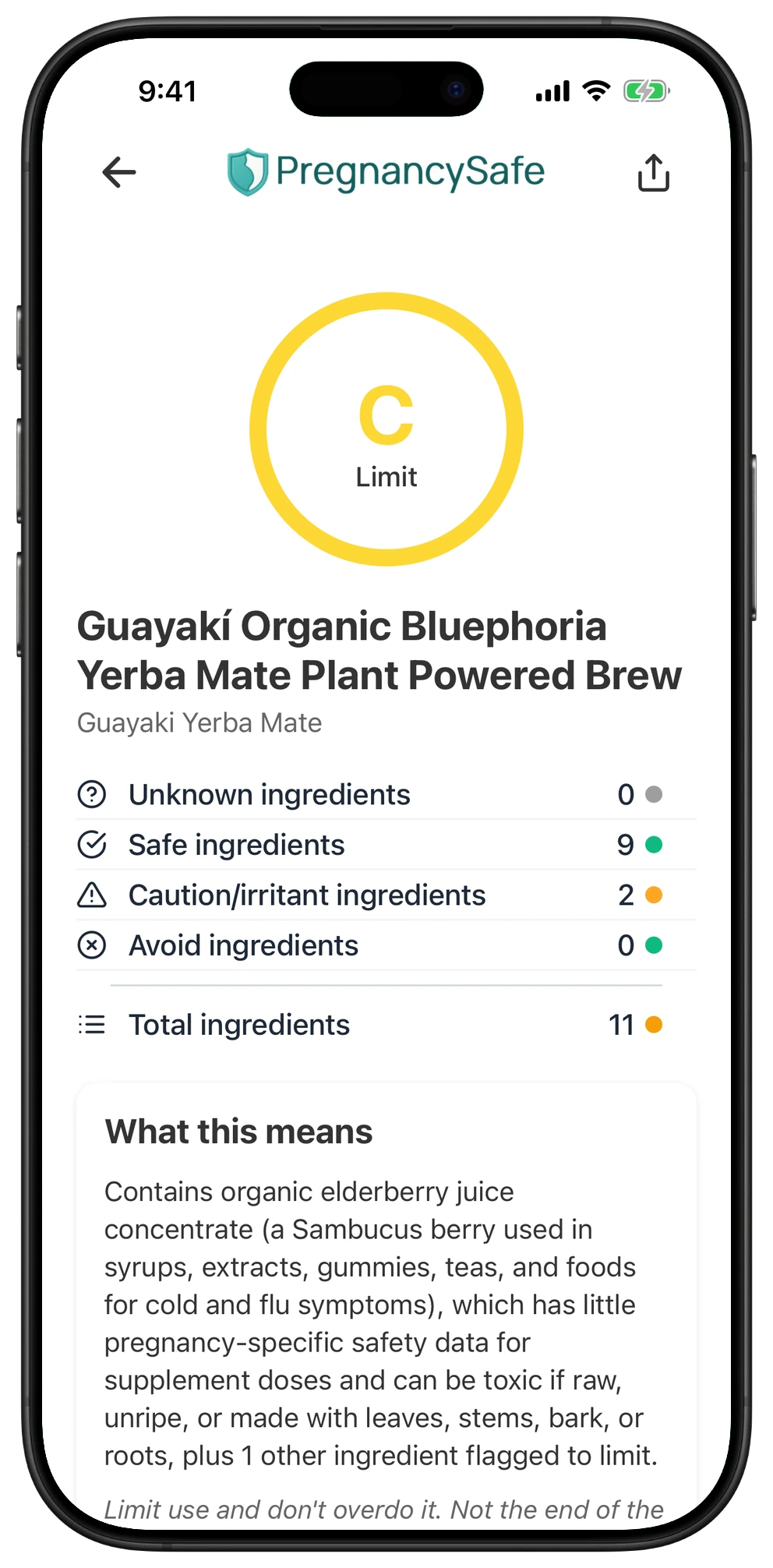
Check your exact yerba mate in the app
✓ What's Safe
- • Check the caffeine amount for the exact serving you will drink, including the number of servings in a can or bottle.
- • Keep a daily caffeine total that includes mate, coffee, other teas, soda, chocolate and any caffeine containing medicines or supplements.
- • Choose ordinary beverage preparations rather than capsules, tinctures, concentrated extracts or energy shots.
- • Read the full current label for added caffeine and herbal blends; check the exact version rather than relying on an archived label.
- • Let hot mate cool before drinking; choose a comfortably warm or cool drink rather than an extremely hot one.
✗ What to Avoid
- • Avoid portions that bring your total caffeine to 200 mg or more in a day.
- • Avoid guessing that a cup, gourd or bottle has a standard caffeine dose; strength, preparation and serving size vary.
- • Avoid concentrated mate energy products and extract supplements, even if their ingredient grade is A.
- • Avoid treating organic caffeine or natural caffeine from tea as exempt from your caffeine limit, or assuming decaf means caffeine free.
- • Avoid self prescribing medicinal herbal blends containing ginseng, hibiscus flowers or elderflowers; discuss their dose and purpose with your prenatal clinician.
- • Avoid alcoholic mate drinks and extremely hot servings.
Most Common Ingredients in Yerba Mate Products
We analyzed 51 yerba mate products. Here are the most common ingredients, ranked by how often they appear:
Ingredients to Watch Out For in Yerba Mate
These are the most common flagged ingredients across 51 yerba mate products we analyzed.
organic caffeine
Caution
Organic caffeine is a natural stimulant derived from organically grown coffee beans, tea leaves, or other plant sources, providing an energizing boost without synthetic additives.
Should be counted across all sources and generally limited to below 200 mg/day in pregnancy because higher intake has observational links to miscarriage and fetal growth outcomes.
Flagged in 13 of 51 products (25%)
organic hibiscus flower
Caution
Organic hibiscus flower is a vibrant, tangy, and antioxidant rich blossom often used to make teas, infusions, and natural remedies.
Has limited human pregnancy safety data; medicinal teas or supplements may lower blood pressure and uterine or menstrual effects are uncertain.
Flagged in 4 of 51 products (8%)
organic brewed yerba mate and hibiscus flower purified water
Caution
A refreshing infusion of organic brewed yerba mate and hibiscus flower blended with purified water.
Has limited human pregnancy safety data; medicinal teas or supplements may lower blood pressure and uterine or menstrual effects are uncertain.
Flagged in 2 of 51 products (4%)
organic elderberry juice concentrate
Caution
Organic elderberry juice concentrate is a natural extract rich in antioxidants, known for supporting immune health and providing a flavorful, nutritious addition to beverages and remedies.
Has little pregnancy specific safety data for supplement doses and can be toxic if raw, unripe, or made with leaves, stems, bark, or roots.
Flagged in 2 of 51 products (4%)
alcohol
Caution
Alcohol is a volatile, colorless liquid commonly used as a solvent, disinfectant, or intoxicating beverage.
No amount of Alcohol is considered safe. Avoid alcohol beverages entirely. Be extremely careful when using in cooking or even with small percentages.
Flagged in 1 of 51 products (2%)
eldercraft organic elderberry extract
Caution
Eldercraft Organic Elderberry Extract is a natural, concentrated extract derived from organic elderberries, known for supporting immune health and overall wellness.
Has little pregnancy specific safety data for supplement doses and can be toxic if raw, unripe, or made with leaves, stems, bark, or roots.
Flagged in 1 of 51 products (2%)
elderflowers
Caution
Elderflowers are delicate, fragrant white blossoms from the elderberry shrub, often used to add a floral, citrusy note to beverages and desserts.
Has limited pregnancy safety data; medicinal teas and extracts are not recommended in pregnancy, while pasteurized food flavor amounts are a different lower exposure context.
Flagged in 1 of 51 products (2%)
Avoid
Ginseng is a medicinal root known for its energizing and adaptogenic properties, often used to boost vitality and overall well being.
Is not recommended as an oral supplement in pregnancy because human safety data are limited and Panax ginsenosides have animal or embryo culture developmental concerns.
Flagged in 1 of 51 products (2%)
Yerba Mate Products We've Analyzed
Our catalog contains ratings for 51 yerba mate products. These are database grades, not independent safety certifications.
Catalog ingredient grades do not measure current-label completeness, pathogens, preparation, caffeine or clinical pregnancy suitability. These counts include unreviewed records and are not a percentage of independently verified safe products.
Pregnancy Safe Yerba Mate Products
Popular options from our catalog, prioritizing A and B ingredient grades, with C grade options used to fill remaining places. Within each group, products are ordered by searches in Pregnancy Safe, not retail sales. Read the cautions and guidance above; grades do not verify a complete current label or guarantee pregnancy safety.
| Grade | Product | Brand |
|---|---|---|
| A | Mint Yerba Mate, Mint | Langers |
| A | Yerba Mate 450 Mg | Terravita Premium Collection |
| A | Yerba Mate Powder | Terravita Premium Collection |
| A | Yerba Mate | Terravita |
| A | Yerba Mate Strawberry Flavor | Terravita |
Your Questions Answered
Can I drink yerba mate during pregnancy?
If you choose to drink yerba mate, keep total caffeine below 200 mg per day from all sources. Mate is caffeinated, not a caffeine free herbal tea, and its caffeine content varies with preparation and portion size. Choose an ordinary beverage with a known caffeine amount and avoid concentrated energy or extract preparations.
How much yerba mate can I drink while pregnant?
There is no reliable universal number of cups because strength, preparation and serving size vary. Use the caffeine amount for your actual portion, then add your other caffeine sources to stay below 200 mg for the day. If you cannot establish the amount, do not assume a small cup or a single bottle fits within that limit.
Is organic or decaffeinated yerba mate safer during pregnancy?
Organic labeling does not remove caffeine or change how it counts toward your daily total. Decaffeinated mate should not be assumed to contain zero caffeine; check the amount for the exact product and serving. Also read the other ingredients, because reducing caffeine does not resolve questions about added herbal extracts.
Are yerba mate capsules and extracts the same as drinking the tea?
No an ordinary brewed beverage should not be equated with a concentrated supplement dose. Avoid concentrated mate energy and extract preparations during pregnancy rather than using tea guidance to justify them. A capsule's stated weight is not itself a measurement of its caffeine content, and an A ingredient grade is not a clinical endorsement.
What if my yerba mate contains hibiscus or elderberry?
These additions need their own assessment rather than being covered by the caffeine limit. Hibiscus has very limited human pregnancy safety data, and findings from continuous animal extract exposure do not establish harm from an ordinary beverage. Elderberry also has little pregnancy specific evidence for supplement doses; properly cooked ripe berry ingredients differ from raw or unripe berries and other potentially toxic plant parts. Ask your prenatal clinician before using concentrated or medicinal blends, especially hibiscus preparations if you have low blood pressure or take blood pressure medicines.
Does an A grade mean a yerba mate product is safe during pregnancy?
No. Our catalog contains 51 products, including 29 with an A ingredient grade, but these are not 29 independently verified pregnancy safe products. Grades do not measure caffeine, preparation, pathogens or current label completeness, and incomplete information is not proof of harm. Check the current package and apply the caffeine and preparation precautions regardless of grade.
How Do We Score Products for Pregnancy Safety?
We analyze each product's ingredients and category to flag known risks and provide cautionary notices for general category safety concerns.
Grades reflect the ingredient and category information available to us. They don’t verify a complete, current label or account for dose, preparation, or contamination. Read them alongside the guidance above, not as a guarantee of pregnancy safety or proof that every use is harmful.
A - Safe
Excellent choice! All ingredients are considered safe during pregnancy.
What to do: Use with confidence.
B - Likely Safe
Pretty much safe with very minimal risk. Some ingredients may have limited pregnancy studies, but no significant safety concerns have been identified.
What to do: Use with confidence.
C - Limit
Contains ingredients with some pregnancy considerations. Research shows these ingredients may have limited safety data, potential for minor hormonal effects, or require caution based on animal studies.
What to do: Use sparingly and consider safer alternatives when available.
D - Caution
Similar to C grade but contains multiple cautionary ingredients. The combination increases overall concern.
What to do: Try to avoid if that makes you feel better. If you've already used it, no need to panic.
F - Avoid
Contains an ingredient Pregnancy Safe recommends avoiding during pregnancy. This may reflect an established risk or a precaution based on limited evidence; check the ingredient guidance and exposure context.
What to do: Do not use during pregnancy. If you've already used it, don't worry - contact your OBGYN if concerned.
People Also Checked
References
- https://www.acog.org/womens-health/experts-and-stories/ask-acog/how-much-coffee-can-i-drink-while-pregnant
- https://www.acog.org/clinical/clinical-guidance/committee-opinion/articles/2010/08/moderate-caffeine-consumption-during-pregnancy
- https://www.nhs.uk/pregnancy/keeping-well/foods-to-avoid/
- https://www.ncbi.nlm.nih.gov/books/NBK582613/
- https://www.who.int/tools/elena/interventions/caffeine-pregnancy
- https://www.fda.gov/consumers/consumer-updates/spilling-beans-how-much-caffeine-too-much
- https://pubmed.ncbi.nlm.nih.gov/25179792/
- https://pubmed.ncbi.nlm.nih.gov/25238871/
- https://mothertobaby.org/fact-sheets/herbal-products-pregnancy/
- https://www.ncbi.nlm.nih.gov/books/NBK501882/
- https://pubmed.ncbi.nlm.nih.gov/19434218/
- https://pubmed.ncbi.nlm.nih.gov/18066103/
- https://pmc.ncbi.nlm.nih.gov/articles/PMC9086798/
- https://www.nccih.nih.gov/health/hypertension-high-blood-pressure
- https://www.ffhdj.com/index.php/ffhd/article/view/1768
- https://www.nccih.nih.gov/health/elderberry
- https://pmc.ncbi.nlm.nih.gov/articles/PMC3941201/
- https://pmc.ncbi.nlm.nih.gov/articles/PMC8026097/
- https://pmc.ncbi.nlm.nih.gov/articles/PMC7961730/
- https://www.cdc.gov/mmwr/preview/mmwrhtml/00000311.htm
- https://www.fda.gov/food/information-consumers-using-dietary-supplements/questions-and-answers-dietary-supplements
- https://pubmed.ncbi.nlm.nih.gov/11518905/
- https://infantrisk.com/content/management-cold-and-flu-during-pregnancy
- https://www.ema.europa.eu/en/documents/herbal-monograph/final-european-union-herbal-monograph-sambucus-nigra-l-flos-revision-1_en.pdf
- https://www.ema.europa.eu/en/documents/herbal-report/final-assessment-report-sambucus-nigra-l-flos-revision-1_en.pdf
- https://www.ema.europa.eu/en/documents/herbal-report/addendum-assessment-report-sambucus-nigra-l-flos_en.pdf
- https://webprod.hc-sc.gc.ca/nhpid-bdipsn/atReq?atid=elder.sureau&lang=eng
- https://pubmed.ncbi.nlm.nih.gov/33806603/
- https://www.nccih.nih.gov/health/asian-ginseng
- https://www.ema.europa.eu/en/documents/herbal-report/draft-assessment-report-panax-ginseng-camey-radix-revision-1_en.pdf
- https://pubmed.ncbi.nlm.nih.gov/18204104/
- https://www.ncbi.nlm.nih.gov/books/NBK501814/
- https://www.mskcc.org/cancer-care/integrative-medicine/herbs/ginseng-asian
- https://www.mskcc.org/cancer-care/integrative-medicine/herbs/ginseng-american
- https://pubmed.ncbi.nlm.nih.gov/14507839/