Is Tuna Salad Safe During Pregnancy? (Updated 2026 Guide)
Updated September 9, 2026
The Answer
You can have homemade tuna salad during pregnancy when you use suitable canned or fully cooked lower mercury tuna and prepare it hygienically. Avoid premade deli tuna salad and high mercury tuna such as bigeye; canned light and albacore have different serving guidance.
The main considerations are foodborne illness from preparation and storage, and mercury exposure from the type and amount of tuna you eat. Choose homemade tuna salad with suitable canned or cooked fish, pasteurized egg mayonnaise, clean utensils and prompt refrigeration. Added sugar and food dye concerns do not establish harm from occasional food amounts, and a white wine ingredient listing alone cannot establish the alcohol dose in a serving.
Pregnancy Safe is 100% independent and research driven. No companies pay to promote or sponsor products.
Stress Less This Pregnancy
Check your exact tuna salad in the app

✓ What's Safe
- • Make tuna salad at home so you can control the ingredients, cleanliness and refrigeration.
- • Choose canned light tuna rather than assuming albacore or white tuna is equally low in mercury.
- • Check the tuna type and follow its FDA serving guidance, counting other fish you eat that week.
- • Use mayonnaise made with pasteurized eggs and canned or fully cooked tuna.
- • Use clean utensils and preparation surfaces, and refrigerate the finished mixture promptly.
✗ What to Avoid
- • Avoid premade deli tuna salad during pregnancy, including ready to eat chilled tubs.
- • Avoid bigeye tuna and other high mercury fish; cooking does not substitute for choosing a suitable species.
- • Do not use raw or undercooked tuna, or add refrigerated smoked seafood to a salad served cold.
- • Avoid mayonnaise made with raw, unpasteurized eggs.
- • Do not eat tuna salad that has been left sitting out or whose refrigeration history is uncertain.
- • Do not assume a sealed package, familiar brand or ingredient grade guarantees safe preparation and storage.
Most Common Ingredients in Tuna Salad Products
We analyzed 20 tuna salad products. Here are the most common ingredients, ranked by how often they appear:
Ingredients to Watch Out For in Tuna Salad
These are the most common flagged ingredients across 20 tuna salad products we analyzed.
fd c blue 1 and yellow 5
Caution
Has limited human pregnancy data; regulated food use is not shown to cause fetal harm, but high dose animal neurobehavior findings and child sensitivity concerns support minimizing frequent exposure.
Flagged in 1 of 20 products (5%)
fd c yellow 5 and blue 1
Caution
FD&C Yellow 5 and Blue 1 are synthetic food colorings used to add vibrant yellow and blue hues to various edible products.
Has limited human pregnancy data, rare hypersensitivity labeling concerns, and animal/children's neurobehavior signals despite regulated dietary use under ADI based limits.
Flagged in 1 of 20 products (5%)
high fructose corn syrup
Caution
High fructose corn syrup is a sweet, liquid sweetener made from corn starch, commonly used in processed foods and beverages.
Is not a known teratogen at occasional food amounts, but high added sugar intake can displace nutrients and raise gestational diabetes and metabolic concerns.
Flagged in 1 of 20 products (5%)
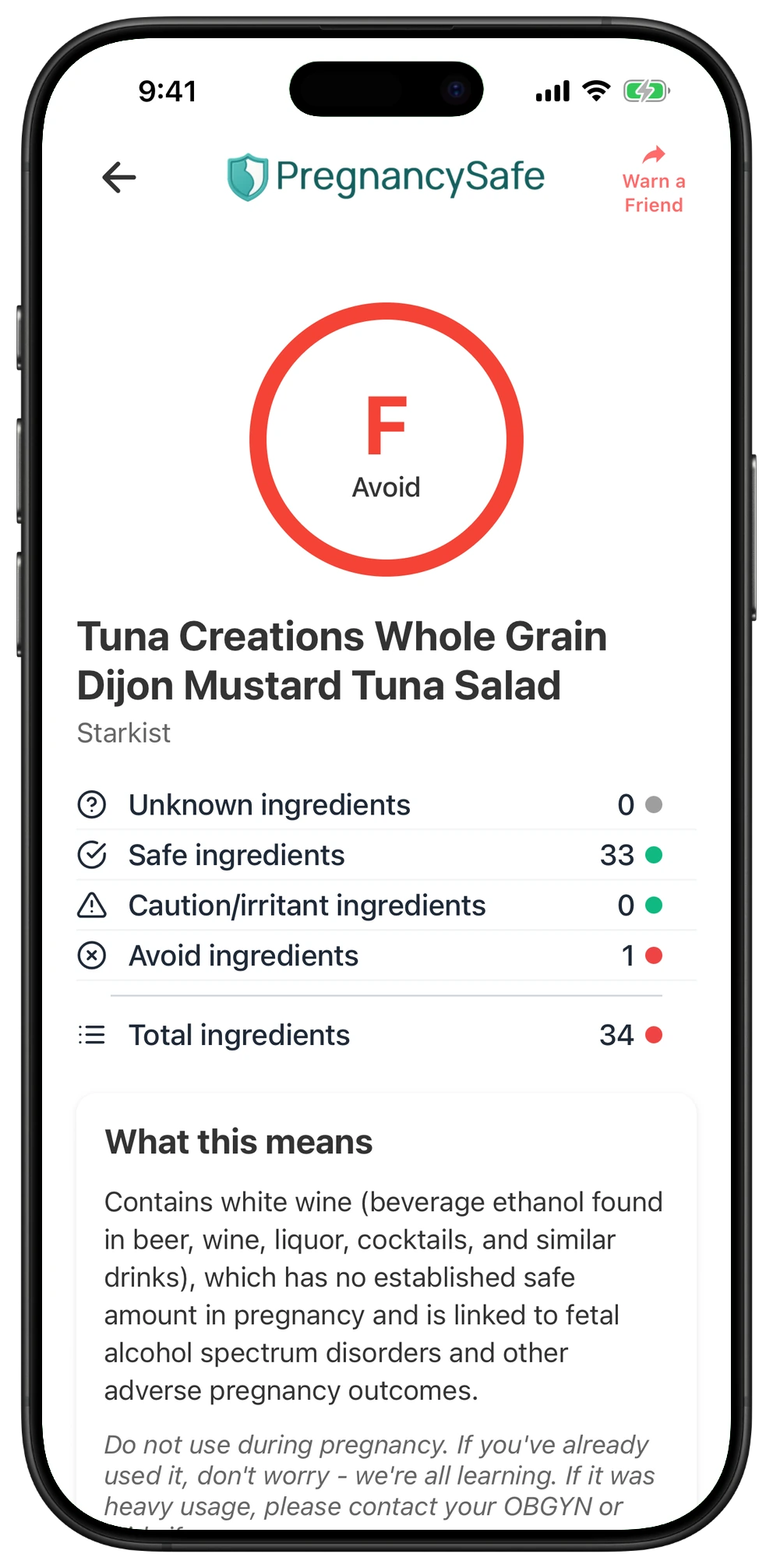
white wine
Avoid
White wine is a crisp, pale yellow alcoholic beverage made from fermented white grapes, often used to enhance the flavor of dishes or enjoyed on its own.
Has no established safe amount in pregnancy and is linked to fetal alcohol spectrum disorders and other adverse pregnancy outcomes.
Flagged in 1 of 20 products (5%)
Tuna Salad Products We've Analyzed
Our catalog contains ratings for 20 tuna salad products. These are database grades, not independent safety certifications.
Ingredient grades cannot establish dose, preparation, label completeness, efficacy or pregnancy suitability. An A score is not an endorsement, and counts include unreviewed catalog records.
Your Questions Answered
Can pregnant ladies have tuna salad?
Yes, a homemade version can fit into your pregnancy diet when made with suitable canned or fully cooked lower mercury tuna. Use pasteurized egg mayonnaise, clean utensils and prompt refrigeration. Avoid premade deli salads and high mercury tuna such as bigeye.
Can I eat tuna salad bought at the grocery store?
Avoid premade deli tuna salad during pregnancy, including refrigerated ready to eat tubs. A sealed lid does not remove the food handling concern. Shelf stable canned or pouched foods are a different storage category, so check the exact label rather than relying on the words tuna salad. Making your own with suitable canned tuna is the practical alternative.
Which type of tuna should I use?
Canned light tuna is a lower mercury choice for homemade tuna salad. Albacore, also called white tuna, has different FDA serving guidance and should not be treated as interchangeable with canned light. Avoid bigeye tuna during pregnancy. If the type is unclear, choose an option with clearer labeling.
How much tuna salad can I eat during pregnancy?
Base your portion planning on the amount and type of tuna, not the total weight of the salad. Pregnancy guidance recommends 8–12 ounces of lower mercury fish per week, with the species specific limits determining how tuna fits into that total. Count fish from your other meals too, and follow the separate guidance for canned light versus albacore or white tuna.
Is mayonnaise the reason tuna salad can be risky?
Mayonnaise is not the only consideration. Choose mayonnaise made with pasteurized eggs, but remember that contamination and storage of the entire mixture still matter. Clean utensils, suitable cooked or canned tuna and prompt refrigeration are important even when the mayonnaise is appropriate.
Do F grades mean all tuna salad is unsafe during pregnancy?
No. Our catalog contains 20 tuna salad records, all graded F, but those grades do not establish mercury dose, preparation, storage or pregnancy suitability. The counts include records that have not been independently label reviewed. Use the practical distinction instead: avoid premade deli salads and high mercury tuna, and prepare a homemade version with suitable fish and hygienic handling.
How Do We Score Products for Pregnancy Safety?
We analyze each product's ingredients and category to flag known risks and provide cautionary notices for general category safety concerns.
Grades reflect the ingredient and category information available to us. They don’t verify a complete, current label or account for dose, preparation, or contamination. Read them alongside the guidance above, not as a guarantee of pregnancy safety or proof that every use is harmful.
A - Safe
Excellent choice! All ingredients are considered safe during pregnancy.
What to do: Use with confidence.
B - Likely Safe
Pretty much safe with very minimal risk. Some ingredients may have limited pregnancy studies, but no significant safety concerns have been identified.
What to do: Use with confidence.
C - Limit
Contains ingredients with some pregnancy considerations. Research shows these ingredients may have limited safety data, potential for minor hormonal effects, or require caution based on animal studies.
What to do: Use sparingly and consider safer alternatives when available.
D - Caution
Similar to C grade but contains multiple cautionary ingredients. The combination increases overall concern.
What to do: Try to avoid if that makes you feel better. If you've already used it, no need to panic.
F - Avoid
Contains an ingredient Pregnancy Safe recommends avoiding during pregnancy. This may reflect an established risk or a precaution based on limited evidence; check the ingredient guidance and exposure context.
What to do: Do not use during pregnancy. If you've already used it, don't worry - contact your OBGYN if concerned.
People Also Checked
References
- https://www.fda.gov/food/consumers/advice-about-eating-fish
- https://www.epa.gov/choose-fish-and-shellfish-wisely/epa-fda-advice-about-eating-fish-and-shellfish
- https://www.cdc.gov/listeria/prevention/index.html
- https://www.fda.gov/food/people-risk-foodborne-illness/cooking-food-safety-moms-be
- https://www.hfpappexternal.fda.gov/scripts/fdcc/index.cfm?id=FDCBlue1&set=ColorAdditives
- https://www.ecfr.gov/current/title-21/chapter-I/subchapter-A/part-74
- https://www.fda.gov/food/color-additives-information-consumers/tracking-food-industry-pledges-remove-petroleum-based-food-dyes
- https://efsa.onlinelibrary.wiley.com/doi/10.2903/j.efsa.2010.1853
- https://apps.who.int/food-additives-contaminants-jecfa-database/Home/Chemical/3309
- https://pubmed.ncbi.nlm.nih.gov/23208798/
- https://pubmed.ncbi.nlm.nih.gov/24257113/
- https://oehha.ca.gov/risk-assessment/report/health-effects-assessment-potential-neurobehavioral-effects-synthetic-food-dyes-children
- https://hfpappexternal.fda.gov/scripts/fdcc/index.cfm?id=FDCYellow5&set=ColorAdditives
- https://www.ecfr.gov/current/title-21/chapter-I/subchapter-A/part-74#74.705
- https://www.fda.gov/food/nutrition-food-labeling-and-critical-foods/food-allergies
- https://apps.who.int/food-additives-contaminants-jecfa-database/Home/Chemical/3885
- https://efsa.onlinelibrary.wiley.com/doi/10.2903/j.efsa.2009.1331
- https://pubmed.ncbi.nlm.nih.gov/1628860/
- https://pmc.ncbi.nlm.nih.gov/articles/PMC7023231/
- https://pmc.ncbi.nlm.nih.gov/articles/PMC6354951/
- https://cdn.realfood.gov/DGA.pdf
- https://www.dietaryguidelines.gov/sites/default/files/2021-12/DGA_Pregnancy_FactSheet-508c.pdf
- https://www.acog.org/womens-health/faqs/healthy-eating-during-pregnancy
- https://www.cdc.gov/nutrition/php/data-research/added-sugars.html
- https://www.cdc.gov/diabetes/about/gestational-diabetes.html
- https://www.who.int/publications/i/item/9789241549028
- https://nesr.usda.gov/2025-dietary-guidelines-advisory-committee-systematic-reviews/dietary-patterns_gestational-diabetes
- https://www.cdc.gov/alcohol-pregnancy/about/index.html
- https://www.cdc.gov/fasd/about/index.html
- https://www.acog.org/womens-health/infographics/alcohol-and-pregnancy
- https://www.niaaa.nih.gov/publications/brochures-and-fact-sheets/alcohol-and-your-pregnancy
- https://mothertobaby.org/fact-sheets/alcohol-pregnancy/
- https://pubmed.ncbi.nlm.nih.gov/26482673/
- https://pmc.ncbi.nlm.nih.gov/articles/PMC9543418/