Is Truffle Safe During Pregnancy? (Updated 2026 Guide)
Updated September 9, 2026
The Answer
You can have commercially sourced culinary truffles during pregnancy with careful cleaning, preparation and storage. This guidance concerns edible truffle fungus not chocolate truffle candy or psychoactive products and catalog grades cannot establish its safety.
For culinary truffles, focus on correct food identification, clean preparation and following package storage instructions rather than an ingredient grade. Chocolate truffles are a different food with their own label considerations. The product sample below is limited to whole or sliced preserved culinary truffles; it does not establish safe handling of every fresh, foraged or prepared truffle product.
Pregnancy Safe is 100% independent and research driven. No companies pay to promote or sponsor products.
Stress Less This Pregnancy
Check your exact truffle in the app

✓ What's Safe
- • Buy culinary truffles from a commercial food supplier with clear product identification.
- • Check whether the package contains edible truffle fungus, flavored oil or chocolate candy before applying safety advice.
- • Clean fresh truffles carefully before preparation and use clean hands, utensils and food contact surfaces.
- • Follow the exact package directions for preparation, refrigeration and use after opening.
- • Check the whole dish or filling, including any added alcohol, rather than judging it by the word truffle.
✗ What to Avoid
- • Unidentified or uncertain foraged fungi; do not rely on an app to establish edibility.
- • Eating fresh truffles without first cleaning them carefully.
- • Using preserved truffles or truffle oil that have not been stored according to their package instructions.
- • Treating psychoactive products marketed as truffles as equivalent to culinary food truffles.
- • Alcohol filled chocolate truffles when an alcohol free option is available.
- • Treating an A grade, a short ingredient list or a truffle flavored label as a guarantee against contamination.
Ingredients in the Reviewed Sample
Selected ingredients are counted once per product where the reviewed source label declares them. Compound label phrases are normalized. These are occurrence counts, not amounts or a complete ingredient list.
Truffle Products We've Analyzed
This page uses a source-reviewed sample of 6 truffle product records. It is not a comprehensive catalog count or a pregnancy-safety ranking.
This sample contains six whole or sliced preserved culinary-truffle products. Chocolate confections, sauces, spreads and chips are excluded. These records do not represent every fresh truffle or establish safe identification, handling or storage.
Pregnancy Safe Truffle Products
Popular options from our catalog, prioritizing A and B ingredient grades, with C grade options used to fill remaining places. Within each group, products are ordered by searches in Pregnancy Safe, not retail sales. Read the cautions and guidance above; grades do not verify a complete current label or guarantee pregnancy safety.
| Grade | Product | Brand |
|---|---|---|
| A | Reserve Sliced Black Truffle | Tuscanini |
| A | Trufffles | — |
| A | Organic Whole Black Summer Truffles | Regalis |
| A | Whole Black Summer Truffles | Sabatino Tartufi |
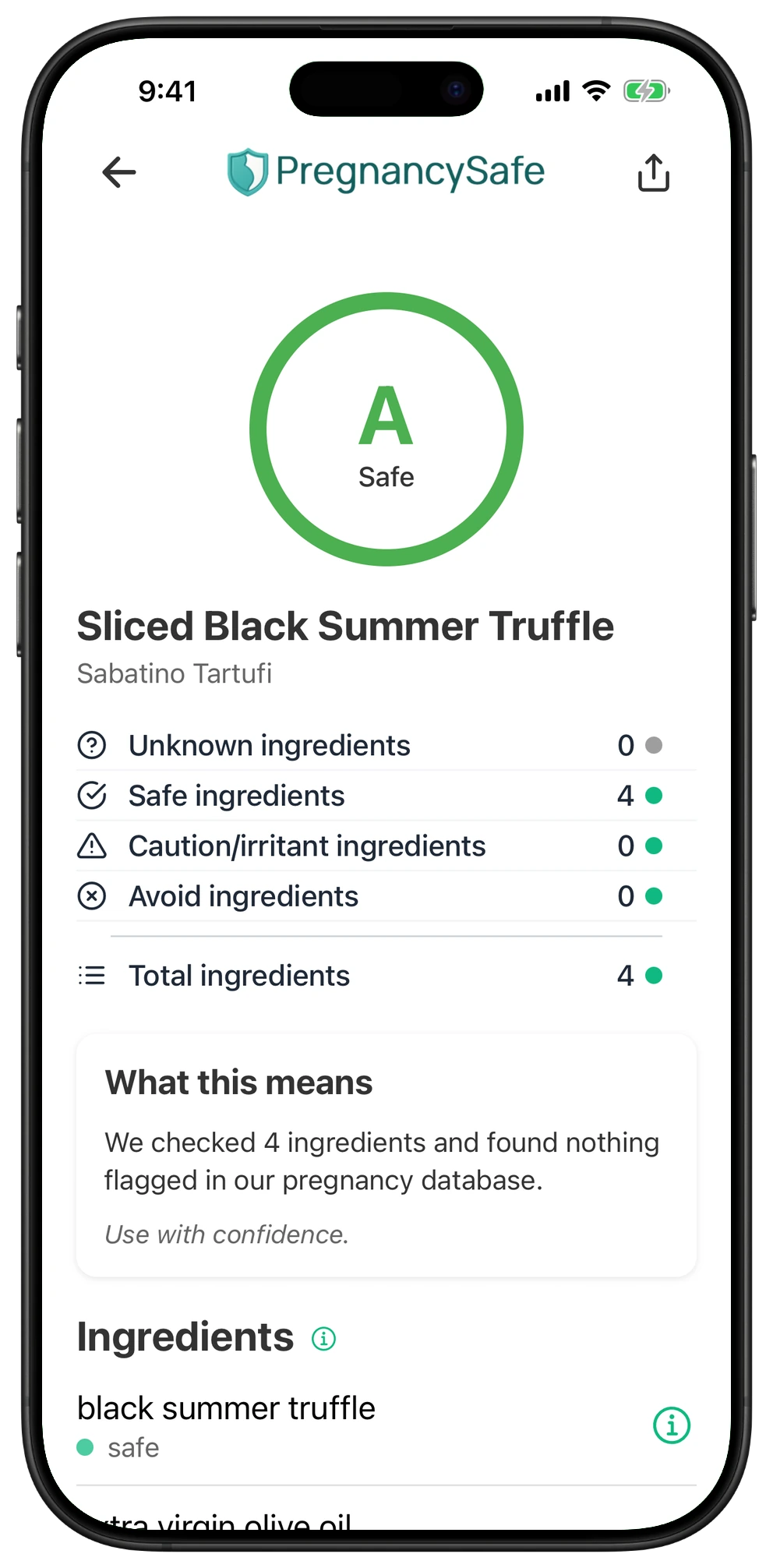
| A | Sliced Black Summer Truffle | Sabatino Tartufi |
Your Questions Answered
Can you have truffle when pregnant?
Commercially sourced culinary truffles can fit into your meals with careful food handling. Choose clearly identified edible truffles, clean them before preparation and follow storage directions. This does not extend to uncertain foraged fungi or psychoactive products sold under the same name.
Can I eat raw or cooked truffle during pregnancy?
Do not assume raw truffle shavings are ready to eat just because they are served as a garnish. Careful cleaning and hygienic preparation matter, and cooking does not replace correct identification or storage. For packaged truffles, follow the preparation instructions rather than assuming every preserved, frozen or dried form can be eaten without further preparation.
Is truffle oil safe during pregnancy?
Ordinary culinary truffle oil or flavoring is not, by itself, a reason to assume pregnancy toxicity. Check the actual ingredients and follow the bottle's storage and use after opening instructions. Truffle oil is a food flavoring, not a pregnancy treatment, and its name alone does not establish the safety of the finished dish.
How much truffle can I eat while pregnant?
There is no established pregnancy specific portion limit here for culinary truffles. Use them as a food ingredient rather than assuming larger amounts offer pregnancy benefits. Guidance about ordinary food use should not be extended to concentrated supplements or psychoactive products.
Are chocolate truffles the same as culinary truffles?
No chocolate truffles are confections, while culinary truffles are edible fungi. For chocolate versions, check the filling and choose alcohol free options. If you want to limit nonessential dyes, look for versions without red 40, red 3, yellow 5 or blue 1; limited pregnancy data and indirect findings do not establish fetal harm from an occasional regulated food exposure.
Does an A grade mean a truffle product is pregnancy safe?
No. Grades describe ingredient scores, not pathogen testing, preparation, serving amounts or current package contents. This page now uses six whole or sliced culinary truffle records, excluding chocolate confections and other prepared foods. Even this more relevant sample cannot establish the safety of every edible truffle or replace food handling precautions.
How Do We Score Products for Pregnancy Safety?
We analyze each product's ingredients and category to flag known risks and provide cautionary notices for general category safety concerns.
Grades reflect the ingredient and category information available to us. They don’t verify a complete, current label or account for dose, preparation, or contamination. Read them alongside the guidance above, not as a guarantee of pregnancy safety or proof that every use is harmful.
A - Safe
Excellent choice! All ingredients are considered safe during pregnancy.
What to do: Use with confidence.
B - Likely Safe
Pretty much safe with very minimal risk. Some ingredients may have limited pregnancy studies, but no significant safety concerns have been identified.
What to do: Use with confidence.
C - Limit
Contains ingredients with some pregnancy considerations. Research shows these ingredients may have limited safety data, potential for minor hormonal effects, or require caution based on animal studies.
What to do: Use sparingly and consider safer alternatives when available.
D - Caution
Similar to C grade but contains multiple cautionary ingredients. The combination increases overall concern.
What to do: Try to avoid if that makes you feel better. If you've already used it, no need to panic.
F - Avoid
Contains an ingredient Pregnancy Safe recommends avoiding during pregnancy. This may reflect an established risk or a precaution based on limited evidence; check the ingredient guidance and exposure context.
What to do: Do not use during pregnancy. If you've already used it, don't worry - contact your OBGYN if concerned.