Best Pregnancy Safe Teeth Whitening Strips (Updated 2026 Guide)
Updated September 9, 2026
The Answer
Postpone teeth whitening strips during pregnancy and discuss whitening with your dentist; NHS guidance does not recommend elective whitening while pregnant. Our catalog contains 17 products—1 graded A, 5 C+, and 11 C but these ingredient grades do not establish pregnancy suitability or identify a proven safe alternative.
The main consideration is limited pregnancy evidence for elective whitening, rather than proof that every exposure causes harm. Hydrogen peroxide bleaching can irritate the mouth, particularly with stronger concentrations or repeated treatments; concerns about other ingredients often come from swallowed or high dose exposures and do not establish harm from strip use. Peroxide free or natural formulas are not proven pregnancy safe substitutes, so prioritize fluoride brushing, flossing, and necessary dental care.
Pregnancy Safe is 100% independent and research driven. No companies pay to promote or sponsor products.
Stress Less This Pregnancy
Check your exact teeth whitening strips in the app

✓ What's Safe
- • Choose routine fluoride toothpaste and flossing rather than a replacement whitening strip during pregnancy.
- • Look for a complete ingredient label for the exact version you are discussing with your dentist; an ingredient grade alone cannot establish suitability.
- • Check whether the whitening agent and its concentration are disclosed, along with contact time and treatment frequency.
- • Read pregnancy warnings and instructions about swallowing, gum contact, and irritation before considering future use.
- • Ask your dentist about discoloration and appropriate dental care rather than relying on peroxide free, enzyme, or coconut oil claims.
✗ What to Avoid
- • Avoid starting elective whitening during pregnancy, including hydrogen peroxide strips; defer rather than switching to an unproven alternative.
- • Avoid higher strength hydrogen peroxide, repeated bleaching courses, or longer wear times as a shortcut to faster results.
- • Avoid treating salvia officinalis oil as reassurance that a natural strip is pregnancy safe; essential oil concentration and swallowed exposure matter.
- • Avoid assuming sodium saccharin, alcohol, or ci 42090 on a strip label proves fetal harm or that removing them proves the whole formula safe.
- • Avoid swallowing whitening gel or using household peroxide as a dental treatment.
- • Avoid DIY acid or abrasive whitening, and do not let cosmetic whitening delay care for dental pain or infection.
Most Common Ingredients in Teeth Whitening Strips Products
We analyzed 17 teeth whitening strips products. Here are the most common ingredients, ranked by how often they appear:
Ingredients to Watch Out For in Teeth Whitening Strips
These are the most common flagged ingredients across 17 teeth whitening strips products we analyzed.
hydrogen peroxide
Caution
Hydrogen peroxide is a colorless, aqueous liquid commonly used as a disinfectant, antiseptic, and bleaching agent.
Is low concern for occasional dilute intact skin hair or oral care exposure as directed, but concentrated bleaching products, ingestion, eye contact, and large area or significantly broken skin use can irritate or cause toxicity.
Hydrogen peroxide is the bleaching agent in many whitening strips. Oral irritation depends on concentration, contact time, and repeated use; evidence about dilute intact skin exposure does not establish pregnancy safety for dental bleaching. Do not swallow the gel, and defer elective whitening during pregnancy.
Flagged in 11 of 17 products (65%)
sodium saccharin
Caution
Sodium saccharin is a synthetic, calorie free sweetener commonly used to enhance the sweetness of foods and beverages.
Crosses the placenta and has limited pregnancy outcome data so frequent or high intake is best treated cautiously.
Sodium saccharin is a sweetener that can appear in whitening strip formulas. Pregnancy concerns relate mainly to swallowed exposure, placental transfer, and uncertainty with frequent or high intake, not demonstrated harm from strip contact. Its presence alone does not reveal the absorbed dose or establish fetal harm.
Flagged in 9 of 17 products (53%)
salvia officinalis oil
Caution
Salvia officinalis oil is an aromatic essential oil derived from sage leaves, known for its antimicrobial, anti inflammatory, and invigorating properties.
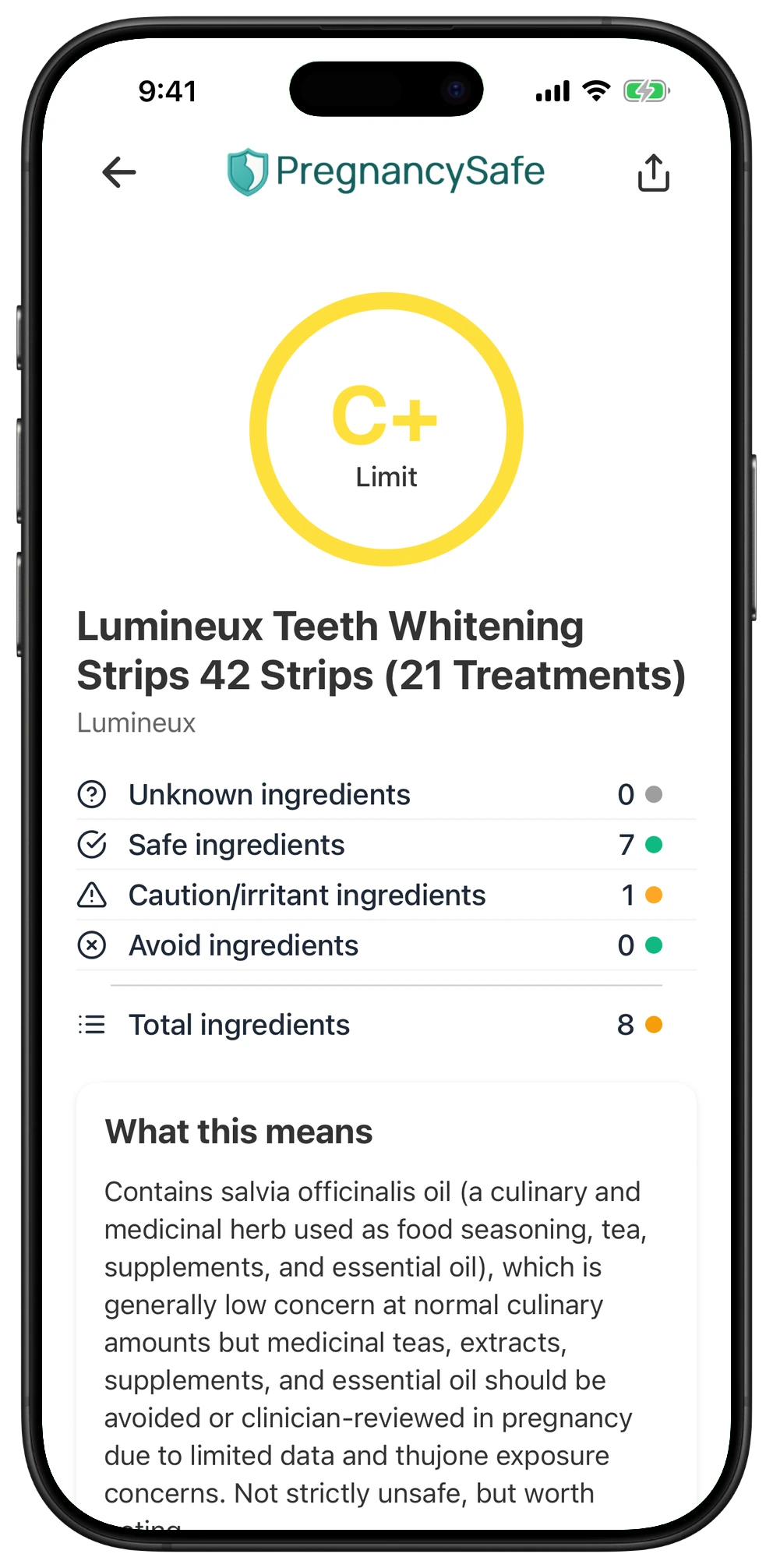
Is generally low concern at normal culinary amounts but medicinal teas, extracts, supplements, and essential oil should be avoided or clinician reviewed in pregnancy due to limited data and thujone exposure concerns.
Salvia officinalis oil is sage essential oil, not simply the herb used in seasoning. It can contain thujone, which is neurotoxic at high doses, but that hazard does not establish harm from an unspecified amount in a whitening strip. Concentration and swallowed exposure remain important unknowns; a natural formulation is not a proven pregnancy safe alternative.
Flagged in 3 of 17 products (18%)
alcohol
Caution
Alcohol is a volatile, colorless liquid commonly used as a solvent, disinfectant, or intoxicating beverage.
No amount of Alcohol is considered safe. Avoid alcohol beverages entirely. Be extremely careful when using in cooking or even with small percentages.
Alcohol may serve as a solvent in a whitening strip formulation. Guidance against drinking alcohol during pregnancy should not be treated as proof that brief contact with an alcohol containing strip creates the same exposure. The label alone does not establish concentration or swallowed dose, and an alcohol free claim does not establish whitening safety.
Flagged in 2 of 17 products (12%)
ci 42090
Caution
CI 42090, also known as Brilliant Blue FCF, is a vibrant synthetic blue dye commonly used to add color to foods, beverages, and cosmetics.
Has limited human pregnancy data; regulated food use is not shown to cause fetal harm, but high dose animal neurobehavior findings and child sensitivity concerns support minimizing frequent exposure.
CI 42090 is Brilliant Blue FCF, also called Blue 1, a color additive. Limited pregnancy data and findings from high dose animal or childhood dietary exposure do not establish fetal harm from whitening strip use. A dye free formula may omit this colorant, but that does not make elective whitening pregnancy safe.
Flagged in 2 of 17 products (12%)
How Do Teeth Whitening Strips Products Stack Up?
Our catalog contains ratings for 17 teeth whitening strips products. These are database grades, not independent safety certifications.
Ingredient grades cannot establish dose, preparation, label completeness, efficacy or pregnancy suitability. An A score is not an endorsement, and counts include unreviewed catalog records.
Your Questions Answered
Can I use teeth whitening strips while pregnant?
Postpone elective whitening and discuss it with your dentist. NHS guidance does not recommend teeth whitening during pregnancy because safety evidence is limited. This precaution does not mean that every strip or previous exposure has been shown to harm a pregnancy.
Why is postponing teeth whitening during pregnancy better?
Whitening is elective, so you can defer it without postponing necessary dental treatment. Pregnancy specific evidence is limited, and bleaching can irritate your mouth. Waiting avoids an optional exposure while you continue fluoride brushing, flossing, and dental care.
Are peroxide free or natural whitening strips pregnancy safe?
Peroxide free, enzyme, coconut oil, and natural claims do not establish pregnancy safety. Removing hydrogen peroxide changes the formula but does not demonstrate that its replacement has adequate pregnancy evidence. Sage essential oil also needs exposure specific consideration rather than being treated like culinary sage. Defer whitening rather than selecting a substitute based on marketing.
What if I used whitening strips before knowing I was pregnant?
A previous use does not by itself establish that your pregnancy was harmed. The recommendation to defer reflects limited evidence, not proof of harm from every exposure. Pause further whitening and tell your dentist or pregnancy clinician the exact product, number of treatments, wear time, and whether you swallowed gel. Seek prompt advice if you swallowed a substantial amount or have ongoing mouth irritation.
Does an A grade mean a whitening strip is safe during pregnancy?
No. Our catalog contains one A grade record, but ingredient grades cannot establish concentration, label completeness, effectiveness, or pregnancy suitability. Counts include catalog records that have not been independently reviewed. No whitening strip is recommended here as a pregnancy safe replacement.
Can I have professional whitening or use home remedies instead?
The recommendation to defer elective whitening also applies to professional whitening during pregnancy. Dentist supervision does not remove the pregnancy evidence gap. Do not replace strips with DIY acid or abrasive treatments. Continue routine oral hygiene and seek dental care for pain or infection rather than delaying necessary treatment.
How Do We Score Products for Pregnancy Safety?
We analyze each product's ingredients and category to flag known risks and provide cautionary notices for general category safety concerns.
Grades reflect the ingredient and category information available to us. They don’t verify a complete, current label or account for dose, preparation, or contamination. Read them alongside the guidance above, not as a guarantee of pregnancy safety or proof that every use is harmful.
A - Safe
Excellent choice! All ingredients are considered safe during pregnancy.
What to do: Use with confidence.
B - Likely Safe
Pretty much safe with very minimal risk. Some ingredients may have limited pregnancy studies, but no significant safety concerns have been identified.
What to do: Use with confidence.
C - Limit
Contains ingredients with some pregnancy considerations. Research shows these ingredients may have limited safety data, potential for minor hormonal effects, or require caution based on animal studies.
What to do: Use sparingly and consider safer alternatives when available.
D - Caution
Similar to C grade but contains multiple cautionary ingredients. The combination increases overall concern.
What to do: Try to avoid if that makes you feel better. If you've already used it, no need to panic.
F - Avoid
Contains an ingredient Pregnancy Safe recommends avoiding during pregnancy. This may reflect an established risk or a precaution based on limited evidence; check the ingredient guidance and exposure context.
What to do: Do not use during pregnancy. If you've already used it, don't worry - contact your OBGYN if concerned.
People Also Checked
References
- https://www.nhs.uk/tests-and-treatments/teeth-whitening/
- https://pmc.ncbi.nlm.nih.gov/articles/PMC8884185/
- https://pmc.ncbi.nlm.nih.gov/articles/PMC3114665/
- https://journals.sagepub.com/doi/10.1177/10915818241237790
- https://wwwn.cdc.gov/TSP/MMG/MMGDetails.aspx?mmgid=304&toxid=55
- https://www.gov.uk/government/publications/hydrogen-peroxide-properties-incident-management-and-toxicology/hydrogen-peroxide-general-information
- https://dailymed.nlm.nih.gov/dailymed/lookup.cfm?setid=2c48f58a-a2d1-4a28-8dbf-a9d2c620bca6
- https://ec.europa.eu/health/ph_risk/committees/04_sccp/docs/sccp_o_122.pdf
- https://pubmed.ncbi.nlm.nih.gov/38914633/
- https://www.fda.gov/food/food-additives-petitions/aspartame-and-other-sweeteners-food
- https://apps.who.int/food-additives-contaminants-jecfa-database/Home/Chemical/3164
- https://www.efsa.europa.eu/en/news/saccharin-safety-threshold-increased
- https://pubmed.ncbi.nlm.nih.gov/34500483/
- https://pubmed.ncbi.nlm.nih.gov/3756841/
- https://pubmed.ncbi.nlm.nih.gov/32275895/
- https://www.acog.org/womens-health/experts-and-stories/ask-acog/are-diet-drinks-a-good-choice
- https://pubmed.ncbi.nlm.nih.gov/22777177/
- https://www.nccih.nih.gov/health/sage
- https://www.ema.europa.eu/en/documents/herbal-monograph/final-european-union-herbal-monograph-salvia-officinalis-l-folium-revision-1_en.pdf
- https://www.ema.europa.eu/en/documents/public-statement/public-statement-salvia-officinalis-l-aetheroleum_en.pdf
- https://www.ema.europa.eu/en/documents/scientific-guideline/public-statement-use-herbal-medicinal-products-containing-thujone-revision-1_en.pdf
- https://webprod.hc-sc.gc.ca/nhpid-bdipsn/dbImages/mono_Sage_Oral_EN.pdf
- https://pubmed.ncbi.nlm.nih.gov/23933314/
- https://pmc.ncbi.nlm.nih.gov/articles/PMC7956842/
- https://www.hfpappexternal.fda.gov/scripts/fdcc/index.cfm?id=FDCBlue1&set=ColorAdditives
- https://www.ecfr.gov/current/title-21/chapter-I/subchapter-A/part-74
- https://www.fda.gov/food/color-additives-information-consumers/tracking-food-industry-pledges-remove-petroleum-based-food-dyes
- https://efsa.onlinelibrary.wiley.com/doi/10.2903/j.efsa.2010.1853
- https://apps.who.int/food-additives-contaminants-jecfa-database/Home/Chemical/3309
- https://pubmed.ncbi.nlm.nih.gov/23208798/
- https://pubmed.ncbi.nlm.nih.gov/24257113/
- https://oehha.ca.gov/risk-assessment/report/health-effects-assessment-potential-neurobehavioral-effects-synthetic-food-dyes-children