Is Pesto Safe During Pregnancy? (Updated 2026 Guide)
Updated September 9, 2026
The Answer
Yes ordinary food portions of pesto are generally suitable during pregnancy when dairy pasteurization and safe preparation and storage are confirmed. Our catalog contains 165 A grade entries out of 177, but ingredient grades do not verify food handling or guarantee pregnancy safety.
The main consideration is foodborne contamination, particularly with dairy ingredients or pesto that has not been stored as directed. Pasteurized feta is generally acceptable when handled safely, though contamination can occur after pasteurization. Ordinary culinary basil, pine nuts and fennel are distinct from concentrated herbal preparations; concerns about medicinal fennel use do not establish harm from a normal serving of pesto.
Pregnancy Safe is 100% independent and research driven. No companies pay to promote or sponsor products.
Stress Less This Pregnancy
Check your exact pesto in the app

✓ What's Safe
- • Check the exact package for dairy ingredients and confirm pasteurization with the manufacturer if it is unclear.
- • Follow the storage instructions for your particular pesto, including refrigeration and the use within period after opening.
- • For homemade pesto, wash fresh herbs and use clean utensils and preparation equipment.
- • Choose pesto with a complete ingredient and allergen label, especially if you need to avoid milk, pine nuts or cashews.
- • Use pesto in ordinary food portions rather than adding concentrated herbal oils or extracts.
✗ What to Avoid
- • Avoid pesto containing unpasteurized feta or feta whose pasteurization status you cannot confirm.
- • Do not eat refrigerated pesto that has been left unrefrigerated contrary to its storage instructions.
- • Avoid recalled pesto and jars with damaged seals; do not try to make them usable by heating.
- • Do not keep opened pesto beyond the package's stated use within period.
- • Avoid adding concentrated fennel essential oil or medicinal extracts unless your clinician recommends them; culinary fennel seed or leaves are a different exposure.
Most Common Ingredients in Pesto Products
We analyzed 177 pesto products. Here are the most common ingredients, ranked by how often they appear:
Ingredients to Watch Out For in Pesto
These are the most common flagged ingredients across 177 pesto products we analyzed.
Caution
Fennel seed is a aromatic spice with a sweet, licorice like flavor commonly used to enhance savory dishes and digestive remedies.
Is generally low concern at normal culinary amounts but should be avoided as concentrated medicinal tea, essential oil, or supplement during pregnancy because safety data are limited and estrogenic or uterine concerns exist.
Flagged in 1 of 177 products (1%)
feta cheese pasteurized milk
Caution
Feta cheese made from pasteurized milk is a tangy, crumbly Greek cheese with a creamy texture and salty flavor.
May carry Listeria risk if made from raw or unpasteurized milk or contaminated after pasteurization, while pasteurized feta kept cold or cooked until steaming hot is generally the safer pregnancy choice.
Flagged in 1 of 177 products (1%)
iblean wild fennel leaves
Caution
Is generally low concern at normal culinary amounts but should be avoided as concentrated medicinal tea, essential oil, or supplement during pregnancy because safety data are limited and estrogenic or uterine concerns exist.
Flagged in 1 of 177 products (1%)
Pesto Products We've Analyzed
Our catalog contains ratings for 177 pesto products. These are database grades, not independent safety certifications.
Catalog ingredient grades do not measure current-label completeness, pathogens, preparation, caffeine or clinical pregnancy suitability. These counts include unreviewed records and are not a percentage of independently verified safe products.
Pregnancy Safe Pesto Products
Popular options from our catalog, prioritizing A and B ingredient grades, with C grade options used to fill remaining places. Within each group, products are ordered by searches in Pregnancy Safe, not retail sales. Read the cautions and guidance above; grades do not verify a complete current label or guarantee pregnancy safety.
| Grade | Product | Brand |
|---|---|---|
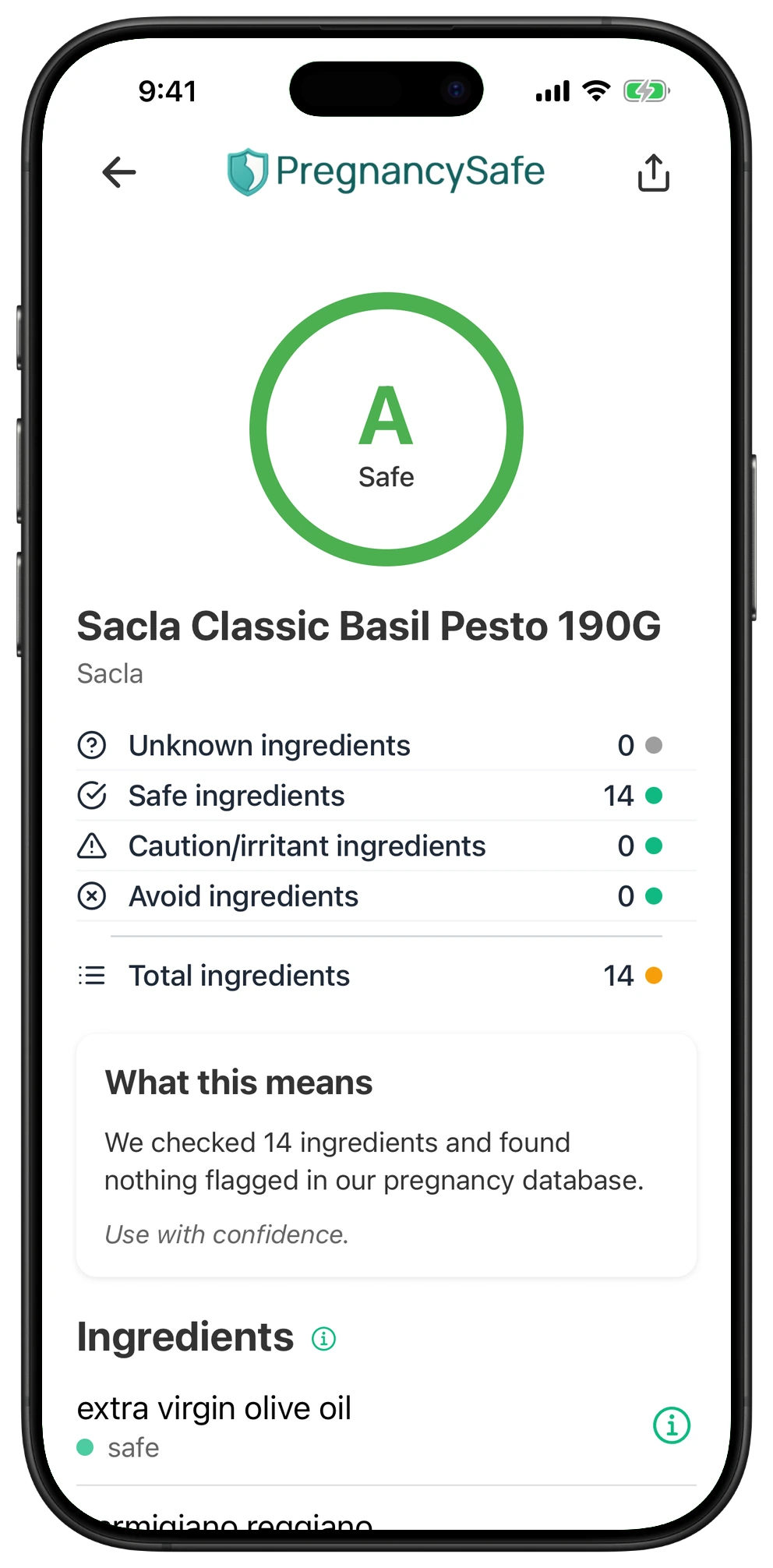
| A | Sacla Classic Basil Pesto | Sacla |
| A | Leggo'S Basil Pesto | Leggo'S |
| A | Irresistible Basil Pesto | Irresistibles |
| A | Giovanni Rana Basil Pesto | Rana Meal Solutions |
| A | Lidl Baresa Green Pesto With Basil | Baresa |
Your Questions Answered
Is store bought pesto pasteurized?
Do not assume every store bought pesto is pasteurized. Pasteurization of a dairy ingredient and heat treatment of the finished sauce are separate questions. Check the exact package or ask the manufacturer to confirm dairy pasteurization. Follow its storage directions even when pasteurized ingredients are used.
What sauces should I avoid when pregnant?
Avoid sauces made with raw or partly cooked unpasteurized eggs, such as some homemade hollandaise or Caesar dressings. With pesto, focus on dairy pasteurization and safe storage rather than avoiding basil or pine nuts. Avoid recalled sauces and those stored contrary to their instructions. Recipes vary, so check ingredients rather than relying on the sauce's name.
Is homemade pesto safer than store bought pesto during pregnancy?
Homemade pesto is not automatically safer. It lets you choose the ingredients, but washing herbs, using clean equipment and refrigerating it promptly still matter. Confirm pasteurization for dairy ingredients. Store bought pesto also needs correct handling and adherence to its package instructions.
Can pesto containing feta cause Listeria infection?
Feta can carry Listeria if it is contaminated, particularly when made from unpasteurized milk. Pasteurized feta is generally an acceptable choice when handled safely, but pasteurization does not prevent later contamination. Check dairy pasteurization, keep the pesto cold as directed and follow its use within instructions. A catalog ingredient grade cannot tell you whether a particular jar is contaminated.
Should I avoid basil, pine nuts or fennel in pesto?
Ordinary culinary basil and pine nuts are not grounds for claiming that pesto causes miscarriage. Avoid nuts if you have a relevant allergy, which is a separate consideration. Fennel seed and leaves in normal culinary amounts are low concern. Concentrated fennel teas, essential oils and supplements are different exposures with limited pregnancy safety data and should be avoided unless your clinician recommends them.
Does an A grade mean pesto is verified safe during pregnancy?
No an A grade describes catalog ingredient scoring, not a clinical safety assessment. Our catalog contains 177 pesto entries: 165 graded A, nine B+ and three C+. Those counts include records without independent current label verification and do not measure pathogens or storage conditions. Check your actual package and its handling instructions regardless of the grade.
How Do We Score Products for Pregnancy Safety?
We analyze each product's ingredients and category to flag known risks and provide cautionary notices for general category safety concerns.
Grades reflect the ingredient and category information available to us. They don’t verify a complete, current label or account for dose, preparation, or contamination. Read them alongside the guidance above, not as a guarantee of pregnancy safety or proof that every use is harmful.
A - Safe
Excellent choice! All ingredients are considered safe during pregnancy.
What to do: Use with confidence.
B - Likely Safe
Pretty much safe with very minimal risk. Some ingredients may have limited pregnancy studies, but no significant safety concerns have been identified.
What to do: Use with confidence.
C - Limit
Contains ingredients with some pregnancy considerations. Research shows these ingredients may have limited safety data, potential for minor hormonal effects, or require caution based on animal studies.
What to do: Use sparingly and consider safer alternatives when available.
D - Caution
Similar to C grade but contains multiple cautionary ingredients. The combination increases overall concern.
What to do: Try to avoid if that makes you feel better. If you've already used it, no need to panic.
F - Avoid
Contains an ingredient Pregnancy Safe recommends avoiding during pregnancy. This may reflect an established risk or a precaution based on limited evidence; check the ingredient guidance and exposure context.
What to do: Do not use during pregnancy. If you've already used it, don't worry - contact your OBGYN if concerned.
References
- https://www.nhs.uk/pregnancy/keeping-well/foods-to-avoid/
- https://www.fda.gov/food/people-risk-foodborne-illness/cooking-food-safety-moms-be
- https://hfpappexternal.fda.gov/scripts/fdcc/index.cfm?id=FENNELCOMMON&set=FoodSubstances
- https://www.ema.europa.eu/en/documents/herbal-monograph/final-european-union-herbal-monograph-foeniculum-vulgare-miller-subsp-vulgare-var-dulce-mill-batt-trab-fructus-revision-1_en.pdf
- https://webprod.hc-sc.gc.ca/nhpid-bdipsn/dbImages/mono_fennel-sweet_english.pdf
- https://www.swissmedic.ch/swissmedic/en/home/news/mitteilungen/fencheltee-fuer-schwangere-kinder-unter-4-jahren.html
- https://www.efsa.europa.eu/en/news/have-your-say-estragole-fennel-seed-preparations
- https://www.ncbi.nlm.nih.gov/books/NBK501793/
- https://pubmed.ncbi.nlm.nih.gov/30969204/
- https://pubmed.ncbi.nlm.nih.gov/32733750/
- https://pubmed.ncbi.nlm.nih.gov/23275017/
- https://www.utep.edu/herbal-safety/populations/herbs-to-avoid-during-pregnancy.html
- https://www.cdc.gov/food-safety/foods/pregnant-women.html
- https://www.cdc.gov/listeria/causes/dairy.html
- https://www.fda.gov/food/health-educators/listeria-food-safety-moms-be
- https://www.foodsafety.gov/people-at-risk/pregnant-women
- https://www.acog.org/clinical/clinical-guidance/committee-opinion/articles/2014/12/management-of-pregnant-women-with-presumptive-exposure-to-listeria-monocytogenes
- https://www.ncbi.nlm.nih.gov/books/NBK582795/
- https://pubmed.ncbi.nlm.nih.gov/29774843/