Is Olives Safe During Pregnancy? (Updated 2026 Guide)
Updated September 9, 2026
The Answer
Yes ordinary food portions of commercially packaged olives are generally suitable during pregnancy when stored as directed, with extra checks for cheese fillings and alcohol marinades. Our catalog contains 1,748 A grade records among 1,877 products, but ingredient grades do not verify food handling or clinical pregnancy safety.
For olives, focus on storage and preparation rather than treating routine additives, salt or culinary spices as evidence of fetal harm. Cheese fillings require pasteurization and handling checks, while vermouth or vodka marinades warrant choosing an option without added alcohol because the label alone does not establish your alcohol exposure. Follow refrigeration after opening instructions and compare sodium per serving if you have individualized sodium advice.
Pregnancy Safe is 100% independent and research driven. No companies pay to promote or sponsor products.
Stress Less This Pregnancy
Check your exact olives in the app

✓ What's Safe
- • Choose commercially packaged olives with a readable ingredient list and clear storage instructions.
- • Follow the exact package directions for refrigeration and use after opening.
- • Check every cheese filling for pasteurized milk; choose plain olives if the filling or handling is unclear.
- • Choose marinades without added vermouth or vodka rather than relying on a cocktail themed name to tell you the ingredients.
- • Compare sodium using the same serving size, and match your portion to any sodium advice from your clinician.
✗ What to Avoid
- • Avoid olives from salad bars or open containers when you cannot confirm their storage and handling.
- • Avoid keeping opened olives unrefrigerated when their package requires refrigeration.
- • Avoid raw milk or unlabeled feta cheese fillings; pasteurized feta still needs safe handling.
- • Avoid cold soft blue cheese fillings if following NHS guidance, which recommends cooking them until steaming hot even when pasteurized.
- • Skip deliberately alcohol marinated olives containing vermouth or vodka when the remaining alcohol amount is unknown; do not assume draining makes them alcohol free.
Most Common Ingredients in Olives Products
We analyzed 1,877 olives products. Here are the most common ingredients, ranked by how often they appear:
Ingredients to Watch Out For in Olives
These are the most common flagged ingredients across 1,877 olives products we analyzed.
vermouth
Avoid
Vermouth is a fortified wine flavored with herbs, spices, and botanicals, commonly used in cocktails and as an aperitif.
Has no established safe amount in pregnancy and is linked to fetal alcohol spectrum disorders and other adverse pregnancy outcomes.
Flagged in 17 of 1,877 products (1%)
blue cheese pasteurized cultured milk
Caution
A creamy, tangy cheese made from pasteurized cultured milk, known for its distinctive blue veins and bold flavor.
Can carry Listeria risk in pregnancy when soft unpasteurized or eaten cold and is lower risk when pasteurized and heated until steaming hot.
Flagged in 3 of 1,877 products (0%)
Caution
Fennel seed is a aromatic spice with a sweet, licorice like flavor commonly used to enhance savory dishes and digestive remedies.
Is generally low concern at normal culinary amounts but should be avoided as concentrated medicinal tea, essential oil, or supplement during pregnancy because safety data are limited and estrogenic or uterine concerns exist.
Flagged in 3 of 1,877 products (0%)
feta cheese
Caution
Feta cheese is a tangy, crumbly Greek cheese made from sheep's or goat's milk, often used in salads and Mediterranean dishes.
May carry Listeria risk if made from raw or unpasteurized milk or contaminated after pasteurization, while pasteurized feta kept cold or cooked until steaming hot is generally the safer pregnancy choice.
Flagged in 3 of 1,877 products (0%)
vodka
Avoid
Vodka is a clear, distilled alcoholic beverage known for its neutral flavor and smooth, clean taste.
Has no established safe amount in pregnancy and is linked to fetal alcohol spectrum disorders and other adverse pregnancy outcomes.
Flagged in 3 of 1,877 products (0%)
blue cheese cow's milk
Caution
Can carry Listeria risk in pregnancy when soft unpasteurized or eaten cold and is lower risk when pasteurized and heated until steaming hot.
Flagged in 2 of 1,877 products (0%)
bleu cheese
Caution
Bleu cheese is a creamy, tangy, and pungent blue veined cheese known for its bold flavor and crumbly texture.
Can carry Listeria risk in pregnancy when soft unpasteurized or eaten cold and is lower risk when pasteurized and heated until steaming hot.
Flagged in 1 of 1,877 products (0%)
bleu cheese olives
Caution
Bleu cheese olives are briny green olives stuffed with creamy, tangy bleu cheese, offering a savory and flavorful bite.
Can carry Listeria risk in pregnancy when soft unpasteurized or eaten cold and is lower risk when pasteurized and heated until steaming hot.
Flagged in 1 of 1,877 products (0%)
Olives Products We've Analyzed
Our catalog contains ratings for 1,877 olives products. These are database grades, not independent safety certifications.
Catalog ingredient grades do not measure current-label completeness, pathogens, preparation, caffeine or clinical pregnancy suitability. These counts include unreviewed records and are not a percentage of independently verified safe products.
Pregnancy Safe Olives Products
Popular options from our catalog, prioritizing A and B ingredient grades, with C grade options used to fill remaining places. Within each group, products are ordered by searches in Pregnancy Safe, not retail sales. Read the cautions and guidance above; grades do not verify a complete current label or guarantee pregnancy safety.
| Grade | Product | Brand |
|---|---|---|
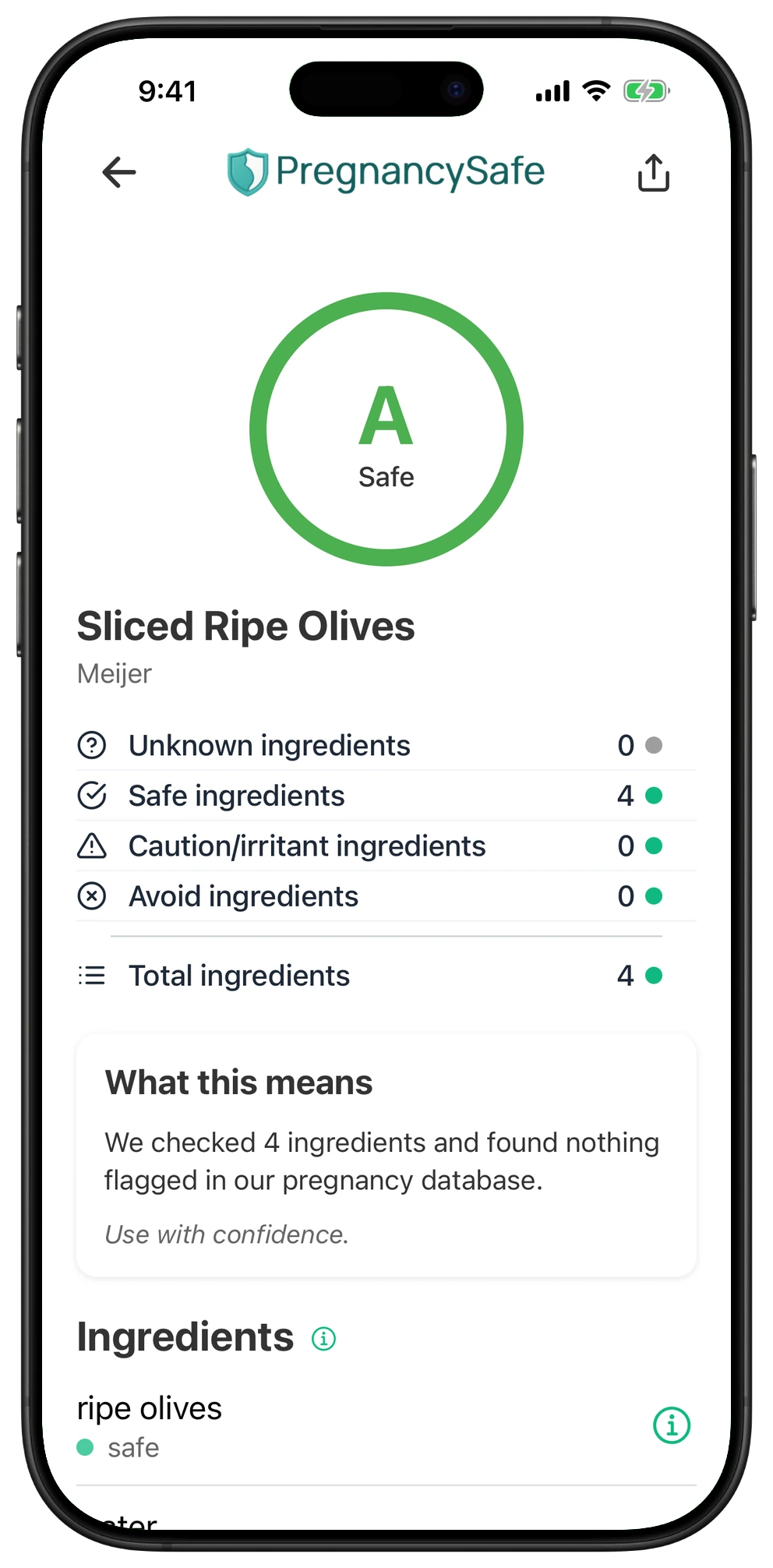
| A | Sliced Ripe Olives | Meijer |
| A | Mezzetta Pitted Greek Kalamata Olives | G. L. Mezzatta, Inc. |
| A | Ode To Olives | H-E-B |
| A | Large Pitted Olives | Lindsay |
| A | Unico Pizza Style Sliced Olives | Unico |
Your Questions Answered
Are olives good for pregnant women?
Olives can fit into your diet during pregnancy in ordinary food portions. Choose them based on their ingredients, storage instructions and sodium per serving rather than an ingredient grade alone. You do not need to eat them for a special pregnancy benefit.
Can I eat canned or jarred olives during pregnancy?
Commercially packaged canned or jarred olives are generally suitable when you follow their storage and preparation instructions. Check the actual package, including any fillings or marinade, rather than assuming every version is the same. Follow refrigeration after opening directions; an unopened shelf stable product does not necessarily remain shelf stable once opened.
Are green, black and Kalamata olives equally suitable?
The practical checks apply to all three: ingredients, fillings, storage and handling matter more than color or variety. Compare sodium on the actual labels rather than assuming one type is lower in salt. A plain packaged olive and a cheese stuffed or alcohol marinated version need different checks, even when they use the same olive variety.
Can I eat cheese stuffed olives while pregnant?
Check the cheese type and whether the milk is pasteurized. Pasteurized feta is generally acceptable when handled safely, although contamination can occur after pasteurization. Guidance differs for soft blue cheese: US guidance emphasizes pasteurized milk, while NHS guidance recommends avoiding it even when pasteurized unless cooked until steaming hot throughout. Plain olives are a simpler choice if you cannot confirm the filling or handling.
Can I eat olives marinated in vermouth or vodka?
Choose olives without added beverage alcohol as a precaution when the remaining alcohol amount is unknown. Vermouth and vodka are alcoholic drinks, but their presence on an olive label does not tell you the dose in a serving or make it equivalent to drinking a cocktail. Pregnancy guidance recommends avoiding beverage alcohol because no safe amount has been established. A small accidental food exposure is not proof that harm occurred.
Do fennel seed or ordinary olive additives need to be avoided?
Fennel seed used as a culinary seasoning is a different exposure from concentrated fennel tea, essential oil or supplements. Ordinary food amounts are low concern; limited pregnancy evidence for concentrated preparations should not be presented as established harm from seasoned olives. Likewise, the presence of routine additives or salt alone does not establish fetal harm. Keep allergy needs and any individualized sodium advice separate from those concerns.
Does an A grade mean olives are guaranteed safe during pregnancy?
No an ingredient grade does not measure pathogens, storage conditions, sodium content or current label completeness. Our catalog contains 1,877 olive products, including 1,748 A grade records, but these are not counts of independently verified safe products. Read your current package and follow its handling instructions regardless of grade. A lower grade or incomplete record is not, by itself, proof that a product is harmful.
How Do We Score Products for Pregnancy Safety?
We analyze each product's ingredients and category to flag known risks and provide cautionary notices for general category safety concerns.
Grades reflect the ingredient and category information available to us. They don’t verify a complete, current label or account for dose, preparation, or contamination. Read them alongside the guidance above, not as a guarantee of pregnancy safety or proof that every use is harmful.
A - Safe
Excellent choice! All ingredients are considered safe during pregnancy.
What to do: Use with confidence.
B - Likely Safe
Pretty much safe with very minimal risk. Some ingredients may have limited pregnancy studies, but no significant safety concerns have been identified.
What to do: Use with confidence.
C - Limit
Contains ingredients with some pregnancy considerations. Research shows these ingredients may have limited safety data, potential for minor hormonal effects, or require caution based on animal studies.
What to do: Use sparingly and consider safer alternatives when available.
D - Caution
Similar to C grade but contains multiple cautionary ingredients. The combination increases overall concern.
What to do: Try to avoid if that makes you feel better. If you've already used it, no need to panic.
F - Avoid
Contains an ingredient Pregnancy Safe recommends avoiding during pregnancy. This may reflect an established risk or a precaution based on limited evidence; check the ingredient guidance and exposure context.
What to do: Do not use during pregnancy. If you've already used it, don't worry - contact your OBGYN if concerned.
References
- https://www.nhs.uk/pregnancy/keeping-well/foods-to-avoid/
- https://www.fda.gov/food/people-risk-foodborne-illness/cooking-food-safety-moms-be
- https://www.cdc.gov/alcohol-pregnancy/about/index.html
- https://www.cdc.gov/fasd/about/index.html
- https://www.acog.org/womens-health/infographics/alcohol-and-pregnancy
- https://www.niaaa.nih.gov/publications/brochures-and-fact-sheets/alcohol-and-your-pregnancy
- https://mothertobaby.org/fact-sheets/alcohol-pregnancy/
- https://pubmed.ncbi.nlm.nih.gov/26482673/
- https://pmc.ncbi.nlm.nih.gov/articles/PMC9543418/
- https://www.cdc.gov/food-safety/foods/pregnant-women.html
- https://www.cdc.gov/listeria/causes/dairy.html
- https://www.fda.gov/food/people-risk-foodborne-illness/ready-eat-foods-food-safety-moms-be
- https://www.foodsafety.gov/people-at-risk/pregnant-women
- https://www.cdc.gov/listeria/signs-symptoms/index.html
- https://wwwnc.cdc.gov/eid/article/24/6/17-1051_article
- https://hfpappexternal.fda.gov/scripts/fdcc/index.cfm?id=FENNELCOMMON&set=FoodSubstances
- https://www.ema.europa.eu/en/documents/herbal-monograph/final-european-union-herbal-monograph-foeniculum-vulgare-miller-subsp-vulgare-var-dulce-mill-batt-trab-fructus-revision-1_en.pdf
- https://webprod.hc-sc.gc.ca/nhpid-bdipsn/dbImages/mono_fennel-sweet_english.pdf
- https://www.swissmedic.ch/swissmedic/en/home/news/mitteilungen/fencheltee-fuer-schwangere-kinder-unter-4-jahren.html
- https://www.efsa.europa.eu/en/news/have-your-say-estragole-fennel-seed-preparations
- https://www.ncbi.nlm.nih.gov/books/NBK501793/
- https://pubmed.ncbi.nlm.nih.gov/30969204/
- https://pubmed.ncbi.nlm.nih.gov/32733750/
- https://pubmed.ncbi.nlm.nih.gov/23275017/
- https://www.utep.edu/herbal-safety/populations/herbs-to-avoid-during-pregnancy.html
- https://www.fda.gov/food/health-educators/listeria-food-safety-moms-be
- https://www.acog.org/clinical/clinical-guidance/committee-opinion/articles/2014/12/management-of-pregnant-women-with-presumptive-exposure-to-listeria-monocytogenes
- https://www.ncbi.nlm.nih.gov/books/NBK582795/
- https://pubmed.ncbi.nlm.nih.gov/29774843/