Best Pregnancy Safe Medicine (Updated 2026 Guide)
Updated September 9, 2026
The Answer
Some medicines can be used during pregnancy, but the right choice depends on the active drug, dose, trimester and reason for treatment check the exact formulation with your pharmacist or obstetric clinician. Our catalog contains 205 products with grades ranging from A to F; those grades do not establish pregnancy suitability or justify stopping prescribed treatment.
Start with the active ingredients and strength, not a familiar brand name or an ingredient grade, and check for overlapping drugs in combination medicines. Oral guaifenesin has limited pregnancy evidence, while oral phenylephrine warrants caution because of blood pressure concerns and poor benefit for congestion. Inactive ingredient flags based on food, cosmetic or high dose studies do not establish harm from the amount present in a medicine.
Pregnancy Safe is 100% independent and research driven. No companies pay to promote or sponsor products.
Stress Less This Pregnancy
Check your exact medicine in the app

✓ What's Safe
- • Check the exact Drug Facts label for active ingredients, strength per tablet or measured dose, warnings and directions.
- • Ask your pharmacist or obstetric clinician to match the formulation to your symptoms, pregnancy week, medical conditions and other medicines.
- • Look for a single active ingredient formulation when it meets your treatment needs, rather than adding drugs for symptoms you do not have.
- • Compare every active ingredient across daytime, nighttime, pain and cold medicines before combining them.
- • Choose an alcohol free oral formulation when an otherwise appropriate equivalent is available; still check its active drugs.
- • Confirm the appropriate dose and duration with your care team rather than treating an A grade, homeopathic label or dye free claim as clearance.
✗ What to Avoid
- • Avoid self selecting oral phenylephrine hcl or phenylephrine hydrochloride for congestion without professional advice, particularly early in pregnancy or with high blood pressure; these names describe the same ingredient.
- • Avoid adding guaifenesin without checking whether you need an expectorant, especially in the first trimester or in a multi symptom combination.
- • Avoid unnecessary alcohol exposure from oral liquid medicines when an appropriate alcohol free formulation is available.
- • Avoid taking overlapping active ingredients, including acetaminophen, in separate pain, cold and nighttime products.
- • Avoid NSAIDs at 20 weeks or later unless specifically directed by your clinician. Prescribed low dose 81 mg aspirin is a separate exception; do not stop it based on this page.
- • Avoid replacing prescribed or effective treatment with homeopathic products because of an A grade or a short ingredient list; homeopathic products are not FDA approved or proven effective.
Most Common Ingredients in Medicine Products
We analyzed 205 medicine products. Here are the most common ingredients, ranked by how often they appear:
Ingredients to Watch Out For in Medicine
These are the most common flagged ingredients across 205 medicine products we analyzed.
guaifenesin
Caution
Guaifenesin is an expectorant medication used to loosen and thin mucus in the airways, making it easier to cough up.
Has limited pregnancy data and small unconfirmed first trimester birth defect signals, especially relevant for early pregnancy or combination cough products.
Guaifenesin is an oral expectorant that loosens mucus. Pregnancy summaries do not expect a large increase in overall birth defect risk, but data remain limited and small first trimester associations are unconfirmed. Ask whether it is needed, especially early in pregnancy, and check all other actives and alcohol content in combination formulas.
Flagged in 63 of 205 products (31%)
phenylephrine hcl
Caution
Phenylephrine HCl is a decongestant commonly used to relieve nasal congestion by constricting blood vessels in the nasal passages.
Has limited and mixed pregnancy data, theoretical placental blood flow and blood pressure concerns, and poor benefit for oral OTC congestion use.
Phenylephrine HCl is phenylephrine hydrochloride, not a different decongestant. Routine oral use warrants caution because it can raise blood pressure, has theoretical placental blood flow concerns and offers poor benefit for congestion. Evidence does not show a clear overall increase in major birth defects; supervised intravenous use during anesthesia is a separate clinical setting.
Flagged in 29 of 205 products (14%)
phenylephrine hydrochloride
Caution
Has limited and mixed pregnancy data, theoretical placental blood flow and blood pressure concerns, and poor benefit for oral OTC congestion use.
Phenylephrine hydrochloride is the full name for phenylephrine HCl. For an oral cold medicine, discuss its limited pregnancy evidence, blood pressure effects and poor congestion benefit with your clinician, particularly in the first trimester or with hypertension. These oral use concerns are not a verdict on clinician administered phenylephrine or every other route.
Flagged in 29 of 205 products (14%)
fd c red 40
Caution
FD&C Red 40 is a synthetic red dye commonly used to add vibrant color to foods, beverages, and cosmetics.
Has limited human pregnancy data and is allowed at regulated food additive levels, but child neurobehavior concerns and high dose animal findings make frequent high dye intake worth limiting.
FD&C Red 40, also called Allura Red AC, is a color additive rather than a medicine’s therapeutic ingredient. Pregnancy specific evidence is limited; concerns from studies of children and high dose animals do not establish fetal harm at medicinal excipient doses. A dye free equivalent is an optional formulation preference, not a reason to abandon needed treatment.
Flagged in 26 of 205 products (13%)
saccharin sodium
Caution
Saccharin sodium is a synthetic, non nutritive sweetener used to provide sweetness without calories.
Crosses the placenta and has limited pregnancy outcome data so frequent or high intake is best treated cautiously.
Saccharin sodium, also called sodium saccharin, is a nonnutritive sweetener. Saccharin can cross the placenta, but placental transfer alone does not establish harm, and human outcome data do not establish a birth defect signal at normal food amounts. Uncertainty about frequent or high dietary intake cannot establish risk from an unspecified amount in a medicine.
Flagged in 23 of 205 products (11%)
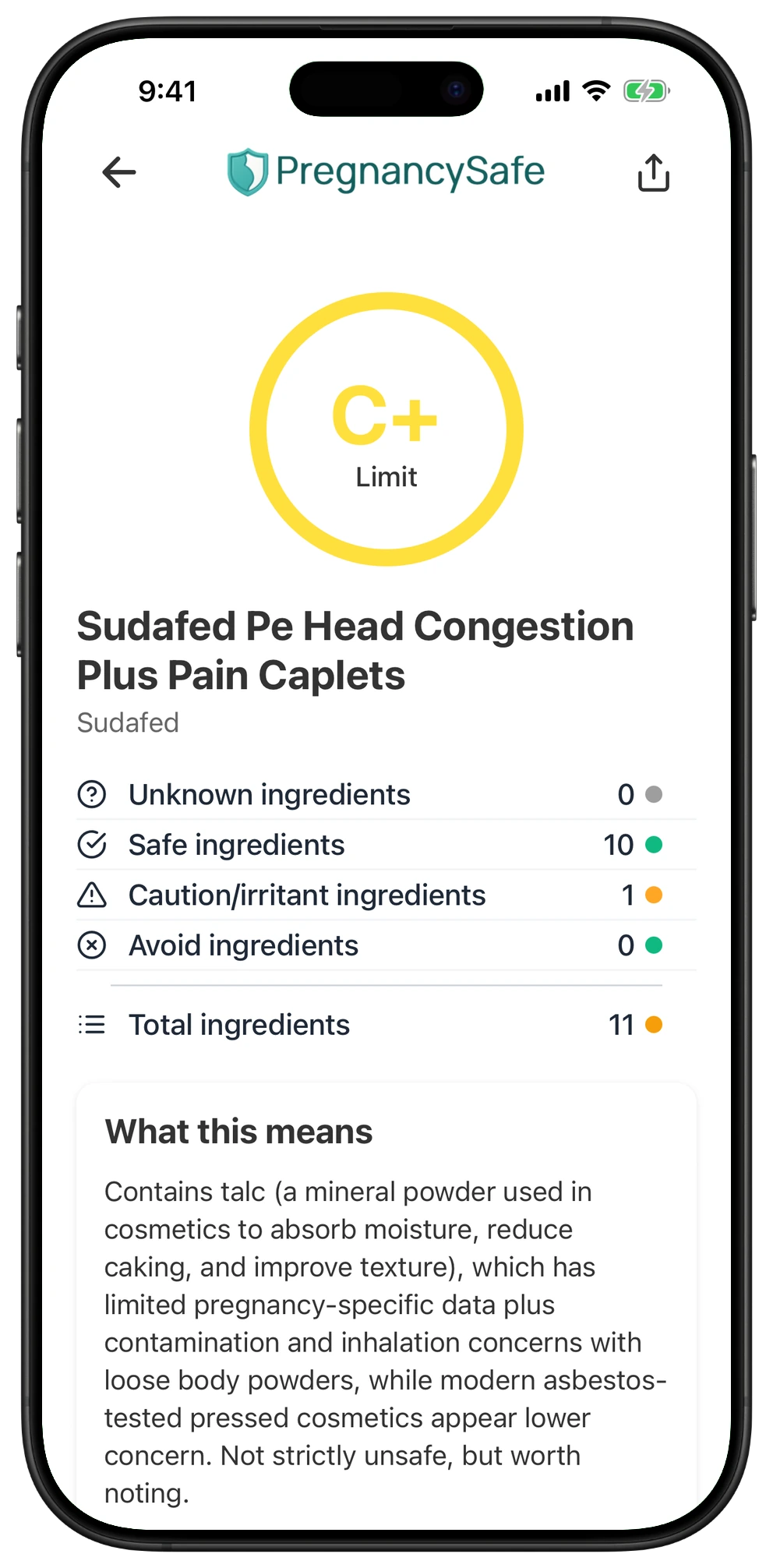
talc
Caution
Talc is a soft mineral composed primarily of magnesium, silicon, and oxygen, commonly used in cosmetics and personal care products for its absorbent and smoothing properties.
Has limited pregnancy specific data plus contamination and inhalation concerns with loose body powders, while modern asbestos tested pressed cosmetics appear lower concern.
Talc is a mineral that may appear among a medicine’s inactive ingredients. Evidence about inhaling loose cosmetic powder or asbestos contamination does not establish pregnancy harm from talc in a swallowed tablet. Its presence alone does not show contamination or justify stopping treatment.
Flagged in 20 of 205 products (10%)
fd c blue 1
Caution
FD&C Blue 1 is a synthetic blue dye commonly used to add color to food, beverages, and pharmaceuticals.
Has limited human pregnancy data; regulated food use is not shown to cause fetal harm, but high dose animal neurobehavior findings and child sensitivity concerns support minimizing frequent exposure.
FD&C Blue 1, also called Brilliant Blue FCF, is a synthetic color additive used in some medicines. Human pregnancy evidence is limited, and child sensitivity findings or high dose animal studies are not direct evidence of fetal harm from a medicinal dose. Prioritize the active drug and dose when comparing formulations.
Flagged in 17 of 205 products (8%)
alcohol
Caution
Alcohol is a volatile, colorless liquid commonly used as a solvent, disinfectant, or intoxicating beverage.
No amount of Alcohol is considered safe. Avoid alcohol beverages entirely. Be extremely careful when using in cooking or even with small percentages.
Alcohol can be a solvent in oral liquid medicines. Prefer an appropriate alcohol free formulation when available, and ask a pharmacist to check the alcohol concentration and amount per dose. Beverage alcohol guidance does not establish the outcome of a particular medicinal exposure; an accidental dose is not proof of fetal harm.
Flagged in 8 of 205 products (4%)
Types of Medicine
How Do Medicine Products Stack Up?
Our catalog contains ratings for 205 medicine products. These are database grades, not independent safety certifications.
Ingredient grades cannot establish dose, preparation, label completeness, efficacy or pregnancy suitability. An A score is not an endorsement, and counts include unreviewed catalog records.
Your Questions Answered
Can medication harm my unborn baby?
Some medicines can pose pregnancy risks, but medicine is not a single exposure with one safety verdict. The active drug, dose, route, timing and condition being treated all matter. Do not stop prescribed treatment on your own; ask your prescriber to review its benefits and risks for your pregnancy.
Could medicine I took before knowing I was pregnant have harmed my baby?
Taking a medicine before recognizing pregnancy does not by itself establish that harm occurred. Save the package or photograph the label, and note how much you took, when and for how long. Your pharmacist or obstetric clinician can assess that specific exposure rather than relying on a catalog grade. Do not abruptly stop an ongoing prescription while waiting for advice.
Is there a list of medicines that are safe for every pregnancy?
No single list can account for your trimester, symptoms, medical conditions and other treatments. Our catalog contains 205 products, including 23 with an A grade, but those counts include records that have not been independently label reviewed. An A grade does not establish effectiveness or pregnancy suitability, and a low grade does not automatically make a medicine contraindicated. This comparison does not offer a universal medicine shopping recommendation.
How should I choose an over the counter cold medicine during pregnancy?
Read the active ingredients on the exact package and ask your pharmacist or obstetric clinician which are appropriate for your symptoms. A single ingredient option may help you avoid drugs you do not need and make duplicate ingredients easier to spot. Oral guaifenesin has limited pregnancy data, and oral phenylephrine deserves caution rather than blanket clearance. If you suspect influenza, contact your clinician promptly about antiviral treatment instead of delaying care to compare OTC products.
Can I take pain medicine during pregnancy?
Ask your clinician or pharmacist about the specific pain medicine, your pregnancy week and the reason you need it. Check combination cold medicines for acetaminophen before adding a separate pain reliever so you do not duplicate it. FDA advises avoiding NSAIDs at 20 weeks or later unless specifically directed by a clinician. Clinician prescribed low dose 81 mg aspirin is a separate exception and should not be stopped on this page’s advice.
Are homeopathic or dye free medicines safer during pregnancy?
Neither label establishes pregnancy safety or treatment effectiveness. Homeopathic products are not FDA approved or proven effective, even when they receive an A ingredient grade. Dye free versions can remove an unnecessary color additive, but you still need to assess the active drugs, strength and formulation. Concerns drawn from high dose animal studies or food color research do not prove fetal harm from a medicine’s inactive ingredient dose.
How Do We Score Products for Pregnancy Safety?
We analyze each product's ingredients and category to flag known risks and provide cautionary notices for general category safety concerns.
Grades reflect the ingredient and category information available to us. They don’t verify a complete, current label or account for dose, preparation, or contamination. Read them alongside the guidance above, not as a guarantee of pregnancy safety or proof that every use is harmful.
A - Safe
Excellent choice! All ingredients are considered safe during pregnancy.
What to do: Use with confidence.
B - Likely Safe
Pretty much safe with very minimal risk. Some ingredients may have limited pregnancy studies, but no significant safety concerns have been identified.
What to do: Use with confidence.
C - Limit
Contains ingredients with some pregnancy considerations. Research shows these ingredients may have limited safety data, potential for minor hormonal effects, or require caution based on animal studies.
What to do: Use sparingly and consider safer alternatives when available.
D - Caution
Similar to C grade but contains multiple cautionary ingredients. The combination increases overall concern.
What to do: Try to avoid if that makes you feel better. If you've already used it, no need to panic.
F - Avoid
Contains an ingredient Pregnancy Safe recommends avoiding during pregnancy. This may reflect an established risk or a precaution based on limited evidence; check the ingredient guidance and exposure context.
What to do: Do not use during pregnancy. If you've already used it, don't worry - contact your OBGYN if concerned.
References
- https://www.fda.gov/safety/medical-product-safety-information/nonsteroidal-anti-inflammatory-drugs-nsaids-drug-safety-communication-avoid-use-nsaids-pregnancy-20
- https://www.fda.gov/drugs/understanding-over-counter-medicines/homeopathic-products
- https://www.cdc.gov/flu/hcp/antivirals/treatment_obstetric.html
- https://www.ncbi.nlm.nih.gov/books/NBK582733/
- https://dailymed.nlm.nih.gov/dailymed/drugInfo.cfm?setid=fedf43d0-d6d1-4f50-bbab-396701e45cb2
- https://pmc.ncbi.nlm.nih.gov/articles/PMC8718348/
- https://www.aafp.org/afp/2023/1000/otc-medications-pregnancy
- https://firstexposure.ca/guaifenesin/
- https://pubmed.ncbi.nlm.nih.gov/9516745/
- https://pubmed.ncbi.nlm.nih.gov/17669294/
- https://www.ncbi.nlm.nih.gov/books/NBK582906/
- https://uktis.org/monographs/treatment-of-hay-fever-allergic-rhinitis-in-pregnancy/
- https://www.medicinesinpregnancy.org/leaflets-a-z/decongestants/
- https://pmc.ncbi.nlm.nih.gov/articles/PMC3816336/
- https://dailymed.nlm.nih.gov/dailymed/lookup.cfm?setid=744da574-dfc9-4a22-8983-2ee15be2ea84
- https://www.fda.gov/news-events/press-announcements/fda-proposes-ending-use-oral-phenylephrine-otc-monograph-nasal-decongestant-active-ingredient-after
- https://www.hfpappexternal.fda.gov/scripts/fdcc/index.cfm?id=FDCRed40&set=ColorAdditives
- https://www.ecfr.gov/current/title-21/chapter-I/subchapter-A/part-74/subpart-A/section-74.340
- https://www.fda.gov/food/color-additives-information-consumers/tracking-food-industry-pledges-remove-petroleum-based-food-dyes
- https://www.efsa.europa.eu/en/efsajournal/pub/1327
- https://www.efsa.europa.eu/en/efsajournal/pub/4007
- https://apps.who.int/food-additives-contaminants-jecfa-database/Home/Chemical/2361
- https://oehha.ca.gov/risk-assessment/report/health-effects-assessment-potential-neurobehavioral-effects-synthetic-food-dyes-children
- https://pubmed.ncbi.nlm.nih.gov/6636206/
- https://pubmed.ncbi.nlm.nih.gov/2613118/
- https://pubmed.ncbi.nlm.nih.gov/7940558/
- https://www.fda.gov/food/food-additives-petitions/aspartame-and-other-sweeteners-food
- https://apps.who.int/food-additives-contaminants-jecfa-database/Home/Chemical/3164
- https://www.efsa.europa.eu/en/news/saccharin-safety-threshold-increased
- https://pubmed.ncbi.nlm.nih.gov/34500483/
- https://pubmed.ncbi.nlm.nih.gov/3756841/
- https://pubmed.ncbi.nlm.nih.gov/32275895/
- https://www.acog.org/womens-health/experts-and-stories/ask-acog/are-diet-drinks-a-good-choice
- https://pubmed.ncbi.nlm.nih.gov/22777177/
- https://www.fda.gov/cosmetics/cosmetic-ingredients/talc
- https://www.fda.gov/cosmetics/cosmetics-news-events/fda-releases-data-agencys-2023-testing-talc-containing-cosmetic-products-asbestos
- https://www.federalregister.gov/documents/2025/11/28/2025-21407/testing-methods-for-detecting-and-identifying-asbestos-in-talc-containing-cosmetic-products
- https://publications.iarc.who.int/Book-And-Report-Series/Iarc-Monographs-On-The-Identification-Of-Carcinogenic-Hazards-To-Humans/Talc-And-Acrylonitrile-2025
- https://www.cancer.org/cancer/risk-prevention/chemicals/talcum-powder-and-cancer.html
- https://www.cdc.gov/niosh/npg/npgd0584.html
- https://pmc.ncbi.nlm.nih.gov/articles/PMC6310682/
- https://recalls-rappels.canada.ca/en/alert-recall/talc-health-risks-associated-inhalation-and-exposure-female-genital-area
- https://www.hfpappexternal.fda.gov/scripts/fdcc/index.cfm?id=FDCBlue1&set=ColorAdditives
- https://www.ecfr.gov/current/title-21/chapter-I/subchapter-A/part-74
- https://efsa.onlinelibrary.wiley.com/doi/10.2903/j.efsa.2010.1853
- https://apps.who.int/food-additives-contaminants-jecfa-database/Home/Chemical/3309
- https://pubmed.ncbi.nlm.nih.gov/23208798/
- https://pubmed.ncbi.nlm.nih.gov/24257113/
- https://wwwn.cdc.gov/TSP/ToxProfiles/ToxProfiles.aspx?id=191&tid=34
- https://pmc.ncbi.nlm.nih.gov/articles/PMC9681673/
- https://pmc.ncbi.nlm.nih.gov/articles/PMC10809980/
- https://www.cdc.gov/vaccine-safety/about/adjuvants.html
- https://www.fda.gov/vaccines-blood-biologics/safety-availability-biologics/common-ingredients-fda-approved-vaccines
- https://www.acog.org/womens-health/infographics/vaccines-during-pregnancy