Is Imitation Crab Safe During Pregnancy? (Updated 2026 Guide)
Updated September 9, 2026
The Answer
Yes imitation crab can fit into pregnancy meals when it is fully cooked, properly stored and hygienically prepared; check the exact package instructions. Our catalog contains mostly B+ ingredient scores, but grades do not establish food safety or replace preparation and handling checks.
Imitation crab is usually cooked surimi, so the main practical consideration is safe preparation and storage, especially when it is served in sushi or chilled premade salads. Check for fish, real crab extract, wheat, soy and egg if you have allergies. Mirin, rice wine or ethanol on an ingredient list does not establish the amount of alcohol in a finished serving, while partially hydrogenated soybean oil raises a separate concern about regular dietary trans fat intake.
Pregnancy Safe is 100% independent and research driven. No companies pay to promote or sponsor products.
Stress Less This Pregnancy
Check your exact imitation crab in the app

✓ What's Safe
- • Check the exact package for fully cooked status and follow its preparation instructions.
- • Choose properly refrigerated or frozen packages and follow storage and use after opening directions.
- • Read the fish species declaration rather than assuming every imitation crab product contains Alaska pollock.
- • Choose freshly prepared dishes made with cooked seafood and utensils kept separate from raw seafood.
- • Read the complete ingredients and allergen statement, including any real crab extract, wheat, soy or egg.
✗ What to Avoid
- • Avoid raw or undercooked seafood additions, even when the imitation crab itself is cooked.
- • Avoid chilled premade seafood salads during pregnancy; choose a freshly prepared, hygienically handled dish instead.
- • Avoid packages or prepared dishes whose refrigeration or storage history is uncertain.
- • Avoid imitation crab containing your allergens; the word imitation does not mean shellfish free.
- • Avoid regularly choosing formulations with partially hydrogenated soybean oil when the current label lists it.
- • Avoid assuming mirin or rice wine means either a beverage sized alcohol exposure or zero residual alcohol; ask the manufacturer if you need clarification.
Most Common Ingredients in Imitation Crab Products
We analyzed 83 imitation crab products. Here are the most common ingredients, ranked by how often they appear:
Ingredients to Watch Out For in Imitation Crab
These are the most common flagged ingredients across 83 imitation crab products we analyzed.
mirin
Avoid
Mirin is a sweet, lightly alcoholic Japanese rice wine used to add depth and subtle sweetness to dishes.
Has no established safe amount in pregnancy and is linked to fetal alcohol spectrum disorders and other adverse pregnancy outcomes.
Flagged in 7 of 83 products (8%)
ethyl alcohol
Avoid
Ethyl alcohol is a colorless, volatile, and flammable organic compound commonly used as a solvent, disinfectant, and in alcoholic beverages.
Has no established safe amount in pregnancy and is linked to fetal alcohol spectrum disorders and other adverse pregnancy outcomes.
Flagged in 6 of 83 products (7%)
alcohol
Caution
Alcohol is a volatile, colorless liquid commonly used as a solvent, disinfectant, or intoxicating beverage.
No amount of Alcohol is considered safe. Avoid alcohol beverages entirely. Be extremely careful when using in cooking or even with small percentages.
Flagged in 4 of 83 products (5%)
rice wine
Avoid
Rice wine is a traditional alcoholic beverage made from fermented polished rice, often used in cooking and for drinking in various Asian cuisines.
Has no established safe amount in pregnancy and is linked to fetal alcohol spectrum disorders and other adverse pregnancy outcomes.
Flagged in 4 of 83 products (5%)
ethanol
Avoid
Ethanol is a clear, volatile, and flammable alcohol commonly used as a solvent, disinfectant, and in alcoholic beverages.
Has no established safe amount in pregnancy and is linked to fetal alcohol spectrum disorders and other adverse pregnancy outcomes.
Flagged in 1 of 83 products (1%)
partially hydrogenated soybean oil
Caution
Partially hydrogenated soybean oil is a processed fat commonly used in foods to improve texture and shelf life, but it contains trans fats linked to health risks.
Mainly raise concern when partially hydrogenated and high in artificial trans fat; fully hydrogenated oils are mostly a saturated fat limit rather than the same trans fat issue.
Flagged in 1 of 83 products (1%)
Imitation Crab Products We've Analyzed
Our catalog contains ratings for 83 imitation crab products. These are database grades, not independent safety certifications.
Grades are ingredient scores, not clinical verdicts or measurements of pathogens, dose, preparation or current package contents. Cohorts include unreviewed catalog records and counts are not independently verified safe-product totals.
Pregnancy Safe Imitation Crab Products
Popular options from our catalog, prioritizing A and B ingredient grades, with C grade options used to fill remaining places. Within each group, products are ordered by searches in Pregnancy Safe, not retail sales. Read the cautions and guidance above; grades do not verify a complete current label or guarantee pregnancy safety.
| Grade | Product | Brand |
|---|---|---|
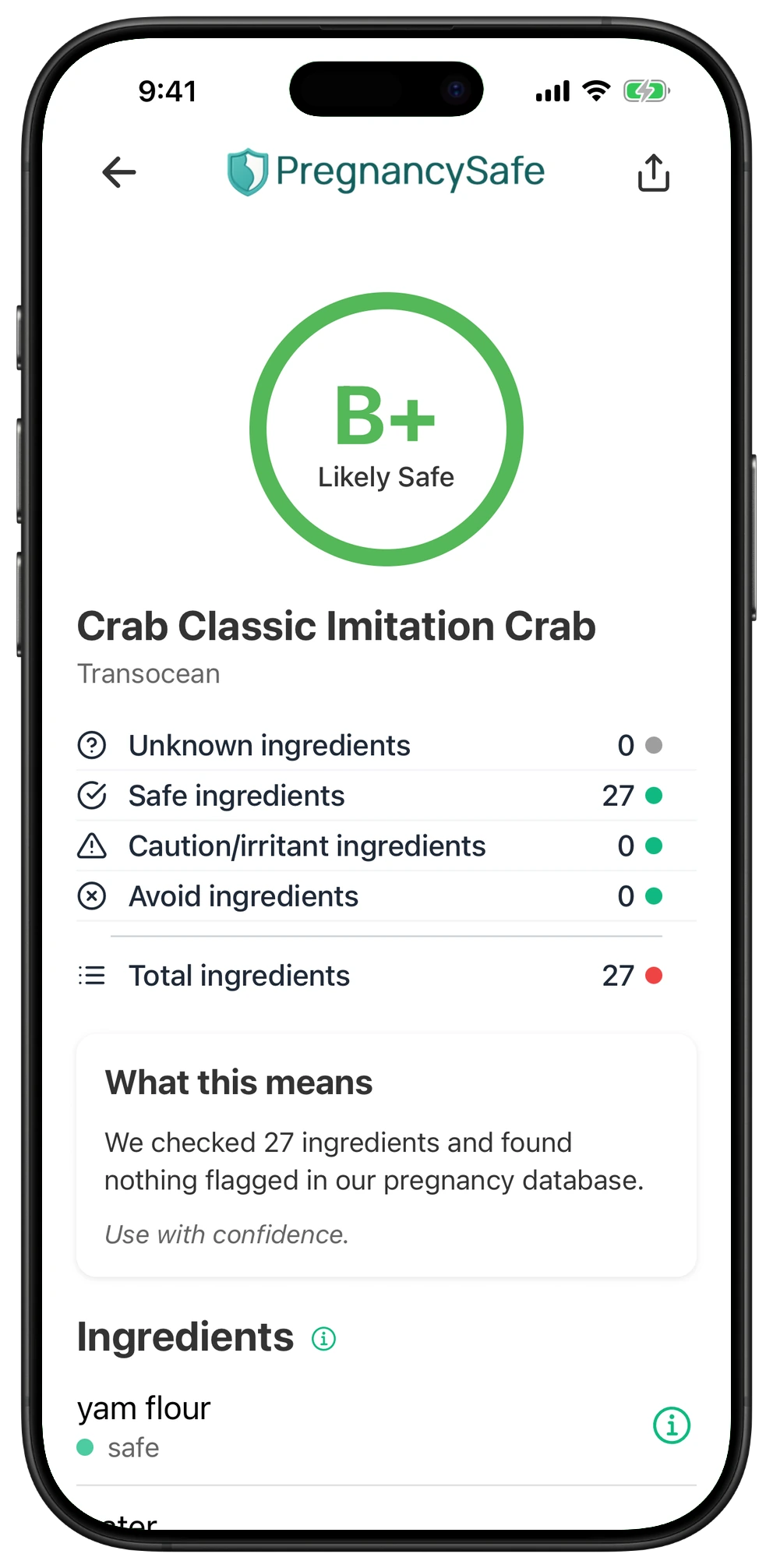
| B+ | Crab Classic Imitation Crab | Transocean |
| B+ | Kroger, Crab Select, Flake Style Imitation Crab Meat | Kroger |
| B+ | Leg Style Imitation Crabmeat | Waterfront Bistro |
| B+ | Great Catch Fully Cooked Imitation Crab Meat - Leg Style | Great Catch |
| B+ | Louis Kemp Crab Delights Flake Style Imitation Crabmeat | Trident Seafoods Corporation |
Your Questions Answered
Is it safe to eat imitation crab while pregnant?
Yes, when it is fully cooked and properly handled, imitation crab can be part of your pregnancy diet. It is usually cooked surimi, but check the exact package rather than relying on the category name. Follow its preparation and storage instructions, and consider the other ingredients and handling of the complete dish.
Does fish help baby brain development?
Fish provides nutrients that support a child's brain development, including omega-3 fats. Choose a variety of lower mercury fish rather than relying only on imitation crab. Surimi formulations vary, so do not assume imitation crab provides the same nutrients or amounts as whole fish or real crab.
Can I eat imitation crab sushi during pregnancy?
A roll made with fully cooked imitation crab differs from sushi containing raw fish. Check that all seafood ingredients are cooked and that preparation avoids contact with raw seafood. Proper storage and hygienic handling still matter, so cooked imitation crab alone does not establish that the entire roll is safe.
Does imitation crab contain mercury?
The fish species matters; imitation crab is not a single standardized fish product. Alaska pollock appears in many formulations, but other species are also used. Check the current label and use lower mercury fish guidance for the declared species rather than treating an ingredient grade as a mercury measurement.
Should I worry about rice wine or mirin in imitation crab?
Rice wine and mirin can introduce alcohol into a recipe, but their presence on a label does not tell you the finished serving's alcohol content. Ethanol and ethyl alcohol are names for the same substance, not separate hazards. Guidance to avoid alcoholic drinks during pregnancy does not establish that a serving of surimi produces an equivalent exposure. If you want to avoid this uncertainty, choose a formulation without these listed ingredients or ask the manufacturer for finished product information.
Is imitation crab safe if I have a shellfish allergy?
Do not assume it is shellfish free. Although imitation crab is generally fish based, it can contain real crab extract and may also contain wheat, soy or egg. Read the current allergen statement and full ingredient list, and follow your allergy clinician's advice when the label is unclear.
Do the grades tell me which imitation crab products are safe?
No grades describe ingredient scores, not clinical safety verdicts. Our catalog contains 83 products: 55 graded B+, 17 F, seven A and four C+. Those counts are not independently verified safe product totals, and grades do not measure pathogens, mercury, exposure dose or current package contents. A low score does not by itself prove a product is harmful, just as an A does not guarantee safe handling.
How Do We Score Products for Pregnancy Safety?
We analyze each product's ingredients and category to flag known risks and provide cautionary notices for general category safety concerns.
Grades reflect the ingredient and category information available to us. They don’t verify a complete, current label or account for dose, preparation, or contamination. Read them alongside the guidance above, not as a guarantee of pregnancy safety or proof that every use is harmful.
A - Safe
Excellent choice! All ingredients are considered safe during pregnancy.
What to do: Use with confidence.
B - Likely Safe
Pretty much safe with very minimal risk. Some ingredients may have limited pregnancy studies, but no significant safety concerns have been identified.
What to do: Use with confidence.
C - Limit
Contains ingredients with some pregnancy considerations. Research shows these ingredients may have limited safety data, potential for minor hormonal effects, or require caution based on animal studies.
What to do: Use sparingly and consider safer alternatives when available.
D - Caution
Similar to C grade but contains multiple cautionary ingredients. The combination increases overall concern.
What to do: Try to avoid if that makes you feel better. If you've already used it, no need to panic.
F - Avoid
Contains an ingredient Pregnancy Safe recommends avoiding during pregnancy. This may reflect an established risk or a precaution based on limited evidence; check the ingredient guidance and exposure context.
What to do: Do not use during pregnancy. If you've already used it, don't worry - contact your OBGYN if concerned.
People Also Checked
References
- https://www.fda.gov/food/consumers/advice-about-eating-fish
- https://www.fda.gov/food/people-risk-foodborne-illness/cooking-food-safety-moms-be
- https://www.cdc.gov/listeria/prevention/index.html
- https://www.cdc.gov/alcohol-pregnancy/about/index.html
- https://www.cdc.gov/fasd/about/index.html
- https://www.acog.org/womens-health/infographics/alcohol-and-pregnancy
- https://www.niaaa.nih.gov/publications/brochures-and-fact-sheets/alcohol-and-your-pregnancy
- https://mothertobaby.org/fact-sheets/alcohol-pregnancy/
- https://pubmed.ncbi.nlm.nih.gov/26482673/
- https://pmc.ncbi.nlm.nih.gov/articles/PMC9543418/
- https://www.fda.gov/food/food-additives-petitions/trans-fat
- https://www.fda.gov/food/hfp-constituent-updates/fda-completes-final-administrative-actions-partially-hydrogenated-oils-foods
- https://www.federalregister.gov/documents/2013/11/08/2013-26854/tentative-determination-regarding-partially-hydrogenated-oils-request-for-comments-and-for
- https://www.who.int/news-room/fact-sheets/detail/trans-fat
- https://cdn.realfood.gov/DGA.pdf
- https://www.fda.gov/food/people-risk-foodborne-illness/dietary-advice-and-during-pregnancy
- https://www.rcpi.ie/Portals/0/Document%20Repository/Institute%20of%20Obstetricians%20and%20Gynaecologists/National%20Clinical%20Guidelines/IOG_National%20Clinical%20Guidelines_Nutrition%20in%20pregnancy%20Guideline_2019.pdf
- https://pmc.ncbi.nlm.nih.gov/articles/PMC8027310/
- https://pmc.ncbi.nlm.nih.gov/articles/PMC3192475/