Is Hot Sauce Safe During Pregnancy? (Updated 2026 Guide)
Updated September 9, 2026
The Answer
Yes ordinary culinary hot sauce is generally acceptable during pregnancy if you tolerate it and follow storage instructions. Our catalog contains 991 A graded entries among 1,289 products, but these are ingredient scores, not independently verified pregnancy safe totals.
The main consideration is your comfort: hot sauce's spiciness and acidity may worsen reflux or nausea, which is different from evidence of miscarriage or fetal harm. Check sodium, added sugars and allergens against your individual dietary needs; occasional regulated food dye exposure is not proven to harm a pregnancy. Ordinary sauce used on food is also different from concentrated capsaicin supplements, and it cannot make raw seafood or eggs safe.
Pregnancy Safe is 100% independent and research driven. No companies pay to promote or sponsor products.
Stress Less This Pregnancy
Check your exact hot sauce in the app

✓ What's Safe
- • Start with a small culinary amount and choose a milder sauce if heat or acidity worsens your symptoms.
- • Read the current bottle's storage instructions, including whether refrigeration is needed after opening.
- • Compare sodium for the amount you actually use, especially if your care team has given you sodium guidance.
- • Check added sugars in sweet hot sauces and fit the portion into any individualized carbohydrate plan.
- • Read the full ingredient and allergen label for the exact flavor and version you are buying.
✗ What to Avoid
- • Avoid pushing through reflux or nausea to finish a spicy meal; reduce the amount or skip the sauce.
- • Avoid using hot sauce as a substitute for properly cooking seafood, meat or eggs.
- • Avoid using sauce that has not been stored according to its label.
- • Avoid treating concentrated chili or capsaicin supplements as equivalent to ordinary hot sauce on food.
- • Avoid large, frequent portions of sweetened sauces containing high fructose corn syrup; the concern is overall added sugar intake, not occasional condiment exposure.
Most Common Ingredients in Hot Sauce Products
We analyzed 1,289 hot sauce products. Here are the most common ingredients, ranked by how often they appear:
Ingredients to Watch Out For in Hot Sauce
These are the most common flagged ingredients across 1,289 hot sauce products we analyzed.
fd c blue 1
Caution
FD&C Blue 1 is a synthetic blue dye commonly used to add color to food, beverages, and pharmaceuticals.
Has limited human pregnancy data; regulated food use is not shown to cause fetal harm, but high dose animal neurobehavior findings and child sensitivity concerns support minimizing frequent exposure.
Flagged in 12 of 1,289 products (1%)
high fructose corn syrup
Caution
High fructose corn syrup is a sweet, liquid sweetener made from corn starch, commonly used in processed foods and beverages.
Is not a known teratogen at occasional food amounts, but high added sugar intake can displace nutrients and raise gestational diabetes and metabolic concerns.
Flagged in 11 of 1,289 products (1%)
papaya
Caution
Papaya is a tropical fruit known for its sweet, orange flesh and rich supply of vitamins, enzymes, and antioxidants.
Is low concern as ripe well washed fruit but calls for avoiding unripe or green papaya and seed/latex/concentrated supplement forms because of animal or in vitro uterine evidence and limited human pregnancy data.
Flagged in 11 of 1,289 products (1%)
blue 1
Caution
Blue 1 is a synthetic blue dye commonly used to add vibrant color to foods, beverages, and cosmetics.
Has limited human pregnancy data; regulated food use is not shown to cause fetal harm, but high dose animal neurobehavior findings and child sensitivity concerns support minimizing frequent exposure.
Flagged in 8 of 1,289 products (1%)
Caution
Red 40 is a synthetic food dye commonly used to add vibrant red color to candies, beverages, and processed foods.
Has limited human pregnancy data and is allowed at regulated food additive levels, but child neurobehavior concerns and high dose animal findings make frequent high dye intake worth limiting.
Flagged in 6 of 1,289 products (0%)
yellow 5
Caution
Yellow 5 is a synthetic food dye used to impart a bright yellow color to various processed foods and beverages.
Has limited human pregnancy data, rare hypersensitivity labeling concerns, and animal/children's neurobehavior signals despite regulated dietary use under ADI based limits.
Flagged in 6 of 1,289 products (0%)
fd c red 40
Caution
FD&C Red 40 is a synthetic red dye commonly used to add vibrant color to foods, beverages, and cosmetics.
Has limited human pregnancy data and is allowed at regulated food additive levels, but child neurobehavior concerns and high dose animal findings make frequent high dye intake worth limiting.
Flagged in 4 of 1,289 products (0%)
fd c red 40 color
Caution
Has limited human pregnancy data and is allowed at regulated food additive levels, but child neurobehavior concerns and high dose animal findings make frequent high dye intake worth limiting.
Flagged in 4 of 1,289 products (0%)
Hot Sauce Products We've Analyzed
Our catalog contains ratings for 1,289 hot sauce products. These are database grades, not independent safety certifications.
Grades are ingredient scores, not clinical verdicts or measurements of pathogens, dose, preparation or current package contents. Cohorts include unreviewed catalog records and counts are not independently verified safe-product totals.
Pregnancy Safe Hot Sauce Products
Popular options from our catalog, prioritizing A and B ingredient grades, with C grade options used to fill remaining places. Within each group, products are ordered by searches in Pregnancy Safe, not retail sales. Read the cautions and guidance above; grades do not verify a complete current label or guarantee pregnancy safety.
| Grade | Product | Brand |
|---|---|---|
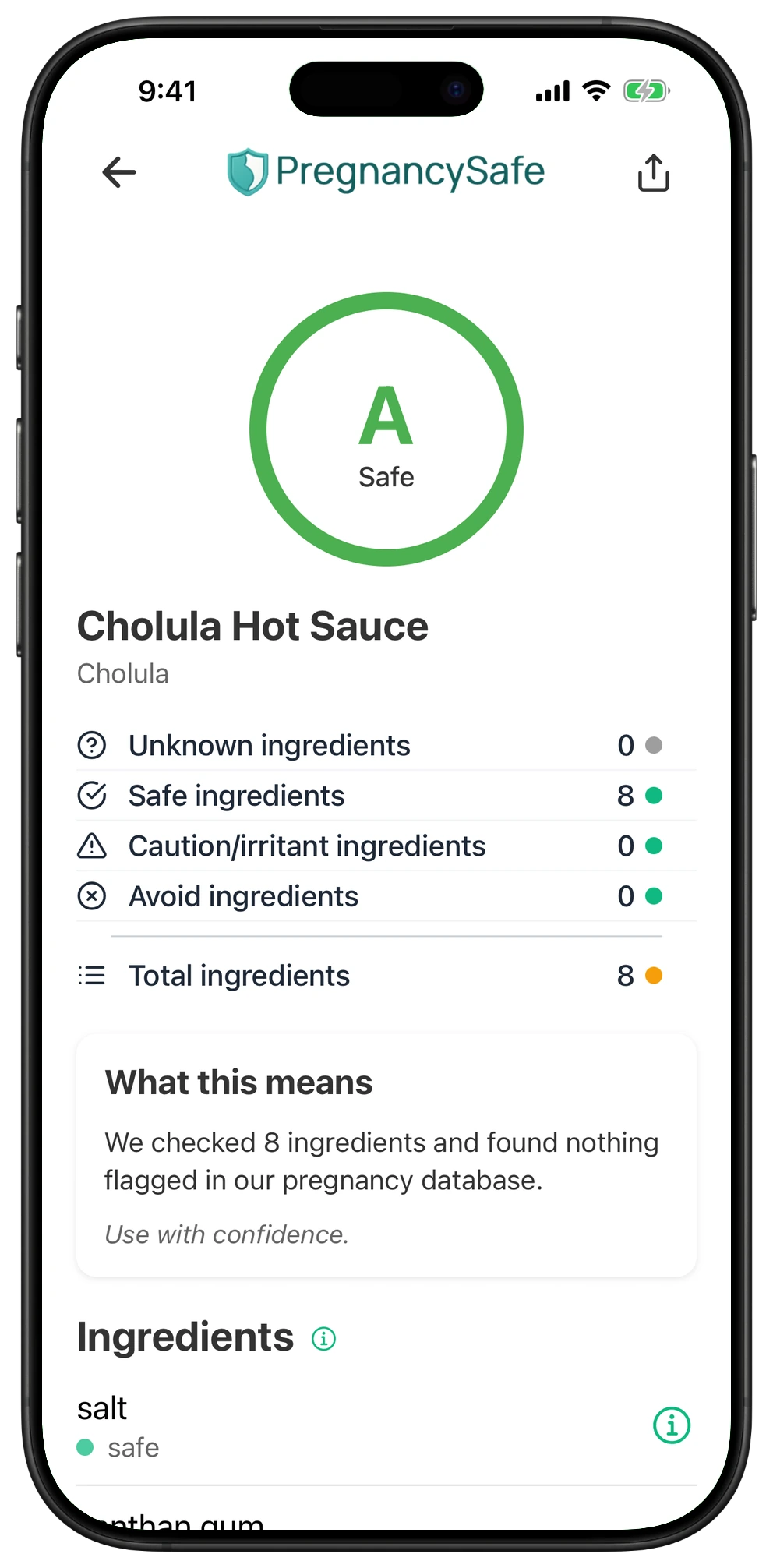
| A | Cholula Hot Sauce | Cholula |
| A | Cholula Original Hot Sauce | Cholula |
| A | Frank'S Redhot Hot Sauce | Frank'S Redhot |
| A | Texas Pete Original Hot Sauce | Texas Pete |
| B+ | Texas Pete Hot Sauce | Texas Pete |
Your Questions Answered
Can a pregnant woman eat hot sauce?
Yes, ordinary hot sauce used as a condiment is not routinely forbidden during pregnancy. Choose an amount that does not worsen nausea or heartburn, and follow the bottle's storage instructions. Your own allergies and any dietary advice from your care team still apply.
Can hot sauce cause miscarriage or hurt the baby?
Ordinary culinary hot sauce is not established as a cause of miscarriage or fetal harm. The burning sensation and reflux you may experience are not evidence that the baby is being harmed. This guidance concerns sauce eaten with food, not concentrated capsaicin supplements or irritant extracts.
How much hot sauce can I eat during pregnancy?
There is no single pregnancy specific amount to recommend for every sauce. Start with a small amount and adjust to your tolerance rather than aiming for a particular heat level. Check sodium and added sugars for your actual portion, and follow individualized guidance if you have gestational diabetes or other dietary needs.
Should I stop eating hot sauce if it gives me heartburn?
Reduce the amount, try a milder sauce or leave it out if it reliably triggers symptoms. Both spiciness and acidity may worsen reflux, so a less spicy sauce may still bother you. If symptoms persist or interfere with eating, ask your pregnancy care team for help.
Do I need to avoid food dyes in hot sauce?
You can choose a sauce without added dyes if you want to limit exposure, but occasional regulated food amounts are not proven to cause fetal harm. Blue 1, Red 40 and Yellow 5 have limited human pregnancy data; concerns from high dose animal studies or studies in children do not establish harm from a small serving during pregnancy. FD&C names and their shorter color number names refer to the same dyes, not separate ingredients. Avoid a dye if you have a known sensitivity to it.
Does hot sauce make raw seafood or eggs safe to eat?
No do not rely on the heat or acidity of hot sauce to disinfect food. Follow pregnancy food safety guidance for the seafood, eggs or other food underneath the sauce. Proper preparation and storage matter independently of the condiment's ingredients.
Does an A grade guarantee a hot sauce is pregnancy safe?
No, an A grade is an ingredient score rather than a clinical safety verdict. Our catalog contains 1,289 hot sauce products, including 991 A graded entries, but these are not independently verified safe product totals. Grades do not measure pathogens, preparation, dose or the current contents of your bottle. Likewise, a lower grade or incomplete record does not by itself prove a sauce is harmful.
How Do We Score Products for Pregnancy Safety?
We analyze each product's ingredients and category to flag known risks and provide cautionary notices for general category safety concerns.
Grades reflect the ingredient and category information available to us. They don’t verify a complete, current label or account for dose, preparation, or contamination. Read them alongside the guidance above, not as a guarantee of pregnancy safety or proof that every use is harmful.
A - Safe
Excellent choice! All ingredients are considered safe during pregnancy.
What to do: Use with confidence.
B - Likely Safe
Pretty much safe with very minimal risk. Some ingredients may have limited pregnancy studies, but no significant safety concerns have been identified.
What to do: Use with confidence.
C - Limit
Contains ingredients with some pregnancy considerations. Research shows these ingredients may have limited safety data, potential for minor hormonal effects, or require caution based on animal studies.
What to do: Use sparingly and consider safer alternatives when available.
D - Caution
Similar to C grade but contains multiple cautionary ingredients. The combination increases overall concern.
What to do: Try to avoid if that makes you feel better. If you've already used it, no need to panic.
F - Avoid
Contains an ingredient Pregnancy Safe recommends avoiding during pregnancy. This may reflect an established risk or a precaution based on limited evidence; check the ingredient guidance and exposure context.
What to do: Do not use during pregnancy. If you've already used it, don't worry - contact your OBGYN if concerned.
People Also Checked
References
- https://www.nhs.uk/pregnancy/keeping-well/foods-to-avoid/
- https://www.fda.gov/food/people-risk-foodborne-illness/cooking-food-safety-moms-be
- https://www.hfpappexternal.fda.gov/scripts/fdcc/index.cfm?id=FDCBlue1&set=ColorAdditives
- https://www.ecfr.gov/current/title-21/chapter-I/subchapter-A/part-74
- https://www.fda.gov/food/color-additives-information-consumers/tracking-food-industry-pledges-remove-petroleum-based-food-dyes
- https://efsa.onlinelibrary.wiley.com/doi/10.2903/j.efsa.2010.1853
- https://apps.who.int/food-additives-contaminants-jecfa-database/Home/Chemical/3309
- https://pubmed.ncbi.nlm.nih.gov/23208798/
- https://pubmed.ncbi.nlm.nih.gov/24257113/
- https://oehha.ca.gov/risk-assessment/report/health-effects-assessment-potential-neurobehavioral-effects-synthetic-food-dyes-children
- https://cdn.realfood.gov/DGA.pdf
- https://www.dietaryguidelines.gov/sites/default/files/2021-12/DGA_Pregnancy_FactSheet-508c.pdf
- https://www.acog.org/womens-health/faqs/healthy-eating-during-pregnancy
- https://www.cdc.gov/nutrition/php/data-research/added-sugars.html
- https://www.cdc.gov/diabetes/about/gestational-diabetes.html
- https://www.who.int/publications/i/item/9789241549028
- https://nesr.usda.gov/2025-dietary-guidelines-advisory-committee-systematic-reviews/dietary-patterns_gestational-diabetes
- https://pubmed.ncbi.nlm.nih.gov/12144723/
- https://pubmed.ncbi.nlm.nih.gov/10837984/
- https://pubmed.ncbi.nlm.nih.gov/14623029/
- https://pubmed.ncbi.nlm.nih.gov/34040647/
- https://www.fda.gov/food/people-risk-foodborne-illness/fruits-veggies-and-juices-food-safety-moms-be
- https://www.cdc.gov/food-safety/foods/pregnant-women.html
- https://www.hfpappexternal.fda.gov/scripts/fdcc/index.cfm?id=FDCRed40&set=ColorAdditives
- https://www.ecfr.gov/current/title-21/chapter-I/subchapter-A/part-74/subpart-A/section-74.340
- https://www.efsa.europa.eu/en/efsajournal/pub/1327
- https://www.efsa.europa.eu/en/efsajournal/pub/4007
- https://apps.who.int/food-additives-contaminants-jecfa-database/Home/Chemical/2361
- https://pubmed.ncbi.nlm.nih.gov/6636206/
- https://pubmed.ncbi.nlm.nih.gov/2613118/
- https://pubmed.ncbi.nlm.nih.gov/7940558/
- https://hfpappexternal.fda.gov/scripts/fdcc/index.cfm?id=FDCYellow5&set=ColorAdditives
- https://www.ecfr.gov/current/title-21/chapter-I/subchapter-A/part-74#74.705
- https://www.fda.gov/food/nutrition-food-labeling-and-critical-foods/food-allergies
- https://apps.who.int/food-additives-contaminants-jecfa-database/Home/Chemical/3885
- https://efsa.onlinelibrary.wiley.com/doi/10.2903/j.efsa.2009.1331
- https://pubmed.ncbi.nlm.nih.gov/1628860/
- https://pmc.ncbi.nlm.nih.gov/articles/PMC7023231/
- https://pmc.ncbi.nlm.nih.gov/articles/PMC6354951/