Is Eggs Safe During Pregnancy? (Updated 2026 Guide)
Updated September 9, 2026
The Answer
Yes, you can eat eggs during pregnancy: under US guidance, cook shell eggs until whites and yolks are firm, or use pasteurized eggs for recipes served raw or undercooked. Our catalog contains 589 A graded entries among 640 products, but ingredient grades do not measure Salmonella risk or safe preparation.
The main concern when eating eggs is Salmonella from raw or undercooked unpasteurized eggs; cook egg dishes to 160°F, refrigerate eggs, and prevent cross contamination. Organic, pasture raised, and brown shell labels do not mean pasteurized. Some prepared or colored items have dye or sodium nitrite cautions, but those concerns do not apply to all eggs or establish harm from occasional regulated food exposure.
Pregnancy Safe is 100% independent and research driven. No companies pay to promote or sponsor products.
Stress Less This Pregnancy
Check your exact eggs in the app

✓ What's Safe
- • Cook ordinary shell eggs until both the whites and yolks are firm.
- • Choose explicitly labeled pasteurized eggs or egg products for recipes that will be served raw or undercooked.
- • Use a food thermometer to check that egg dishes reach 160°F.
- • Keep eggs refrigerated and follow the package's storage and preparation instructions.
- • Wash hands, utensils, and work surfaces after handling raw eggs to prevent cross contamination.
✗ What to Avoid
- • Runny yolks or partially set whites from unpasteurized shell eggs under US guidance.
- • Raw egg sauces, dressings, or desserts when you cannot confirm that pasteurized eggs were used.
- • Assuming organic, pasture raised, cage free, or brown eggs are pasteurized.
- • Letting raw eggs or contaminated utensils touch ready to eat food.
- • Using an A ingredient grade as permission to skip cooking or refrigeration.
- • Applying UK British Lion guidance to ordinary US eggs.
Most Common Ingredients in Eggs Products
We analyzed 640 eggs products. Here are the most common ingredients, ranked by how often they appear:
Ingredients to Watch Out For in Eggs
These are the most common flagged ingredients across 640 eggs products we analyzed.
blue 1
Caution
Blue 1 is a synthetic blue dye commonly used to add vibrant color to foods, beverages, and cosmetics.
Has limited human pregnancy data; regulated food use is not shown to cause fetal harm, but high dose animal neurobehavior findings and child sensitivity concerns support minimizing frequent exposure.
Flagged in 9 of 640 products (1%)
yellow 5
Caution
Yellow 5 is a synthetic food dye used to impart a bright yellow color to various processed foods and beverages.
Has limited human pregnancy data, rare hypersensitivity labeling concerns, and animal/children's neurobehavior signals despite regulated dietary use under ADI based limits.
Flagged in 7 of 640 products (1%)
Caution
Red 40 is a synthetic food dye commonly used to add vibrant red color to candies, beverages, and processed foods.
Has limited human pregnancy data and is allowed at regulated food additive levels, but child neurobehavior concerns and high dose animal findings make frequent high dye intake worth limiting.
Flagged in 5 of 640 products (1%)
red 3
Caution
Red 3 is a synthetic red dye commonly used to add vibrant color to food and beverages.
Has limited human pregnancy outcome data and is being phased out of U.S. foods and ingested drugs after high dose male rat thyroid tumor findings.
Flagged in 3 of 640 products (0%)
fd c red 40
Caution
FD&C Red 40 is a synthetic red dye commonly used to add vibrant color to foods, beverages, and cosmetics.
Has limited human pregnancy data and is allowed at regulated food additive levels, but child neurobehavior concerns and high dose animal findings make frequent high dye intake worth limiting.
Flagged in 2 of 640 products (0%)
red 40 lake
Caution
Red 40 Lake is a synthetic colorant used to impart a vibrant red hue to food, beverages, and cosmetics.
Has limited human pregnancy data and is allowed at regulated food additive levels, but child neurobehavior concerns and high dose animal findings make frequent high dye intake worth limiting.
Flagged in 2 of 640 products (0%)
sodium nitrite
Caution
Sodium nitrite is a chemical compound commonly used as a preservative and color fixative in processed meats.
Is regulated at low food additive levels, but frequent cured or processed meat intake has limited observational pregnancy concerns; cyanide antidote and contaminated water exposures are separate issues.
Flagged in 2 of 640 products (0%)
yellow 5 lake
Caution
Yellow 5 Lake is a synthetic, orange colored dye used to add vibrant color to foods, beverages, and cosmetics.
Has limited human pregnancy data, rare hypersensitivity labeling concerns, and animal/children's neurobehavior signals despite regulated dietary use under ADI based limits.
Flagged in 2 of 640 products (0%)
Eggs Products We've Analyzed
Our catalog contains ratings for 640 eggs products. These are database grades, not independent safety certifications.
Grades are ingredient scores, not clinical verdicts or measurements of pathogens, dose, preparation or current package contents. Cohorts include unreviewed catalog records and counts are not independently verified safe-product totals.
Pregnancy Safe Eggs Products
Popular options from our catalog, prioritizing A and B ingredient grades, with C grade options used to fill remaining places. Within each group, products are ordered by searches in Pregnancy Safe, not retail sales. Read the cautions and guidance above; grades do not verify a complete current label or guarantee pregnancy safety.
| Grade | Product | Brand |
|---|---|---|
| A | Bowl & Basket Fresh White Eggs Large | Bowl & Basket |
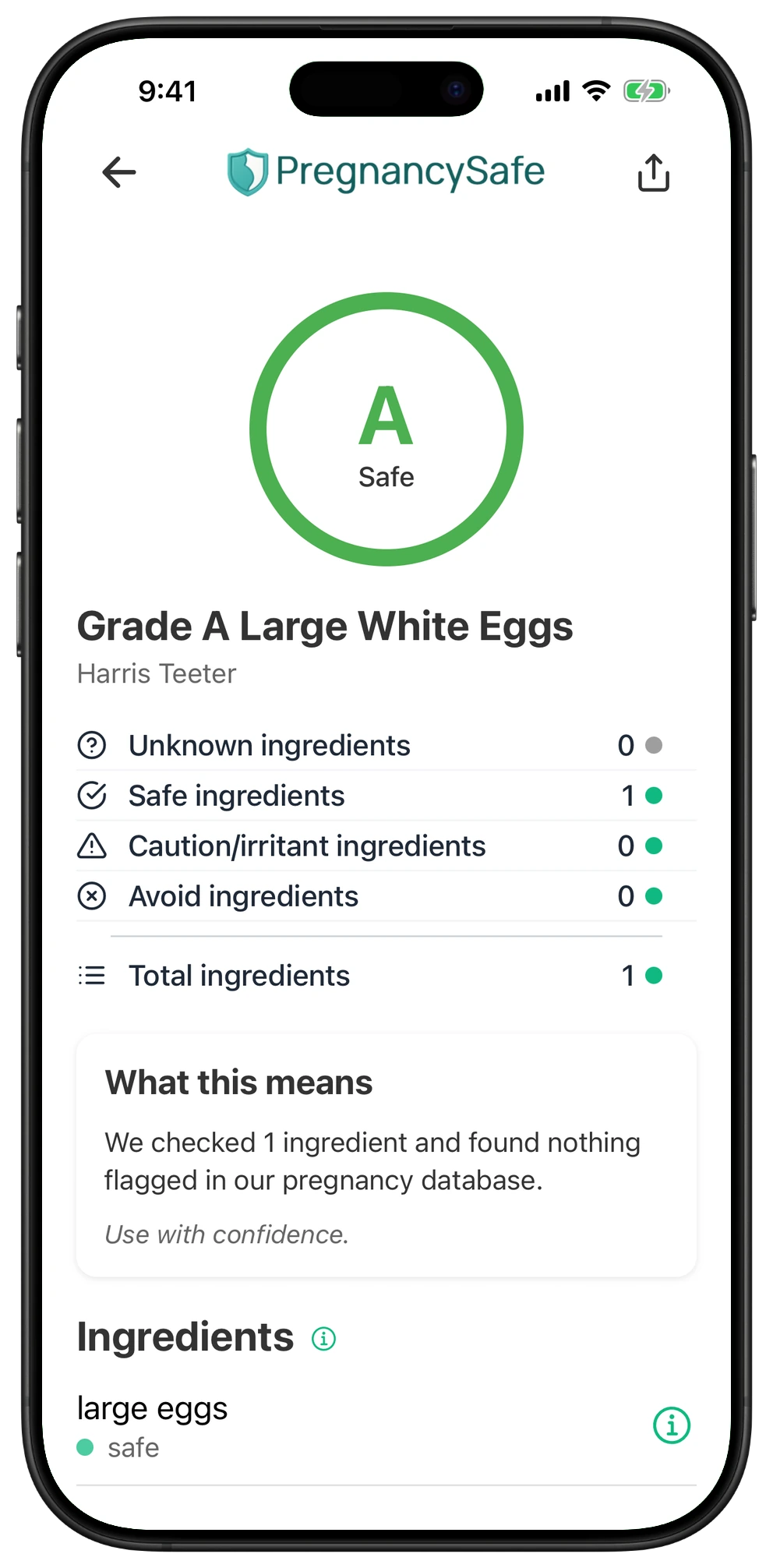
| A | Grade A Large White Eggs | Harris Teeter |
| A | Eggland'S Best Grade A Large Eggs | Eggland'S Best |
| A | Happy Egg Co. Organic Free Range Large Brown Eggs | Happy Egg Co. |
| A | Farm Fresh Egg | Goldhen |
Your Questions Answered
Can pregnant women eat runny eggs?
Under US guidance, use pasteurized eggs if you plan to eat them runny or otherwise undercooked. Cook ordinary unpasteurized shell eggs until both the yolks and whites are firm. Check for an explicit pasteurization statement rather than relying on organic or pasture raised labels. UK British Lion guidance differs and should not be generalized to US eggs.
Are hard boiled eggs safe during pregnancy?
Yes, hard boiled eggs are a suitable option when both the whites and yolks are fully firm. Refrigeration and clean handling still matter after cooking. For packaged hard boiled eggs, follow the storage and use instructions on the current package rather than relying on an ingredient grade.
Are organic or pasture raised eggs safer to eat undercooked?
Those labels do not establish that eggs have been pasteurized. Brown shells also do not indicate pasteurization or permission to eat eggs runny. If the package does not explicitly identify pasteurization, follow US guidance to cook the whites and yolks until firm.
Can I eat foods made with raw eggs during pregnancy?
Use pasteurized eggs or egg products for recipes served raw or undercooked. This matters for foods such as uncooked egg based dressings, sauces, and desserts. When someone else prepares the food, ask whether the eggs were pasteurized. If you cannot confirm that, choose a fully cooked alternative.
How should I cook scrambled eggs, omelets, and other egg dishes?
Cook scrambled eggs and omelets thoroughly rather than leaving liquid egg inside. Egg dishes generally need to reach 160°F; a food thermometer helps check the center. Keep raw egg utensils separate from cooked food, and refrigerate eggs rather than leaving them out.
Does an A grade mean an egg product is safe during pregnancy?
No: an A grade is an ingredient score, not a test for bacteria or a guarantee about preparation. Our catalog contains 640 products, including 589 with an A grade, but those are not independently verified safe product totals. Check the current package, pasteurization status, storage, and cooking instructions. Lower grades or incomplete records likewise do not prove a product is harmful.
Do dye or preservative cautions mean I should avoid eggs?
No, concerns about added ingredients in particular products do not make ordinary eggs unsafe. Dyes such as blue 1, yellow 5, and red 40 have limited human pregnancy evidence; high dose animal findings or effects studied in children do not establish fetal harm from occasional regulated food intake. Sodium nitrite concerns relate mainly to cured or processed meat ingredients, with limited observational pregnancy evidence about frequent intake. For eggs themselves, prioritize pasteurization, thorough cooking, refrigeration, and clean handling.
How Do We Score Products for Pregnancy Safety?
We analyze each product's ingredients and category to flag known risks and provide cautionary notices for general category safety concerns.
Grades reflect the ingredient and category information available to us. They don’t verify a complete, current label or account for dose, preparation, or contamination. Read them alongside the guidance above, not as a guarantee of pregnancy safety or proof that every use is harmful.
A - Safe
Excellent choice! All ingredients are considered safe during pregnancy.
What to do: Use with confidence.
B - Likely Safe
Pretty much safe with very minimal risk. Some ingredients may have limited pregnancy studies, but no significant safety concerns have been identified.
What to do: Use with confidence.
C - Limit
Contains ingredients with some pregnancy considerations. Research shows these ingredients may have limited safety data, potential for minor hormonal effects, or require caution based on animal studies.
What to do: Use sparingly and consider safer alternatives when available.
D - Caution
Similar to C grade but contains multiple cautionary ingredients. The combination increases overall concern.
What to do: Try to avoid if that makes you feel better. If you've already used it, no need to panic.
F - Avoid
Contains an ingredient Pregnancy Safe recommends avoiding during pregnancy. This may reflect an established risk or a precaution based on limited evidence; check the ingredient guidance and exposure context.
What to do: Do not use during pregnancy. If you've already used it, don't worry - contact your OBGYN if concerned.
People Also Checked
References
- https://www.fda.gov/food/people-risk-foodborne-illness/cooking-food-safety-moms-be
- https://www.nhs.uk/pregnancy/keeping-well/foods-to-avoid/
- https://precision.fda.gov/uniisearch/srs/unii/3E0I92Z2GR
- https://ec.europa.eu/health/archive/ph_risk/committees/sccp/documents/out123cm_en.pdf
- https://webprod.hc-sc.gc.ca/nhpid-bdipsn/ingredReq?id=4257
- https://pubmed.ncbi.nlm.nih.gov/12139675/
- https://pubmed.ncbi.nlm.nih.gov/16805419/
- https://pubmed.ncbi.nlm.nih.gov/21980802/
- https://mothertobaby.org/baby-blog/whats-the-skinny-on-skin-care/
- https://www.ogxarabia.com/products/nourishing-coconut-milk-shampoo
- https://originalsbyafricasbest.com/products/hair-mayonnaise-deep-conditioner
- https://www.hfpappexternal.fda.gov/scripts/fdcc/index.cfm?id=FDCBlue1&set=ColorAdditives
- https://www.ecfr.gov/current/title-21/chapter-I/subchapter-A/part-74
- https://www.fda.gov/food/color-additives-information-consumers/tracking-food-industry-pledges-remove-petroleum-based-food-dyes
- https://efsa.onlinelibrary.wiley.com/doi/10.2903/j.efsa.2010.1853
- https://apps.who.int/food-additives-contaminants-jecfa-database/Home/Chemical/3309
- https://pubmed.ncbi.nlm.nih.gov/23208798/
- https://pubmed.ncbi.nlm.nih.gov/24257113/
- https://oehha.ca.gov/risk-assessment/report/health-effects-assessment-potential-neurobehavioral-effects-synthetic-food-dyes-children
- https://hfpappexternal.fda.gov/scripts/fdcc/index.cfm?id=FDCYellow5&set=ColorAdditives
- https://www.ecfr.gov/current/title-21/chapter-I/subchapter-A/part-74#74.705
- https://www.fda.gov/food/nutrition-food-labeling-and-critical-foods/food-allergies
- https://apps.who.int/food-additives-contaminants-jecfa-database/Home/Chemical/3885
- https://efsa.onlinelibrary.wiley.com/doi/10.2903/j.efsa.2009.1331
- https://pubmed.ncbi.nlm.nih.gov/1628860/
- https://pmc.ncbi.nlm.nih.gov/articles/PMC7023231/
- https://pmc.ncbi.nlm.nih.gov/articles/PMC6354951/
- https://www.hfpappexternal.fda.gov/scripts/fdcc/index.cfm?id=FDCRed40&set=ColorAdditives
- https://www.ecfr.gov/current/title-21/chapter-I/subchapter-A/part-74/subpart-A/section-74.340
- https://www.efsa.europa.eu/en/efsajournal/pub/1327
- https://www.efsa.europa.eu/en/efsajournal/pub/4007
- https://apps.who.int/food-additives-contaminants-jecfa-database/Home/Chemical/2361
- https://pubmed.ncbi.nlm.nih.gov/6636206/
- https://pubmed.ncbi.nlm.nih.gov/2613118/
- https://pubmed.ncbi.nlm.nih.gov/7940558/
- https://www.fda.gov/industry/color-additives/fdc-red-no-3
- https://www.federalregister.gov/documents/2025/01/16/2025-00830/color-additive-petition-from-center-for-science-in-the-public-interest-et-al-request-to-revoke-color
- https://efsa.onlinelibrary.wiley.com/doi/10.2903/j.efsa.2011.1854
- https://pubmed.ncbi.nlm.nih.gov/2824305/
- https://pubmed.ncbi.nlm.nih.gov/2177442/
- https://pubmed.ncbi.nlm.nih.gov/8296313/
- https://pubmed.ncbi.nlm.nih.gov/8386132/
- https://pmc.ncbi.nlm.nih.gov/articles/PMC9368057/
- https://hfpappexternal.fda.gov/scripts/fdcc/index.cfm?id=SODIUMNITRITE&set=FoodSubstances
- https://www.ecfr.gov/current/title-9/section-424.21
- https://www.ecfr.gov/current/title-21/section-172.175
- https://www.efsa.europa.eu/en/press/news/170615
- https://www.inchem.org/documents/jecfa/jecmono/v50je07.htm
- https://pubmed.ncbi.nlm.nih.gov/41248583/
- https://www.cdc.gov/food-safety/foods/pregnant-women.html
- https://publications.iarc.who.int/Book-And-Report-Series/Iarc-Monographs-On-The-Identification-Of-Carcinogenic-Hazards-To-Humans/Red-Meat-And-Processed-Meat-2018
- https://dailymed.nlm.nih.gov/dailymed/drugInfo.cfm?setid=52f01c6e-172a-47a9-98a6-9eab7651a032
- https://www.atsdr.cdc.gov/toxprofiles/tp204.pdf