Is Deli Meat Safe During Pregnancy? (Updated 2026 Guide)
Updated September 9, 2026
The Answer
You can eat deli meat during pregnancy if you reheat it to 165°F or until steaming hot just before eating; otherwise, avoid eating it cold. This precaution applies even to turkey, organic, uncured and nitrate free varieties because they can carry Listeria.
The main pregnancy concern is Listeria, so heating, refrigeration and preventing cross contamination matter more than an ingredient grade. Sodium nitrite and nitrate concerns relate to dietary exposure and frequency; limited observational evidence does not establish that ordinary food additive amounts harm the fetus. BHA and BHT also have limited human pregnancy evidence, and findings from high dose animal exposure are not proof of harm from an occasional serving.
Pregnancy Safe is 100% independent and research driven. No companies pay to promote or sponsor products.
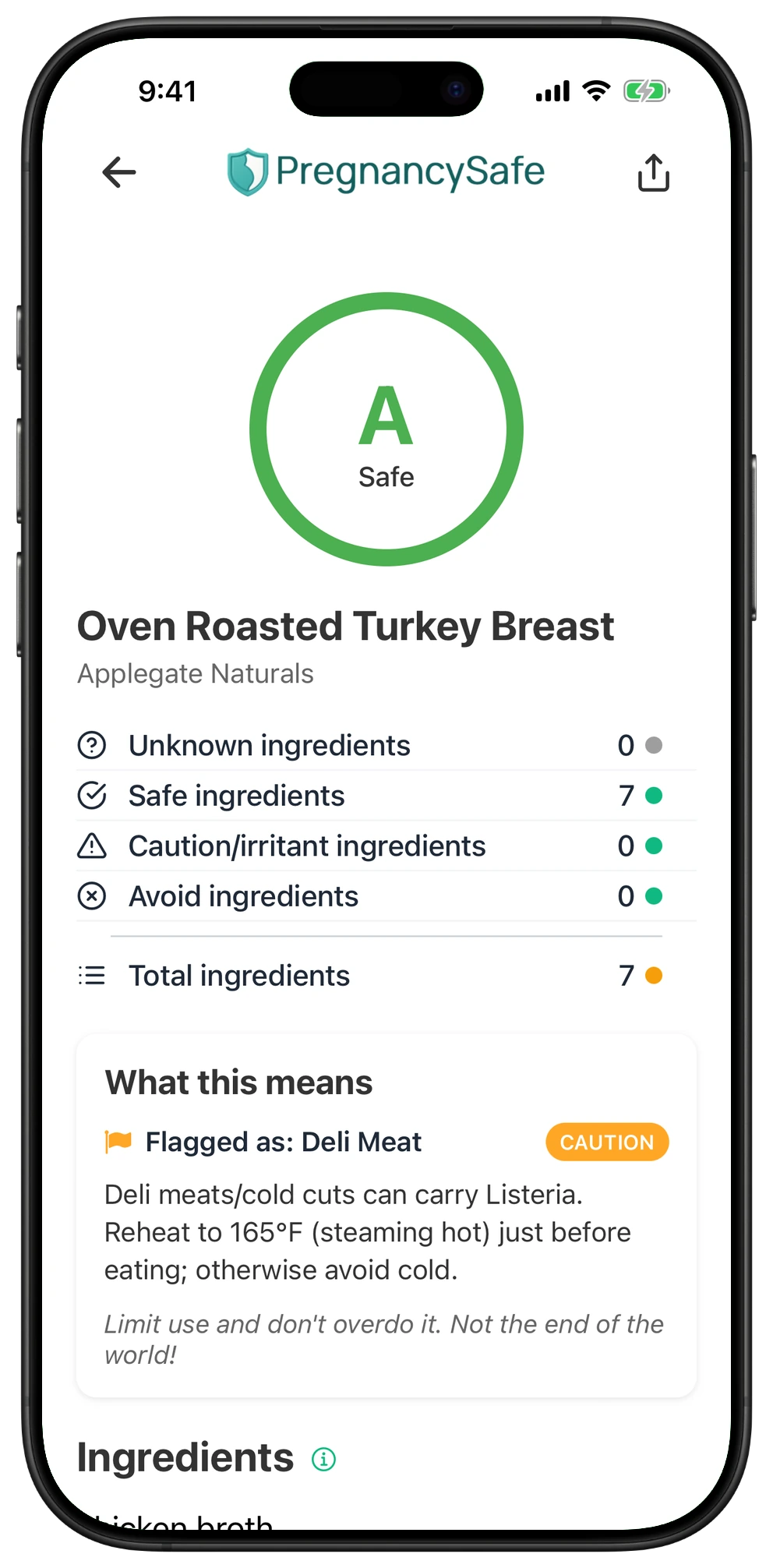
Stress Less This Pregnancy
Check your exact deli meat in the app

✓ What's Safe
- • Heat deli slices to 165°F or until steaming hot throughout, then eat promptly.
- • When ordering a sandwich, ask for the meat itself to be heated thoroughly, not just the bread.
- • Keep refrigerated deli meat refrigerated and follow the package’s storage and use instructions.
- • Use clean utensils and surfaces, and keep heated meat separate from unheated slices and their juices.
- • Distinguish freshly cooked intact poultry from refrigerated deli turkey; an oven roasted label does not remove the need to reheat deli slices.
✗ What to Avoid
- • Cold deli sandwiches or unheated slices straight from the package or deli counter.
- • Deli meat that is only lukewarm after toasting; the meat needs to reach 165°F or be steaming hot.
- • Unheated dry or fermented sausages, including salami; curing does not replace the pregnancy heating precaution.
- • Treating organic, uncured, nitrate free or ready to eat labels as protection against Listeria.
- • Leaving deli meat unrefrigerated or allowing heated slices to touch unclean utensils and surfaces.
- • Using an A grade or a short ingredient list as permission to skip safe handling and reheating.
Most Common Ingredients in Deli Meat Products
We analyzed 2,058 deli meat products. Here are the most common ingredients, ranked by how often they appear:
Ingredients to Watch Out For in Deli Meat
These are the most common flagged ingredients across 2,058 deli meat products we analyzed.
sodium nitrite
Caution
Sodium nitrite is a chemical compound commonly used as a preservative and color fixative in processed meats.
Is regulated at low food additive levels, but frequent cured or processed meat intake has limited observational pregnancy concerns; cyanide antidote and contaminated water exposures are separate issues.
Flagged in 1053 of 2,058 products (51%)
bha
Caution
BHA (beta hydroxy acid) is a chemical exfoliant commonly used in skincare to penetrate pores, remove dead skin cells, and improve skin texture.
Has limited pregnancy specific human data and normal regulated food use appears lower concern than high dose animal exposures that drove carcinogenicity classifications.
Flagged in 63 of 2,058 products (3%)
bht
Caution
BHT (butylated hydroxytoluene) is a synthetic antioxidant commonly used as a preservative to prevent the oxidation of fats and oils in food products.
Has limited human pregnancy data, with low concern at reviewed cosmetic levels but reproductive and thyroid related findings in high dose oral animal studies.
Flagged in 63 of 2,058 products (3%)
sodium nitrate
Caution
Sodium nitrate is a chemical compound commonly used as a preservative and curing agent in processed meats and as a fertilizer in agriculture.
Is context dependent because vegetable sources are generally compatible with pregnancy while contaminated well water above nitrate/nitrite limits can cause methemoglobinemia and has observational links to adverse birth outcomes.
Flagged in 57 of 2,058 products (3%)
wine
Caution
Wine is a fermented beverage made from crushed grapes or other fruits, often enjoyed for its rich flavors and cultural significance.
Avoid wine beverages entirely. Be extremely careful when using in cooking or even with small percentages.
Flagged in 33 of 2,058 products (2%)
white wine
Avoid
White wine is a crisp, pale yellow alcoholic beverage made from fermented white grapes, often used to enhance the flavor of dishes or enjoyed on its own.
Has no established safe amount in pregnancy and is linked to fetal alcohol spectrum disorders and other adverse pregnancy outcomes.
Flagged in 7 of 2,058 products (0%)
potassium nitrate
Caution
Potassium nitrate is a crystalline salt commonly used as a fertilizer, food preservative, and oxidizing agent in explosives.
Is context dependent because vegetable sources are generally compatible with pregnancy while contaminated well water above nitrate/nitrite limits can cause methemoglobinemia and has observational links to adverse birth outcomes.
Flagged in 6 of 2,058 products (0%)
sodium nitrite glaze honey
Caution
Is regulated at low food additive levels, but frequent cured or processed meat intake has limited observational pregnancy concerns; cyanide antidote and contaminated water exposures are separate issues.
Flagged in 5 of 2,058 products (0%)
Deli Meat Products We've Analyzed
Our catalog contains ratings for 2,058 deli meat products. These are database grades, not independent safety certifications.
Catalog ingredient grades do not measure current-label completeness, pathogens, preparation, caffeine or clinical pregnancy suitability. These counts include unreviewed records and are not a percentage of independently verified safe products.
Pregnancy Safe Deli Meat Products
Popular options from our catalog, prioritizing A and B ingredient grades, with C grade options used to fill remaining places. Within each group, products are ordered by searches in Pregnancy Safe, not retail sales. Read the cautions and guidance above; grades do not verify a complete current label or guarantee pregnancy safety.
| Grade | Product | Brand |
|---|---|---|
| A | Oven Roasted Turkey Breast | Applegate Naturals |
| A | Italian Dry Salame | Hillshire Snacking |
| B+ | Hillshire Farm Ultra Thin Sliced Oven Roasted Turkey Breast Sandwich Meat | Hillshire Farm |
| A | Roasted Turkey Breast | Originals |
| B+ | Slow Roasted Turkey Breast | Hillshire Farm |
Your Questions Answered
Can I eat a cold ham and cheese sandwich while pregnant?
Avoid eating the deli ham cold during pregnancy. Heat the ham to 165°F or until steaming hot before assembling your sandwich, and eat promptly. Warming the bread or melting the cheese alone does not show that the meat has been heated sufficiently.
Can I eat deli meat while pregnant if I toast it?
Yes, provided the meat itself reaches 165°F or becomes steaming hot throughout. A toasted sandwich can still contain cold or lukewarm slices, so crisp bread is not a reliable indicator. Heat the meat separately if needed, use clean utensils and eat promptly.
Is oven roasted deli turkey different from freshly cooked turkey?
Yes. Refrigerated oven roasted deli turkey is still deli meat, rather than freshly cooked intact poultry straight from the oven. Its earlier cooking does not remove the need to reheat the refrigerated slices during pregnancy. Heat them to 165°F or until steaming hot before eating.
Are organic, uncured or nitrate free deli meats safer during pregnancy?
These labels do not remove Listeria risk or change the reheating precaution. Celery powder is not automatically free of nitrate or nitrite, either. Compare the full ingredient labels if you want to limit particular additives, but heat all deli meat to 165°F or until steaming hot regardless of those claims.
Do I need to avoid deli meat because of sodium nitrite?
Sodium nitrite is a regulated curing preservative, and its presence alone does not establish that an ordinary serving will harm your baby. Pregnancy specific evidence about higher processed meat exposure is limited and mostly observational, rather than proof of causation. Choosing processed meats less often is a reasonable precaution, but it does not replace heating each serving to address Listeria. Concerns about contaminated drinking water or high dose exposures should not be treated as evidence about an occasional serving of deli meat.
Does an A grade mean deli meat is safe to eat cold?
No. Our catalog contains 2,058 deli meat products, including 339 with an A ingredient grade, but these are not counts of independently verified pregnancy safe products. Ingredient grades do not assess pathogens, handling or current label completeness, and lower grades are not automatic proof that a product is harmful. Even a listed product still requires matching your actual package and following the heating precautions.
How Do We Score Products for Pregnancy Safety?
We analyze each product's ingredients and category to flag known risks and provide cautionary notices for general category safety concerns.
Grades reflect the ingredient and category information available to us. They don’t verify a complete, current label or account for dose, preparation, or contamination. Read them alongside the guidance above, not as a guarantee of pregnancy safety or proof that every use is harmful.
A - Safe
Excellent choice! All ingredients are considered safe during pregnancy.
What to do: Use with confidence.
B - Likely Safe
Pretty much safe with very minimal risk. Some ingredients may have limited pregnancy studies, but no significant safety concerns have been identified.
What to do: Use with confidence.
C - Limit
Contains ingredients with some pregnancy considerations. Research shows these ingredients may have limited safety data, potential for minor hormonal effects, or require caution based on animal studies.
What to do: Use sparingly and consider safer alternatives when available.
D - Caution
Similar to C grade but contains multiple cautionary ingredients. The combination increases overall concern.
What to do: Try to avoid if that makes you feel better. If you've already used it, no need to panic.
F - Avoid
Contains an ingredient Pregnancy Safe recommends avoiding during pregnancy. This may reflect an established risk or a precaution based on limited evidence; check the ingredient guidance and exposure context.
What to do: Do not use during pregnancy. If you've already used it, don't worry - contact your OBGYN if concerned.
People Also Checked
References
- https://www.cdc.gov/listeria/outbreaks/delimeats-7-24/index.html
- https://www.cdc.gov/food-safety/foods/pregnant-women.html
- https://www.cdc.gov/listeria/prevention/index.html
- https://www.fda.gov/food/people-risk-foodborne-illness/cooking-food-safety-moms-be
- https://hfpappexternal.fda.gov/scripts/fdcc/index.cfm?id=SODIUMNITRITE&set=FoodSubstances
- https://www.ecfr.gov/current/title-9/section-424.21
- https://www.ecfr.gov/current/title-21/section-172.175
- https://www.efsa.europa.eu/en/press/news/170615
- https://www.inchem.org/documents/jecfa/jecmono/v50je07.htm
- https://pubmed.ncbi.nlm.nih.gov/41248583/
- https://publications.iarc.who.int/Book-And-Report-Series/Iarc-Monographs-On-The-Identification-Of-Carcinogenic-Hazards-To-Humans/Red-Meat-And-Processed-Meat-2018
- https://dailymed.nlm.nih.gov/dailymed/drugInfo.cfm?setid=52f01c6e-172a-47a9-98a6-9eab7651a032
- https://www.atsdr.cdc.gov/toxprofiles/tp204.pdf
- https://www.fda.gov/food/food-chemical-safety/list-select-chemicals-food-supply-under-fda-review
- https://www.federalregister.gov/documents/2026/02/11/2026-02761/butylated-hydroxyanisole-bha-request-for-information
- https://www.ecfr.gov/current/title-21/chapter-I/subchapter-B/part-182/subpart-D/section-182.3169
- https://www.ecfr.gov/current/title-21/chapter-I/subchapter-B/part-172/subpart-B/section-172.110
- https://www.efsa.europa.eu/en/efsajournal/pub/2392
- https://pmc.ncbi.nlm.nih.gov/articles/PMC13092903/
- https://www.ncbi.nlm.nih.gov/books/NBK590883/
- https://www.inchem.org/documents/iarc/vol40/butylatedhydroxyanisole.html
- https://pubmed.ncbi.nlm.nih.gov/7290287/
- https://pubmed.ncbi.nlm.nih.gov/3804125/
- https://health.ec.europa.eu/system/files/2022-08/sccs_o_257.pdf
- https://pubmed.ncbi.nlm.nih.gov/37751543/
- https://pubmed.ncbi.nlm.nih.gov/12396675/
- https://pmc.ncbi.nlm.nih.gov/articles/PMC13151845/
- https://www.ecfr.gov/current/title-21/chapter-I/subchapter-B/part-172/subpart-B/section-172.115
- https://www.ecfr.gov/current/title-21/chapter-I/subchapter-B/part-182/subpart-D/section-182.3173
- https://www.fda.gov/news-events/press-announcements/fda-finalizes-food-chemical-safety-post-market-assessment-program-launches-reassessment-bht-ada
- https://www.epa.gov/ground-water-and-drinking-water/national-primary-drinking-water-regulations
- https://www.epa.gov/children/private-wells-and-drinking-water-safety-and-infants
- https://archive.cdc.gov/www_atsdr_cdc_gov/csem/nitrate-nitrite/who_risk.html
- https://doh.wa.gov/community-and-environment/drinking-water/contaminants/nitrate
- https://pmc.ncbi.nlm.nih.gov/articles/PMC9834225/
- https://www.efsa.europa.eu/en/efsajournal/pub/689
- https://www.food.gov.uk/safety-hygiene/nitrates-and-nitrites-the-science-explained
- https://www.ecfr.gov/current/title-21/chapter-I/subchapter-B/part-172/subpart-B/section-172.175
- https://www.cdc.gov/alcohol-pregnancy/about/index.html
- https://www.cdc.gov/fasd/about/index.html
- https://www.acog.org/womens-health/infographics/alcohol-and-pregnancy
- https://www.niaaa.nih.gov/publications/brochures-and-fact-sheets/alcohol-and-your-pregnancy
- https://mothertobaby.org/fact-sheets/alcohol-pregnancy/
- https://pubmed.ncbi.nlm.nih.gov/26482673/
- https://pmc.ncbi.nlm.nih.gov/articles/PMC9543418/
- https://www.nccih.nih.gov/health/sage
- https://www.ema.europa.eu/en/documents/herbal-monograph/final-european-union-herbal-monograph-salvia-officinalis-l-folium-revision-1_en.pdf
- https://www.ema.europa.eu/en/documents/public-statement/public-statement-salvia-officinalis-l-aetheroleum_en.pdf
- https://www.ema.europa.eu/en/documents/scientific-guideline/public-statement-use-herbal-medicinal-products-containing-thujone-revision-1_en.pdf
- https://webprod.hc-sc.gc.ca/nhpid-bdipsn/dbImages/mono_Sage_Oral_EN.pdf
- https://pubmed.ncbi.nlm.nih.gov/23933314/
- https://pmc.ncbi.nlm.nih.gov/articles/PMC7956842/