Is Custard Safe During Pregnancy? (Updated 2026 Guide)
Updated September 9, 2026
The Answer
Yes, custard can be suitable during pregnancy when made with pasteurized dairy and pasteurized or thoroughly cooked eggs, then stored correctly. Our catalog contains 41 records, including 18 graded A, but ingredient grades do not establish food safety.
The main consideration is foodborne illness from unpasteurized dairy, inadequately cooked eggs or improper storage; cooked egg mixtures should reach 160°F. Dry mixes need suitable added ingredients and preparation according to the package, while chilled and frozen custards have their own storage requirements. Added sugars matter mainly in relation to portion size and frequent intake, while dye cautions reflect limited pregnancy evidence rather than proven harm from occasional regulated food exposure.
Pregnancy Safe is 100% independent and research driven. No companies pay to promote or sponsor products.
Stress Less This Pregnancy
Check your exact custard in the app

✓ What's Safe
- • Choose custard made with pasteurized milk and cream; ask the seller if this is unclear.
- • Use pasteurized eggs or thoroughly cook the eggs; check cooked egg mixtures reach 160°F with a food thermometer.
- • Read whether the package contains ready to eat custard or a dry mix requiring added ingredients and preparation.
- • Follow the exact package instructions for refrigeration, freezing and use after opening; refrigerate homemade finished custard promptly.
- • Compare added sugar per serving and choose a portion that fits your overall diet and any carbohydrate guidance from your care team.
✗ What to Avoid
- • Custard made with unpasteurized milk or cream.
- • Raw or undercooked custard containing unpasteurized eggs, including tasting the mixture before it is properly cooked.
- • Chilled custard that has not been kept refrigerated or whose storage history cannot be confirmed.
- • Treating dry custard powder as ready to eat, or skipping the package's preparation instructions.
- • Frequent large servings of sugary custard, particularly if you need to manage blood glucose.
- • Assuming that vanilla flavor, an A grade or a frozen format proves the ingredients and handling are suitable.
Most Common Ingredients in Custard Products
We analyzed 41 custard products. Here are the most common ingredients, ranked by how often they appear:
Ingredients to Watch Out For in Custard
These are the most common flagged ingredients across 41 custard products we analyzed.
yellow 5 and 6
Caution
Yellow 5 and 6 are synthetic food colorings commonly used to add bright yellow and orange hues to various processed foods and beverages.
Has limited human pregnancy data, rare hypersensitivity labeling concerns, and animal/children's neurobehavior signals despite regulated dietary use under ADI based limits.
Flagged in 5 of 41 products (12%)
yellow 5
Caution
Yellow 5 is a synthetic food dye used to impart a bright yellow color to various processed foods and beverages.
Has limited human pregnancy data, rare hypersensitivity labeling concerns, and animal/children's neurobehavior signals despite regulated dietary use under ADI based limits.
Flagged in 3 of 41 products (7%)
blue 1
Caution
Blue 1 is a synthetic blue dye commonly used to add vibrant color to foods, beverages, and cosmetics.
Has limited human pregnancy data; regulated food use is not shown to cause fetal harm, but high dose animal neurobehavior findings and child sensitivity concerns support minimizing frequent exposure.
Flagged in 2 of 41 products (5%)
high fructose corn syrup
Caution
High fructose corn syrup is a sweet, liquid sweetener made from corn starch, commonly used in processed foods and beverages.
Is not a known teratogen at occasional food amounts, but high added sugar intake can displace nutrients and raise gestational diabetes and metabolic concerns.
Flagged in 2 of 41 products (5%)
aloe barbadensis leaf juice
Caution
Aloe barbadensis leaf juice is a soothing, hydrating extract derived from the aloe vera plant's leaves, commonly used in skincare for its moisturizing and healing properties.
Is low concern on skin but oral latex, whole leaf, laxative, supplement, or juice forms may stimulate uterine contractions and cause laxative related fluid or electrolyte imbalance.
Flagged in 1 of 41 products (2%)
cornstarch vanilla flavour colours e 102
Caution
Has limited human pregnancy data, rare hypersensitivity labeling concerns, and animal/children's neurobehavior signals despite regulated dietary use under ADI based limits.
Flagged in 1 of 41 products (2%)
fragrance
Caution
A fragrant substance used to add a pleasant aroma to products or environments.
Can hide product specific mixtures and has been associated with higher DEP metabolite exposure in some pregnancy studies; fragrance allergens and VOCs may also irritate sensitive skin or airways.
Flagged in 1 of 41 products (2%)
hydrogenated coconut oil
Caution
Hydrogenated coconut oil is a processed form of coconut oil that has been chemically altered to become solid at room temperature, often used in baking and processed foods.
Mainly raise concern when partially hydrogenated and high in artificial trans fat; fully hydrogenated oils are mostly a saturated fat limit rather than the same trans fat issue.
Flagged in 1 of 41 products (2%)
Custard Products We've Analyzed
Our catalog contains ratings for 41 custard products. These are database grades, not independent safety certifications.
Grades are ingredient scores, not clinical verdicts or measurements of pathogens, dose, preparation or current package contents. Cohorts include unreviewed catalog records and counts are not independently verified safe-product totals.
Pregnancy Safe Custard Products
Popular options from our catalog, prioritizing A and B ingredient grades, with C grade options used to fill remaining places. Within each group, products are ordered by searches in Pregnancy Safe, not retail sales. Read the cautions and guidance above; grades do not verify a complete current label or guarantee pregnancy safety.
| Grade | Product | Brand |
|---|---|---|
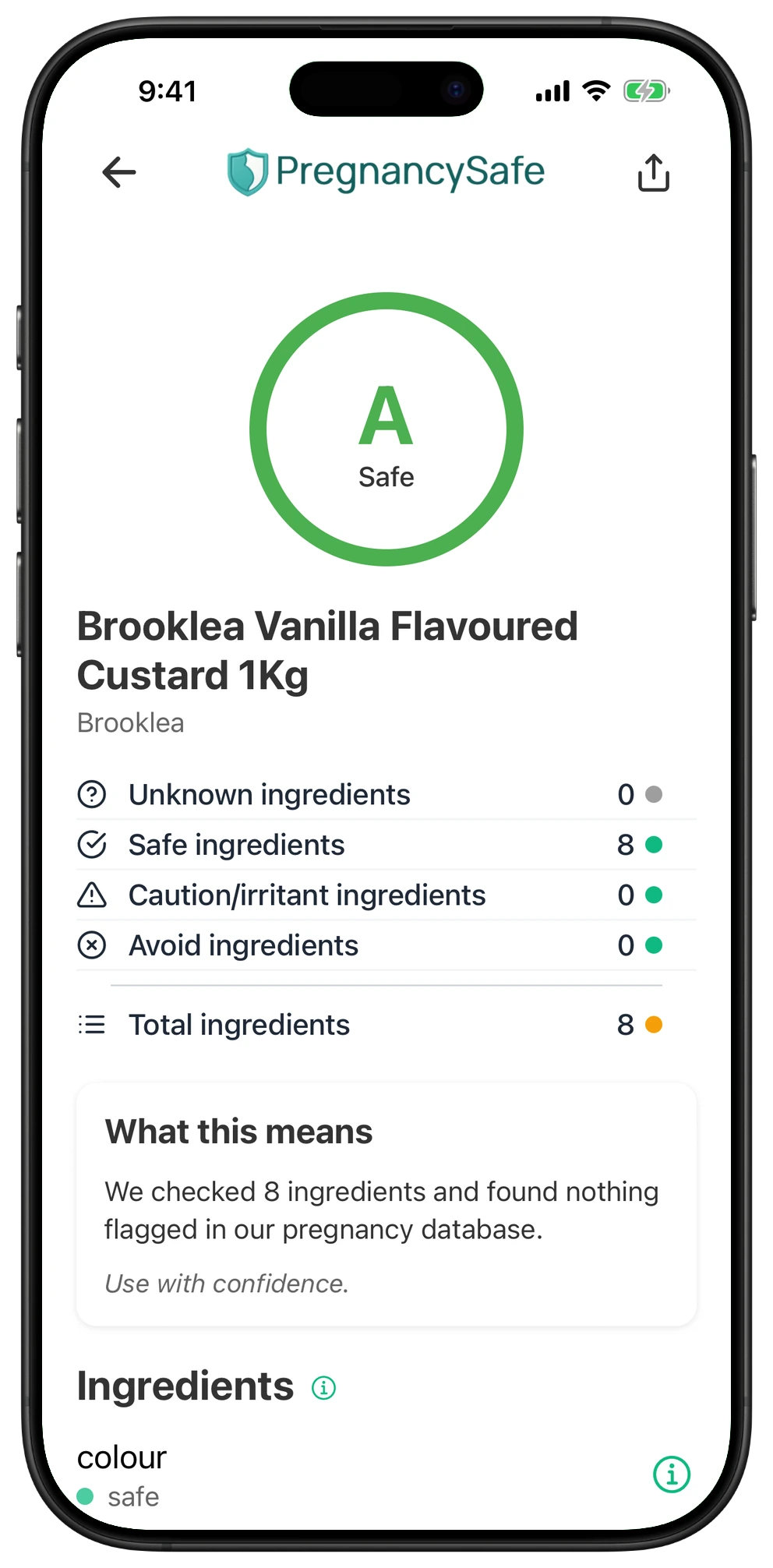
| A | Brooklea Vanilla Flavoured Custard | Brooklea |
| A | Pauls Regular Custard Vanilla | Pauls |
| B+ | Creme Aux Oeufs | Fresh & Easy |
| A | Ambrosia Devon Custard Pot | Ambrosia |
| B+ | Vanilla Custard | Cedar Crest |
Your Questions Answered
Can we eat custard in the first trimester?
Yes, custard can be suitable in the first trimester when made with pasteurized dairy and pasteurized or thoroughly cooked eggs. For cooked egg mixtures, check that they reach 160°F. Follow storage instructions too; these precautions apply throughout pregnancy, not just in the early weeks.
What desserts should I avoid when pregnant?
Avoid desserts made with unpasteurized dairy or raw or undercooked unpasteurized eggs. For custards, mousses and similar desserts, ask about the ingredients and preparation rather than judging by the dessert name. Choose another option if suitable preparation or chilled storage cannot be confirmed.
Is homemade custard safe during pregnancy?
Homemade custard can be suitable when you use pasteurized dairy and prepare the eggs appropriately. Cook egg mixtures to 160°F, checking with a food thermometer rather than relying only on thickness. Do not taste an uncooked mixture containing unpasteurized eggs. Refrigerate the finished dessert promptly and follow the recipe's storage guidance.
Can I eat custard made from powder or a dry mix?
Yes, provided you prepare it according to its actual package instructions and use suitable added ingredients, such as pasteurized milk. A dry starch and sugar mix is not the same as a finished ready to eat dessert. Its ingredient list alone does not establish whether the prepared custard is egg free or made with pasteurized dairy. Follow any required cooking steps and refrigerate the finished dessert.
Are chilled and frozen custards equally safe?
Both can be suitable, but you need to check their ingredients, preparation and storage separately. For chilled custard, confirm pasteurized dairy, appropriately prepared eggs and refrigeration as directed. For frozen custard, check the same ingredient and preparation details and follow the frozen storage instructions. Being frozen is not, by itself, evidence of suitable preparation.
How much custard can I eat during pregnancy?
There is no single pregnancy specific serving limit established here. Use the serving size and added sugar information on the package to keep portions in proportion to your overall diet. High fructose corn syrup is an added sugar, not a known cause of birth defects at occasional food amounts. If you have gestational diabetes, follow your care team's individualized carbohydrate guidance.
Does an A grade mean a custard is safe during pregnancy?
No. Grades describe ingredient scores, not pathogen testing, cooking temperatures, storage or the contents of your current package. Our catalog contains 18 A grade records, but that is not a count of independently verified safe products. Check the exact label and preparation instructions; an incomplete record or a lower grade is not, by itself, proof that a custard is harmful.
How Do We Score Products for Pregnancy Safety?
We analyze each product's ingredients and category to flag known risks and provide cautionary notices for general category safety concerns.
Grades reflect the ingredient and category information available to us. They don’t verify a complete, current label or account for dose, preparation, or contamination. Read them alongside the guidance above, not as a guarantee of pregnancy safety or proof that every use is harmful.
A - Safe
Excellent choice! All ingredients are considered safe during pregnancy.
What to do: Use with confidence.
B - Likely Safe
Pretty much safe with very minimal risk. Some ingredients may have limited pregnancy studies, but no significant safety concerns have been identified.
What to do: Use with confidence.
C - Limit
Contains ingredients with some pregnancy considerations. Research shows these ingredients may have limited safety data, potential for minor hormonal effects, or require caution based on animal studies.
What to do: Use sparingly and consider safer alternatives when available.
D - Caution
Similar to C grade but contains multiple cautionary ingredients. The combination increases overall concern.
What to do: Try to avoid if that makes you feel better. If you've already used it, no need to panic.
F - Avoid
Contains an ingredient Pregnancy Safe recommends avoiding during pregnancy. This may reflect an established risk or a precaution based on limited evidence; check the ingredient guidance and exposure context.
What to do: Do not use during pregnancy. If you've already used it, don't worry - contact your OBGYN if concerned.
People Also Checked
References
- https://www.fda.gov/food/people-risk-foodborne-illness/cooking-food-safety-moms-be
- https://www.cdc.gov/listeria/prevention/index.html
- https://www.nhs.uk/pregnancy/keeping-well/foods-to-avoid/
- https://hfpappexternal.fda.gov/scripts/fdcc/index.cfm?id=FDCYellow5&set=ColorAdditives
- https://www.ecfr.gov/current/title-21/chapter-I/subchapter-A/part-74#74.705
- https://www.fda.gov/food/color-additives-information-consumers/tracking-food-industry-pledges-remove-petroleum-based-food-dyes
- https://www.fda.gov/food/nutrition-food-labeling-and-critical-foods/food-allergies
- https://apps.who.int/food-additives-contaminants-jecfa-database/Home/Chemical/3885
- https://efsa.onlinelibrary.wiley.com/doi/10.2903/j.efsa.2009.1331
- https://oehha.ca.gov/risk-assessment/report/health-effects-assessment-potential-neurobehavioral-effects-synthetic-food-dyes-children
- https://pubmed.ncbi.nlm.nih.gov/1628860/
- https://pmc.ncbi.nlm.nih.gov/articles/PMC7023231/
- https://pmc.ncbi.nlm.nih.gov/articles/PMC6354951/
- https://www.hfpappexternal.fda.gov/scripts/fdcc/index.cfm?id=FDCBlue1&set=ColorAdditives
- https://www.ecfr.gov/current/title-21/chapter-I/subchapter-A/part-74
- https://efsa.onlinelibrary.wiley.com/doi/10.2903/j.efsa.2010.1853
- https://apps.who.int/food-additives-contaminants-jecfa-database/Home/Chemical/3309
- https://pubmed.ncbi.nlm.nih.gov/23208798/
- https://pubmed.ncbi.nlm.nih.gov/24257113/
- https://cdn.realfood.gov/DGA.pdf
- https://www.dietaryguidelines.gov/sites/default/files/2021-12/DGA_Pregnancy_FactSheet-508c.pdf
- https://www.acog.org/womens-health/faqs/healthy-eating-during-pregnancy
- https://www.cdc.gov/nutrition/php/data-research/added-sugars.html
- https://www.cdc.gov/diabetes/about/gestational-diabetes.html
- https://www.who.int/publications/i/item/9789241549028
- https://nesr.usda.gov/2025-dietary-guidelines-advisory-committee-systematic-reviews/dietary-patterns_gestational-diabetes
- https://www.nccih.nih.gov/health/aloe-vera
- https://webprod.hc-sc.gc.ca/nhpid-bdipsn/dbImages/mono_aloe--oral_english.pdf
- https://www.ema.europa.eu/en/documents/herbal-monograph/final-european-union-herbal-monograph-aloe-barbadensis-mill-and-aloe-various-species-mainly-aloe-ferox-mill-and-its-hybrids-folii-succus-siccatus_en.pdf
- https://www.utep.edu/herbal-safety/populations/herbs-to-avoid-during-pregnancy.html
- https://www.federalregister.gov/documents/2002/05/09/02-11510/status-of-certain-additional-over-the-counter-drug-category-ii-and-iii-active-ingredients
- https://pubmed.ncbi.nlm.nih.gov/33164294/
- https://pubmed.ncbi.nlm.nih.gov/28139161/
- https://journals.sagepub.com/doi/10.1080/10915810701351186
- https://www.fda.gov/cosmetics/cosmetic-ingredients/fragrances-cosmetics
- https://www.fda.gov/cosmetics/cosmetic-ingredients/phthalates-cosmetics
- https://www.fda.gov/cosmetics/cosmetic-ingredients/allergens-cosmetics
- https://pmc.ncbi.nlm.nih.gov/articles/PMC3110684/
- https://pmc.ncbi.nlm.nih.gov/articles/PMC4016195/
- https://pmc.ncbi.nlm.nih.gov/articles/PMC4097177/
- https://pmc.ncbi.nlm.nih.gov/articles/PMC8453372/
- https://pmc.ncbi.nlm.nih.gov/articles/PMC10999525/
- https://www.epa.gov/indoor-air-quality-iaq/volatile-organic-compounds-impact-indoor-air-quality
- https://www.fda.gov/food/food-additives-petitions/trans-fat
- https://www.fda.gov/food/hfp-constituent-updates/fda-completes-final-administrative-actions-partially-hydrogenated-oils-foods
- https://www.federalregister.gov/documents/2013/11/08/2013-26854/tentative-determination-regarding-partially-hydrogenated-oils-request-for-comments-and-for
- https://www.who.int/news-room/fact-sheets/detail/trans-fat
- https://www.fda.gov/food/people-risk-foodborne-illness/dietary-advice-and-during-pregnancy
- https://www.rcpi.ie/Portals/0/Document%20Repository/Institute%20of%20Obstetricians%20and%20Gynaecologists/National%20Clinical%20Guidelines/IOG_National%20Clinical%20Guidelines_Nutrition%20in%20pregnancy%20Guideline_2019.pdf
- https://pmc.ncbi.nlm.nih.gov/articles/PMC8027310/
- https://pmc.ncbi.nlm.nih.gov/articles/PMC3192475/
- https://www.hfpappexternal.fda.gov/scripts/fdcc/index.cfm?id=FDCRed40&set=ColorAdditives
- https://www.ecfr.gov/current/title-21/chapter-I/subchapter-A/part-74/subpart-A/section-74.340
- https://www.efsa.europa.eu/en/efsajournal/pub/1327
- https://www.efsa.europa.eu/en/efsajournal/pub/4007
- https://apps.who.int/food-additives-contaminants-jecfa-database/Home/Chemical/2361
- https://pubmed.ncbi.nlm.nih.gov/6636206/
- https://pubmed.ncbi.nlm.nih.gov/2613118/
- https://pubmed.ncbi.nlm.nih.gov/7940558/