Is Creatine Safe During Pregnancy? (Updated 2026 Guide)
Updated September 9, 2026
The Answer
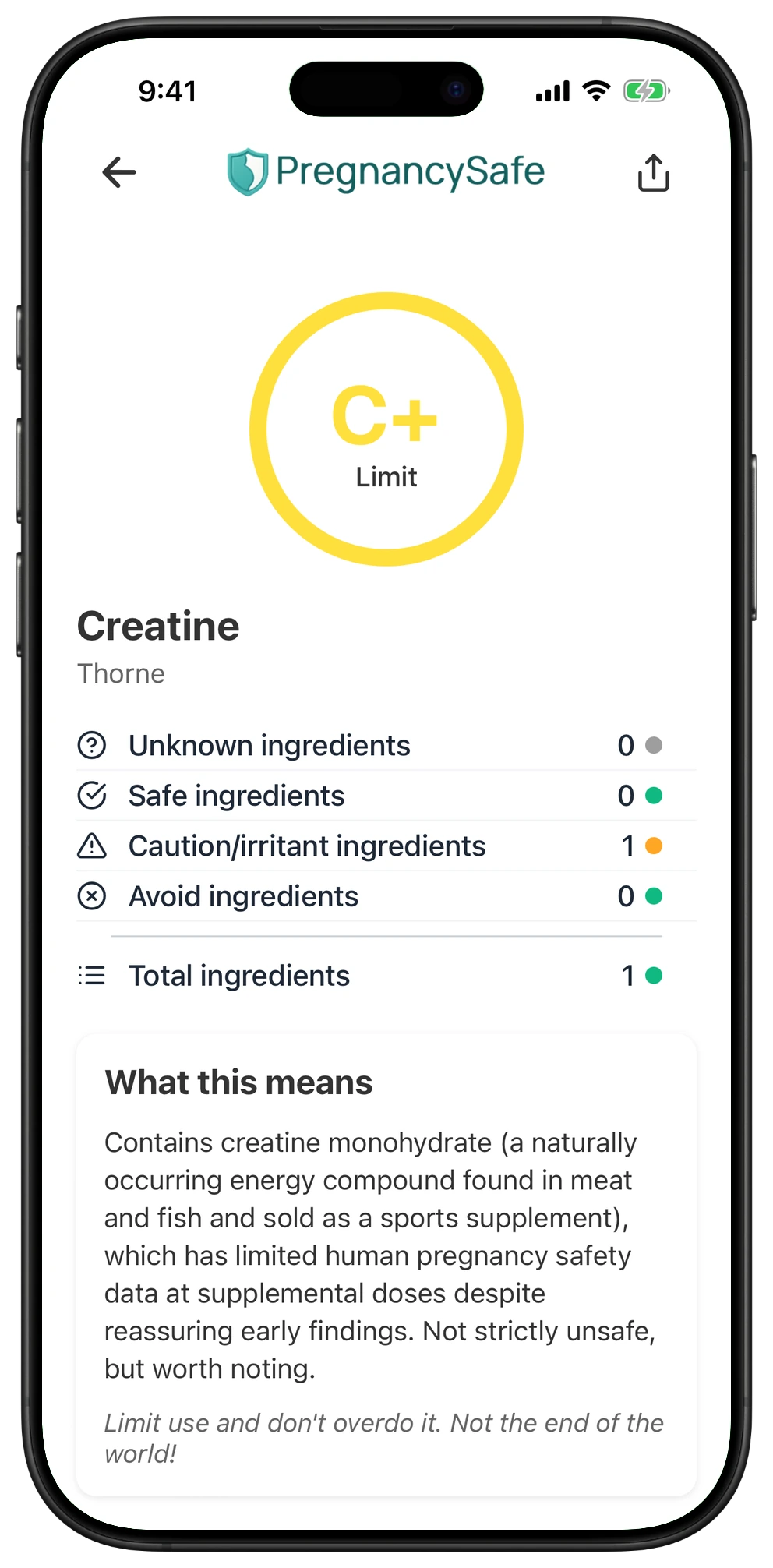
Creatine supplements are not established as safe for routine use during pregnancy; discuss starting or continuing them with your pregnancy clinician. Ordinary creatine intake from meat and fish is different from gram dose supplementation and appears low concern.
The main concern is limited human pregnancy evidence at supplemental doses, not proof that creatine harms your baby. Small recent human studies offer some reassuring findings, but they cannot establish safety across pregnancy or a routine dose. Creatine monohydrate, hydrochloride and other forms share this need for caution, but evidence for one form does not establish another form’s safety.
Pregnancy Safe is 100% independent and research driven. No companies pay to promote or sponsor products.
Stress Less This Pregnancy
Check your exact creatine in the app

✓ What's Safe
- • A discussion with your pregnancy clinician about whether supplemental creatine has a specific role for you before starting or continuing it.
- • A label stating the exact creatine form and amount per serving so your clinician can assess your intended daily intake.
- • The complete ingredient list for your exact powder, capsule or blend, rather than relying on its name or grade.
- • Ordinary dietary sources, such as meat and fish, rather than treating concentrated supplements as equivalent to food intake.
- • If your clinician recommends supplementation, information about product quality testing alongside a clear dosing plan; testing does not establish pregnancy safety.
✗ What to Avoid
- • Starting a loading phase or increasing to high supplemental doses without pregnancy specific clinician guidance.
- • Using adult sports dosing instructions as an established pregnancy regimen.
- • Taking creatine to protect your baby’s brain based on experimental findings rather than a clinician directed plan.
- • Switching from creatine monohydrate to creatine hydrochloride or another form on the assumption that it is proven safer in pregnancy.
- • Treating an A grade, a purity claim or a short ingredient list as proof that routine supplementation is appropriate.
Most Common Ingredients in Creatine Products
We analyzed 404 creatine products. Here are the most common ingredients, ranked by how often they appear:
Ingredients to Watch Out For in Creatine
These are the most common flagged ingredients across 404 creatine products we analyzed.
creatine monohydrate
Caution
Creatine monohydrate is a popular supplement that helps increase muscle strength, power, and performance during high intensity exercise.
Has limited human pregnancy safety data at supplemental doses despite reassuring early findings.
Flagged in 226 of 404 products (56%)
creatine hydrochloride
Caution
Has limited human pregnancy safety data at supplemental doses despite reassuring early findings.
Flagged in 21 of 404 products (5%)
creatine
Caution
Creatine is a naturally occurring compound that helps supply energy to muscles during high intensity exercise.
Has limited human pregnancy safety data at supplemental doses despite reassuring early findings.
Flagged in 19 of 404 products (5%)
creatine hcl
Caution
Creatine HCl is a highly soluble form of creatine that supports increased muscle strength and performance.
Has limited human pregnancy safety data at supplemental doses despite reassuring early findings.
Flagged in 17 of 404 products (4%)
fd c red 40
Caution
FD&C Red 40 is a synthetic red dye commonly used to add vibrant color to foods, beverages, and cosmetics.
Has limited human pregnancy data and is allowed at regulated food additive levels, but child neurobehavior concerns and high dose animal findings make frequent high dye intake worth limiting.
Flagged in 17 of 404 products (4%)
creatine anhydrous
Caution
Creatine anhydrous is a highly concentrated, water free form of creatine that supports increased muscle strength and performance during high intensity exercise.
Has limited human pregnancy safety data at supplemental doses despite reassuring early findings.
Flagged in 16 of 404 products (4%)
micronized creatine monohydrate
Caution
Micronized creatine monohydrate is a highly purified form of creatine with smaller particles that enhance solubility and absorption for improved athletic performance.
Has limited human pregnancy safety data at supplemental doses despite reassuring early findings.
Flagged in 15 of 404 products (4%)
creatine magnapower
Caution
Has limited human pregnancy safety data at supplemental doses despite reassuring early findings.
Flagged in 13 of 404 products (3%)
Creatine Products We've Analyzed
Our catalog contains ratings for 404 creatine products. These are database grades, not independent safety certifications.
Grades cannot determine an appropriate pregnancy dose or certify a supplement’s purity. An A score is not evidence for routine creatine supplementation.
Your Questions Answered
Is creatine safe during pregnancy?
Human pregnancy evidence is still too limited to establish routine supplemental use as safe. Small recent human research includes reassuring early findings, so it would also be inaccurate to call creatine proven harmful. Discuss supplemental use with your pregnancy clinician rather than relying on its safety record in nonpregnant athletes.
Does creatine cross the placenta?
Research describes creatine transport across the placenta into the fetal circulation. That biological role does not establish whether adding gram dose oral supplements is beneficial or safe. Placental transfer alone is neither proof of fetal harm nor a reason to supplement.
Should I stop taking creatine if trying to get pregnant?
Review your creatine supplement with your pregnancy clinician while planning pregnancy rather than automatically continuing your sports routine. Bring the exact label, daily amount and reason you take it. Extensive research in nonpregnant adults does not establish safety around conception or in early pregnancy, and fertility claims are not a sufficient reason to start.
What is a safe creatine dose during pregnancy?
There is no established dose to recommend for routine pregnancy supplementation. A small third trimester dose escalation study reported no major adverse events, but that does not establish a safe regimen for all pregnant people or earlier trimesters. Do not copy a loading protocol or research dose; ask your clinician whether supplementation is appropriate at all.
Do I need to avoid creatine naturally present in food?
You do not need to avoid ordinary meat or fish intake simply because these foods contain creatine. Normal dietary exposure appears low concern and differs from concentrated, gram dose oral supplements. The uncertainty about supplementation is not a reason to eliminate these foods or deliberately eat unusually large amounts to imitate a supplement dose.
Are A grade creatine supplements pregnancy safe choices?
An A grade does not establish that a creatine supplement is appropriate during pregnancy. Our catalog contains 404 products, including 33 with A grades, but those counts are not a count of independently verified pregnancy safe options. Grades cannot determine a pregnancy dose or certify purity, and quality testing cannot establish pregnancy benefit. There is no clinical basis here for recommending an A grade creatine shopping list.
Does the supplement caution also apply to creatine in skincare?
Normal topical use on intact skin is a different exposure from swallowing gram dose supplements. Creatine in topical cosmetics is considered likely safe because systemic exposure is expected to be much lower, although direct pregnancy studies are unavailable. That assessment does not cover ingestion, unusually concentrated formulations, broken skin, large area application or use under an occlusive covering.
How Do We Score Products for Pregnancy Safety?
We analyze each product's ingredients and category to flag known risks and provide cautionary notices for general category safety concerns.
Grades reflect the ingredient and category information available to us. They don’t verify a complete, current label or account for dose, preparation, or contamination. Read them alongside the guidance above, not as a guarantee of pregnancy safety or proof that every use is harmful.
A - Safe
Excellent choice! All ingredients are considered safe during pregnancy.
What to do: Use with confidence.
B - Likely Safe
Pretty much safe with very minimal risk. Some ingredients may have limited pregnancy studies, but no significant safety concerns have been identified.
What to do: Use with confidence.
C - Limit
Contains ingredients with some pregnancy considerations. Research shows these ingredients may have limited safety data, potential for minor hormonal effects, or require caution based on animal studies.
What to do: Use sparingly and consider safer alternatives when available.
D - Caution
Similar to C grade but contains multiple cautionary ingredients. The combination increases overall concern.
What to do: Try to avoid if that makes you feel better. If you've already used it, no need to panic.
F - Avoid
Contains an ingredient Pregnancy Safe recommends avoiding during pregnancy. This may reflect an established risk or a precaution based on limited evidence; check the ingredient guidance and exposure context.
What to do: Do not use during pregnancy. If you've already used it, don't worry - contact your OBGYN if concerned.
References
- https://ods.od.nih.gov/factsheets/Pregnancy-HealthProfessional/
- https://ods.od.nih.gov/factsheets/ExerciseAndAthleticPerformance-HealthProfessional/
- https://pubmed.ncbi.nlm.nih.gov/23957855/
- https://pubmed.ncbi.nlm.nih.gov/22151935/
- https://echa.europa.eu/registration-dossier/-/registered-dossier/12796/7/4/1
- https://www.fda.gov/media/143525/download
- https://webprod.hc-sc.gc.ca/nhpid-bdipsn/ingredReq?id=3655
- https://pmc.ncbi.nlm.nih.gov/articles/PMC12291183/
- https://pubmed.ncbi.nlm.nih.gov/38432717/
- https://pubmed.ncbi.nlm.nih.gov/25523279/
- https://pmc.ncbi.nlm.nih.gov/articles/PMC12086928/
- https://pmc.ncbi.nlm.nih.gov/articles/PMC7912953/
- https://pubmed.ncbi.nlm.nih.gov/32549301/
- https://pmc.ncbi.nlm.nih.gov/articles/PMC12702719/
- https://www.hfpappexternal.fda.gov/scripts/fdcc/index.cfm?id=931&set=GRASNotices
- https://webprod.hc-sc.gc.ca/nhpid-bdipsn/atReq?atid=creatine.mono&lang=eng
- https://www.hfpappexternal.fda.gov/scripts/fdcc/index.cfm?id=FDCRed40&set=ColorAdditives
- https://www.ecfr.gov/current/title-21/chapter-I/subchapter-A/part-74/subpart-A/section-74.340
- https://www.fda.gov/food/color-additives-information-consumers/tracking-food-industry-pledges-remove-petroleum-based-food-dyes
- https://www.efsa.europa.eu/en/efsajournal/pub/1327
- https://www.efsa.europa.eu/en/efsajournal/pub/4007
- https://apps.who.int/food-additives-contaminants-jecfa-database/Home/Chemical/2361
- https://oehha.ca.gov/risk-assessment/report/health-effects-assessment-potential-neurobehavioral-effects-synthetic-food-dyes-children
- https://pubmed.ncbi.nlm.nih.gov/6636206/
- https://pubmed.ncbi.nlm.nih.gov/2613118/
- https://pubmed.ncbi.nlm.nih.gov/7940558/