Best Pregnancy Safe Cough Drops (Updated 2026 Guide)
Updated September 9, 2026
The Answer
Choose cough drops by their exact formula: distinguish ordinary throat sweets from medicated lozenges, and ask a pharmacist to check active ingredients, doses and pregnancy warnings. Our catalog contains 183 products with ingredient grades from A to F, but those scores do not establish which products are clinically safe for you.
Cough drops can contain medicines, herbal extracts or ordinary candy ingredients, so the amount you take and the exact formulation matter more than the flavor or brand. Sage, elder preparations and propolis warrant formulation specific caution because pregnancy evidence is limited, especially for medicinal or concentrated oral exposure; dye concerns do not establish fetal harm from occasional regulated use. Lozenges do not treat influenza or pneumonia, so seek prompt medical advice for fever, breathing difficulty, persistent symptoms or suspected flu.
Pregnancy Safe is 100% independent and research driven. No companies pay to promote or sponsor products.
Stress Less This Pregnancy
Check your exact cough drops in the app

✓ What's Safe
- • Check whether the package describes an ordinary sweet or a medicated lozenge; read the active ingredients rather than relying on the honey, lemon or menthol flavor.
- • Choose a formula with clearly listed ingredients and, for medicated drops, a stated amount per drop and dosing instructions.
- • Ask a pharmacist to check the exact version, pregnancy warnings and any overlap with your other cough or cold medicines.
- • For simple throat soothing, consider a nonmedicated formula without extra herbal extracts rather than assuming more ingredients provide more benefit.
- • Choose dye free versions if you want to reduce optional color additive exposure, while still checking the medicines and herbs.
- • Match any listed product to your current package; an assessment of one candy formula does not establish the suitability of other versions.
✗ What to Avoid
- • Avoid exceeding the labeled dose or combining medicated drops with another product containing the same active medicine.
- • Avoid choosing medicinal sage extracts or sage essential oil for oral use without clinician review; ordinary seasoning exposure is different.
- • Avoid assuming elder or organic elderberry juice concentrate has established pregnancy benefits or safety at concentrated medicinal doses.
- • Avoid using propolis lozenges without professional advice during pregnancy, particularly if you have a known sensitivity to bee products.
- • Limit frequent optional dye exposure from fd c red 40, red 40, red 40 lake, fd c blue 1 or blue 1 when an otherwise suitable dye free formula is available; these labels represent two underlying dyes, not five separate hazards.
- • Avoid relying on cough drops alone when you have fever, breathing difficulty, persistent symptoms or suspected flu.
Most Common Ingredients in Cough Drops Products
We analyzed 183 cough drops products. Here are the most common ingredients, ranked by how often they appear:
Ingredients to Watch Out For in Cough Drops
These are the most common flagged ingredients across 183 cough drops products we analyzed.
fd c red 40
Caution
FD&C Red 40 is a synthetic red dye commonly used to add vibrant color to foods, beverages, and cosmetics.
Has limited human pregnancy data and is allowed at regulated food additive levels, but child neurobehavior concerns and high dose animal findings make frequent high dye intake worth limiting.
This label names Red 40, the same dye also listed as Allura Red AC. In cough drops it supplies color, not cough relief. Pregnancy specific evidence is limited, but occasional regulated oral exposure is unlikely to be a major pregnancy hazard; dye free versions can reduce frequent optional exposure.
Flagged in 17 of 183 products (9%)
Caution
Red 40 is a synthetic food dye commonly used to add vibrant red color to candies, beverages, and processed foods.
Has limited human pregnancy data and is allowed at regulated food additive levels, but child neurobehavior concerns and high dose animal findings make frequent high dye intake worth limiting.
Red 40 is the same underlying color additive as FD&C Red 40, not an additional ingredient hazard. Concerns come mainly from child neurobehavior findings and high dose animal evidence rather than established fetal harm from ordinary cough drop use. Consider a dye free equivalent if you use drops frequently.
Flagged in 17 of 183 products (9%)
Caution
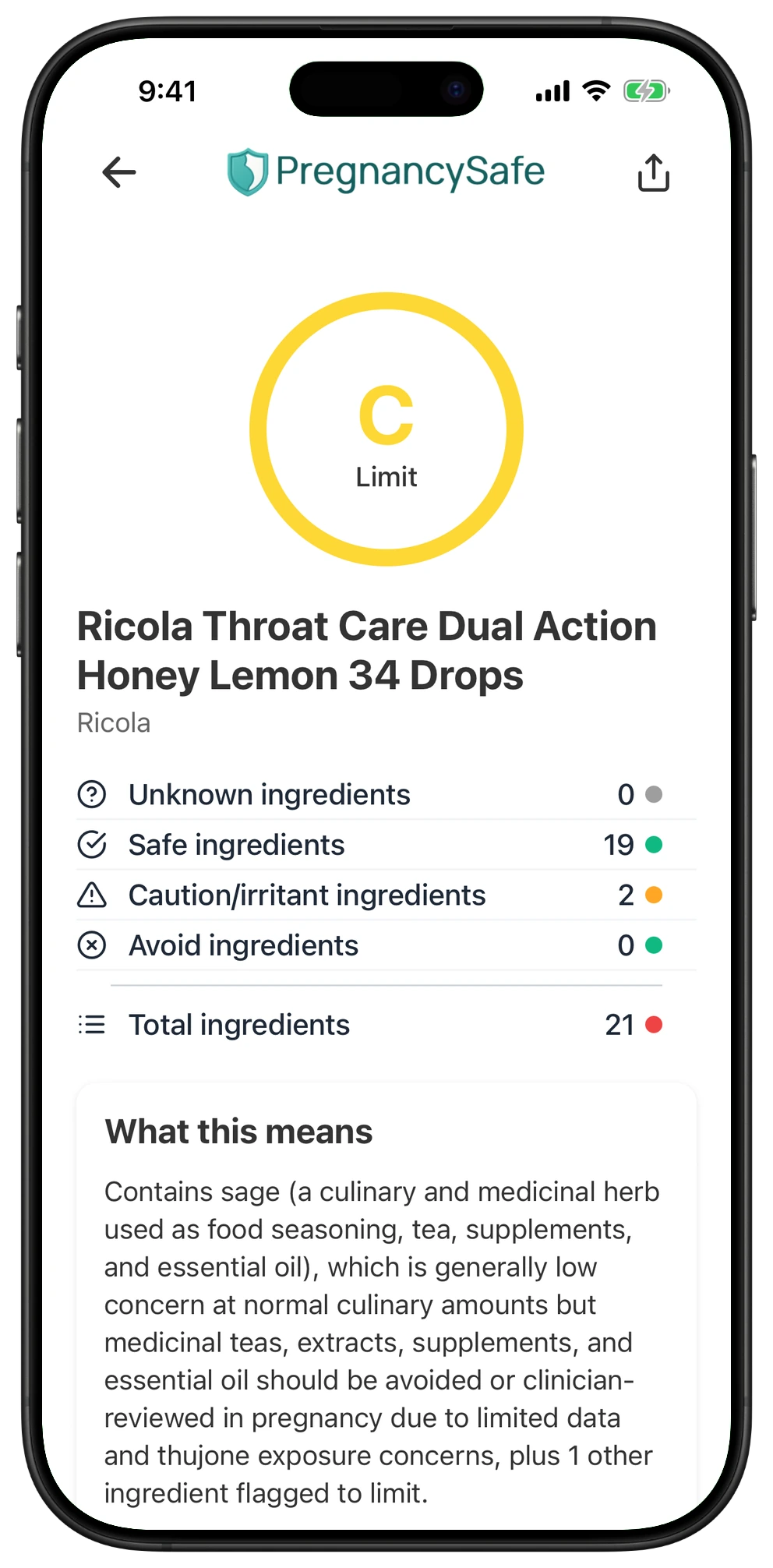
Sage is a fragrant, gray green herb known for its earthy, slightly peppery flavor and aromatic leaves, often used to enhance savory dishes and herbal remedies.
Is generally low concern at normal culinary amounts but medicinal teas, extracts, supplements, and essential oil should be avoided or clinician reviewed in pregnancy due to limited data and thujone exposure concerns.
Sage may be part of a cough drop's herbal blend. Normal culinary amounts differ from medicinal extracts and essential oil, for which pregnancy safety is not established and concentrated thujone can be a concern. The ingredient name alone does not reveal the dose, so ask about the exact lozenge formulation rather than assuming it matches either food seasoning or high dose oil exposure.
Flagged in 16 of 183 products (9%)
fd c blue 1
Caution
FD&C Blue 1 is a synthetic blue dye commonly used to add color to food, beverages, and pharmaceuticals.
Has limited human pregnancy data; regulated food use is not shown to cause fetal harm, but high dose animal neurobehavior findings and child sensitivity concerns support minimizing frequent exposure.
FD&C Blue 1 is a blue color additive, also called Brilliant Blue FCF. Human pregnancy data are limited, but regulated food color use is not shown to cause fetal harm. In cough drops, choosing a dye free version reduces optional coloring without establishing whether the active medicine is suitable.
Flagged in 12 of 183 products (7%)
elder
Caution
Elder is a versatile shrub or small tree known for its dark purple berries and fragrant white flowers, often used in herbal remedies, teas, and culinary preparations.
Has little pregnancy specific safety data for supplement doses and can be toxic if raw, unripe, or made with leaves, stems, bark, or roots.
Elder in a herbal lozenge does not by itself specify the plant part, preparation or amount. Elderberry medicinal use evidence is limited in pregnancy; poisoning from raw or unripe berries and certain other plant parts is not proof that a manufactured lozenge is toxic. Ask for formulation details before repeated medicinal use.
Flagged in 9 of 183 products (5%)
red 40 lake
Caution
Red 40 Lake is a synthetic colorant used to impart a vibrant red hue to food, beverages, and cosmetics.
Has limited human pregnancy data and is allowed at regulated food additive levels, but child neurobehavior concerns and high dose animal findings make frequent high dye intake worth limiting.
Red 40 lake is a colorant form of Red 40, not a separate dye with an independent pregnancy risk finding. Evidence involving high dose animals or children does not demonstrate fetal harm from occasional cough drop exposure. A dye free formula is an optional way to limit repeated exposure.
Flagged in 7 of 183 products (4%)
blue 1
Caution
Blue 1 is a synthetic blue dye commonly used to add vibrant color to foods, beverages, and cosmetics.
Has limited human pregnancy data; regulated food use is not shown to cause fetal harm, but high dose animal neurobehavior findings and child sensitivity concerns support minimizing frequent exposure.
Blue 1 names the same dye as FD&C Blue 1. Its caution reflects limited pregnancy specific data and indirect neurobehavior evidence, not demonstrated fetal harm at ordinary regulated intake. Check the rest of the cough drop formula even if you select a version without this coloring.
Flagged in 6 of 183 products (3%)
extract of a ricola herb mixture elder
Caution
Elder extract from Ricola's herbal mixture, known for its soothing and aromatic properties.
Has little pregnancy specific safety data for supplement doses and can be toxic if raw, unripe, or made with leaves, stems, bark, or roots.
This label describes elder within a mixed herbal extract; it does not establish the elder plant part or dose per lozenge. Limited elderberry supplement evidence cannot establish the safety or harm of this exact blend. Ask a pharmacist to check the preparation and intended frequency of use rather than applying raw berry poisoning findings to the finished drop.
Flagged in 5 of 183 products (3%)
How Do Cough Drops Products Stack Up?
Our catalog contains ratings for 183 cough drops products. These are database grades, not independent safety certifications.
Grades are ingredient scores, not clinical verdicts or measurements of pathogens, dose, preparation or current package contents. Cohorts include unreviewed catalog records and counts are not independently verified safe-product totals.
Best Pregnancy Safe Cough Drops
Popular options from our catalog, prioritizing A and B ingredient grades, with C grade options used to fill remaining places. Within each group, products are ordered by searches in Pregnancy Safe, not retail sales. Read the cautions and guidance above; grades do not verify a complete current label or guarantee pregnancy safety.
| Grade | Product | Brand |
|---|---|---|
| B+ | Vicks Vapocool Severe Honey Lemon Chill Medicated Drops | Vicks |
| B+ | Halls Sugar Free Cough Drops - Honey Lemon | Halls |
| A | Halls Cough & Throat Drops | Halls |
| B+ | Halls Relief Honey Lemon Cough Drops 80 Drops | Halls |
| A | Halls Economy Bag | Halls |
Your Questions Answered
Which cough drops can you take while pregnant?
Start by checking whether the exact product is an ordinary throat sweet or a medicated lozenge. For medicated drops, ask a pharmacist to review the active ingredients, dose and pregnancy warnings alongside your other medicines. A simple nonmedicated formula avoids adding a cough medicine, but herbal extras still need consideration. Neither a familiar brand nor an A ingredient grade guarantees pregnancy safety.
How to treat a cough when pregnant?
Drink water and consider simple throat soothing options while checking which medicines, if any, are appropriate with a pharmacist or your maternity clinician. Use medicated lozenges only according to their directions and avoid overlapping active ingredients with other cold remedies. Cough drops provide symptom relief rather than treatment for influenza or pneumonia. Seek prompt advice for fever, breathing difficulty, persistent symptoms or suspected flu.
Are menthol cough drops safe during pregnancy?
Menthol flavor alone is not evidence of fetal harm at ordinary use. However, menthol may also appear as an active ingredient, so check the amount per drop and the dosing instructions. Other medicines or herbal ingredients in the same lozenge also matter. Ask a pharmacist about the exact formula rather than treating all menthol drops as interchangeable.
Are herbal cough drops safer than medicated ones?
Not necessarily: a natural or herbal label does not establish pregnancy safety. Medicinal sage preparations have limited pregnancy safety evidence, and concentrated sage oil raises additional thujone concerns. Elder preparations and propolis also have limited human pregnancy data, with uncertainty depending on the preparation and oral dose. Have the exact herbal formula checked rather than assuming evidence about a supplement applies directly to one lozenge.
Should I worry about red or blue dyes in cough drops?
Red 40 and Blue 1 have limited pregnancy specific evidence, but ordinary regulated use has not been shown to cause fetal harm. Findings involving children or high dose animal exposure do not establish harm from occasional cough drop use during pregnancy. Choosing dye free drops is a reasonable way to reduce optional exposure if you use them frequently. Dye free labeling does not replace checking active medicines, herbal extracts and dosing.
Does an A grade mean a cough drop is verified safe for pregnancy?
No: grades are ingredient scores, not clinical verdicts. Our catalog contains 67 A grade records among 183 products, but that is not a count of independently verified pregnancy safe products. Scores do not measure drug dose or confirm current package contents, and a low grade does not automatically mean a medicine is contraindicated. A product listing does not establish drug doses or suitability; distinguish ordinary candy from medicated drops.
How Do We Score Products for Pregnancy Safety?
We analyze each product's ingredients and category to flag known risks and provide cautionary notices for general category safety concerns.
Grades reflect the ingredient and category information available to us. They don’t verify a complete, current label or account for dose, preparation, or contamination. Read them alongside the guidance above, not as a guarantee of pregnancy safety or proof that every use is harmful.
A - Safe
Excellent choice! All ingredients are considered safe during pregnancy.
What to do: Use with confidence.
B - Likely Safe
Pretty much safe with very minimal risk. Some ingredients may have limited pregnancy studies, but no significant safety concerns have been identified.
What to do: Use with confidence.
C - Limit
Contains ingredients with some pregnancy considerations. Research shows these ingredients may have limited safety data, potential for minor hormonal effects, or require caution based on animal studies.
What to do: Use sparingly and consider safer alternatives when available.
D - Caution
Similar to C grade but contains multiple cautionary ingredients. The combination increases overall concern.
What to do: Try to avoid if that makes you feel better. If you've already used it, no need to panic.
F - Avoid
Contains an ingredient Pregnancy Safe recommends avoiding during pregnancy. This may reflect an established risk or a precaution based on limited evidence; check the ingredient guidance and exposure context.
What to do: Do not use during pregnancy. If you've already used it, don't worry - contact your OBGYN if concerned.
People Also Checked
References
- https://www.nhs.uk/pregnancy/keeping-well/foods-to-avoid/
- https://www.fda.gov/drugs/resources-drugs/drug-interactions-what-you-should-know
- https://www.cdc.gov/flu/treatment/antiviral-drugs.html
- https://www.hfpappexternal.fda.gov/scripts/fdcc/index.cfm?id=FDCRed40&set=ColorAdditives
- https://www.ecfr.gov/current/title-21/chapter-I/subchapter-A/part-74/subpart-A/section-74.340
- https://www.fda.gov/food/color-additives-information-consumers/tracking-food-industry-pledges-remove-petroleum-based-food-dyes
- https://www.efsa.europa.eu/en/efsajournal/pub/1327
- https://www.efsa.europa.eu/en/efsajournal/pub/4007
- https://apps.who.int/food-additives-contaminants-jecfa-database/Home/Chemical/2361
- https://oehha.ca.gov/risk-assessment/report/health-effects-assessment-potential-neurobehavioral-effects-synthetic-food-dyes-children
- https://pubmed.ncbi.nlm.nih.gov/6636206/
- https://pubmed.ncbi.nlm.nih.gov/2613118/
- https://pubmed.ncbi.nlm.nih.gov/7940558/
- https://www.nccih.nih.gov/health/sage
- https://www.ema.europa.eu/en/documents/herbal-monograph/final-european-union-herbal-monograph-salvia-officinalis-l-folium-revision-1_en.pdf
- https://www.ema.europa.eu/en/documents/public-statement/public-statement-salvia-officinalis-l-aetheroleum_en.pdf
- https://www.ema.europa.eu/en/documents/scientific-guideline/public-statement-use-herbal-medicinal-products-containing-thujone-revision-1_en.pdf
- https://webprod.hc-sc.gc.ca/nhpid-bdipsn/dbImages/mono_Sage_Oral_EN.pdf
- https://pubmed.ncbi.nlm.nih.gov/23933314/
- https://pmc.ncbi.nlm.nih.gov/articles/PMC7956842/
- https://www.hfpappexternal.fda.gov/scripts/fdcc/index.cfm?id=FDCBlue1&set=ColorAdditives
- https://www.ecfr.gov/current/title-21/chapter-I/subchapter-A/part-74
- https://efsa.onlinelibrary.wiley.com/doi/10.2903/j.efsa.2010.1853
- https://apps.who.int/food-additives-contaminants-jecfa-database/Home/Chemical/3309
- https://pubmed.ncbi.nlm.nih.gov/23208798/
- https://pubmed.ncbi.nlm.nih.gov/24257113/
- https://www.nccih.nih.gov/health/elderberry
- https://pmc.ncbi.nlm.nih.gov/articles/PMC3941201/
- https://pmc.ncbi.nlm.nih.gov/articles/PMC8026097/
- https://pmc.ncbi.nlm.nih.gov/articles/PMC7961730/
- https://www.cdc.gov/mmwr/preview/mmwrhtml/00000311.htm
- https://www.fda.gov/food/information-consumers-using-dietary-supplements/questions-and-answers-dietary-supplements
- https://pubmed.ncbi.nlm.nih.gov/11518905/
- https://infantrisk.com/content/management-cold-and-flu-during-pregnancy
- https://webprod.hc-sc.gc.ca/nhpid-bdipsn/dbImages/mono_propolis--oral_english.pdf
- https://webprod.hc-sc.gc.ca/nhpid-bdipsn/atReq?atid=propolis_buc&lang=eng
- https://www.drugs.com/npp/propolis.html
- https://pmc.ncbi.nlm.nih.gov/articles/PMC6820270/
- https://pubmed.ncbi.nlm.nih.gov/20872924/
- https://pubmed.ncbi.nlm.nih.gov/9651052/
- https://www.ema.europa.eu/en/human-regulatory-overview/herbal-medicinal-products/herbal-medicinal-products-questions-answers