Is Clam Safe During Pregnancy? (Updated 2026 Guide)
Updated September 9, 2026
The Answer
Yes clams can be a lower mercury seafood choice during pregnancy when thoroughly cooked and bought from regulated sources. Avoid raw or undercooked clams; ingredient grades cannot establish whether a serving is safely prepared.
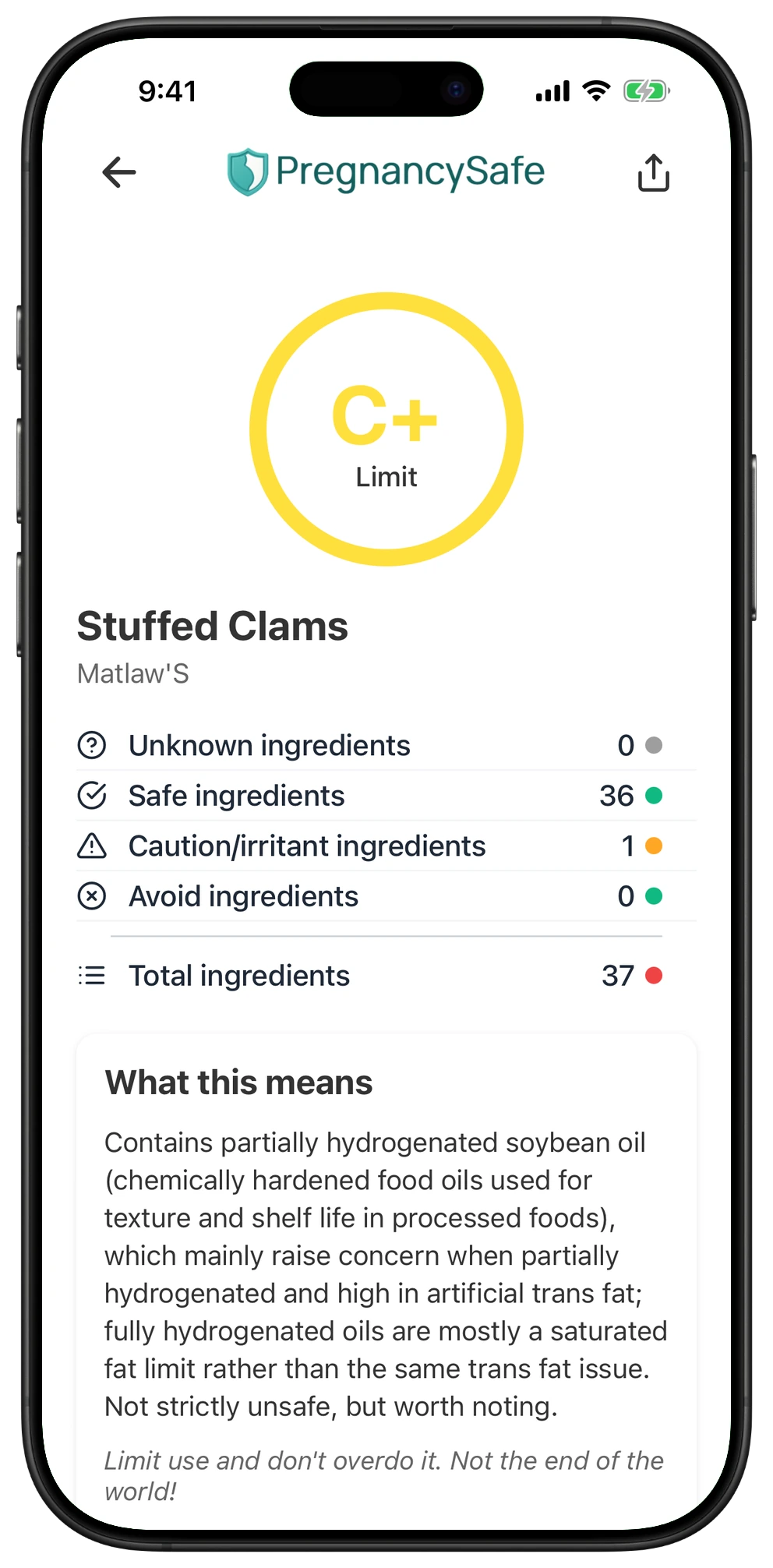
For clams, the main pregnancy consideration is safe sourcing and preparation, including observing harvest advisories and cooking thoroughly. Shell on clams, shucked meat, canned clams, clam juice, and stuffed clams need different preparation instructions and are not interchangeable. Prepared versions may also contain partially hydrogenated soybean oil or added sugars, which warrant attention to regular dietary intake rather than treating every flagged ingredient as evidence of fetal harm.
Pregnancy Safe is 100% independent and research driven. No companies pay to promote or sponsor products.
Stress Less This Pregnancy
Check your exact clam in the app

✓ What's Safe
- • Buy clams from regulated suppliers and check applicable harvest advisories.
- • Choose thoroughly cooked clams rather than raw or lightly cooked preparations.
- • For shell on clams, follow cooking and shell opening guidance and discard shells that remain closed after cooking.
- • Follow the exact preparation and storage instructions for shucked, canned, frozen, or stuffed clams.
- • For chowder, confirm that the clam meat is fully cooked; a hot broth alone does not establish that.
- • Check the current ingredient label on prepared clam dishes, especially for partially hydrogenated oils and added sugars.
✗ What to Avoid
- • Raw or undercooked clams, including raw clams served on the half shell.
- • Clams from unregulated sources or harvest areas covered by safety advisories.
- • Shell on clams that remain unopened after cooking.
- • Using shell opening instructions for shucked meat, canned clams, or stuffed clam filling instead of their own preparation directions.
- • Choosing a clam dish solely because of an A grade; ingredient scores do not detect pathogens or marine toxins.
- • Regularly choosing preparations containing partially hydrogenated soybean oil when alternatives without it are available; fully hydrogenated oil is a different, mainly saturated fat consideration.
Most Common Ingredients in Clam Products
We analyzed 61 clam products. Here are the most common ingredients, ranked by how often they appear:
Ingredients to Watch Out For in Clam
These are the most common flagged ingredients across 61 clam products we analyzed.
partially hydrogenated soybean oil
Caution
Partially hydrogenated soybean oil is a processed fat commonly used in foods to improve texture and shelf life, but it contains trans fats linked to health risks.
Mainly raise concern when partially hydrogenated and high in artificial trans fat; fully hydrogenated oils are mostly a saturated fat limit rather than the same trans fat issue.
Flagged in 11 of 61 products (18%)
high fructose corn syrup
Caution
High fructose corn syrup is a sweet, liquid sweetener made from corn starch, commonly used in processed foods and beverages.
Is not a known teratogen at occasional food amounts, but high added sugar intake can displace nutrients and raise gestational diabetes and metabolic concerns.
Flagged in 6 of 61 products (10%)
Caution
Red 40 is a synthetic food dye commonly used to add vibrant red color to candies, beverages, and processed foods.
Has limited human pregnancy data and is allowed at regulated food additive levels, but child neurobehavior concerns and high dose animal findings make frequent high dye intake worth limiting.
Flagged in 3 of 61 products (5%)
sodium nitrate
Caution
Sodium nitrate is a chemical compound commonly used as a preservative and curing agent in processed meats and as a fertilizer in agriculture.
Is context dependent because vegetable sources are generally compatible with pregnancy while contaminated well water above nitrate/nitrite limits can cause methemoglobinemia and has observational links to adverse birth outcomes.
Flagged in 2 of 61 products (3%)
and or fully hydrogenated soybean oil
Caution
Mainly raise concern when partially hydrogenated and high in artificial trans fat; fully hydrogenated oils are mostly a saturated fat limit rather than the same trans fat issue.
Flagged in 1 of 61 products (2%)
hydrogenated soybean oil
Caution
Hydrogenated soybean oil is a processed vegetable oil that has been chemically altered to become solid at room temperature, often used in processed foods to improve texture and shelf life.
Mainly raise concern when partially hydrogenated and high in artificial trans fat; fully hydrogenated oils are mostly a saturated fat limit rather than the same trans fat issue.
Flagged in 1 of 61 products (2%)
liquid margarine liquid and hydrogenated soybean oil
Caution
Liquid margarine made from hydrogenated soybean oil, offering a versatile fat source for cooking and baking.
Mainly raise concern when partially hydrogenated and high in artificial trans fat; fully hydrogenated oils are mostly a saturated fat limit rather than the same trans fat issue.
Flagged in 1 of 61 products (2%)
margarine liquid and partially hydrogenated soybean oil
Caution
A liquid margarine made from partially hydrogenated soybean oil, commonly used as a butter substitute in cooking and baking.
Mainly raise concern when partially hydrogenated and high in artificial trans fat; fully hydrogenated oils are mostly a saturated fat limit rather than the same trans fat issue.
Flagged in 1 of 61 products (2%)
Clam Products We've Analyzed
Our catalog contains ratings for 61 clam products. These are database grades, not independent safety certifications.
Grades are ingredient scores, not clinical verdicts or measurements of pathogens, dose, preparation or current package contents. Cohorts include unreviewed catalog records and counts are not independently verified safe-product totals.
Pregnancy Safe Clam Products
Popular options from our catalog, prioritizing A and B ingredient grades, with C grade options used to fill remaining places. Within each group, products are ordered by searches in Pregnancy Safe, not retail sales. Read the cautions and guidance above; grades do not verify a complete current label or guarantee pregnancy safety.
| Grade | Product | Brand |
|---|---|---|
| A | Steamed Clams | Private Selection |
| B+ | Fried Clams | Mrs. Paul'S |
| A | Clam Juice | Casa Imports Inc. |
| A | Gordon'S, Chesapeake Classics, Clam Broth Juice | Mid-Atlantic Foods Inc. |
| A | Whole White Clam | Oceankist |
Your Questions Answered
Can you eat clams if you are pregnant?
Yes, thoroughly cooked clams can be a lower mercury seafood choice during pregnancy. Buy them from regulated sources and observe harvest advisories. Avoid raw or undercooked clams regardless of how fresh they look or how favorable an ingredient score appears.
Can I eat clam chowder during pregnancy?
Clam chowder can fit these precautions when its clam meat is thoroughly cooked and the dish is properly handled. Follow the preparation and storage instructions for packaged chowder, or confirm how a restaurant prepares it. Do not assume that warm broth means the clams themselves have been fully cooked.
How should I cook shell on clams during pregnancy?
Follow shell on clam cooking guidance and check that the shells open during cooking. Discard any that remain closed afterward. These instructions do not replace the separate directions needed for shucked clam meat or prepared stuffed clams.
Are canned clams, clam juice, and stuffed clams equivalent to plain clams?
No these are different foods with different preparation instructions and ingredient profiles. Follow the exact package directions for canned clams rather than applying shell on cooking rules. Clam juice is not equivalent to a serving of clam meat, and stuffed clams include a filling that also needs appropriate preparation. None should be treated as a substitute based on its grade alone.
Do the catalog grades tell me which clams are safe during pregnancy?
Our catalog contains 61 products, including 36 with an A ingredient grade. Those are not 36 independently verified pregnancy safe products: grades do not measure pathogens, marine toxins, preparation, portion size, or current package contents. A lower grade is not automatically a reason to avoid the product, and an incomplete record is not proof of harm. Use grades alongside the current label, sourcing information, and cooking instructions.
Should I worry about additives in prepared clam dishes?
Start with sourcing and thorough cooking, then consider the formulation and how often you eat it. Partially hydrogenated soybean oil is an artificial trans fat concern, whereas fully hydrogenated oil is mainly a saturated fat consideration. High fructose corn syrup contributes added sugar; occasional food exposure is not treated as a pregnancy teratogen. Limited human pregnancy evidence and high dose animal findings for dyes such as red 40 or red 3 do not establish fetal harm from an occasional serving.
How Do We Score Products for Pregnancy Safety?
We analyze each product's ingredients and category to flag known risks and provide cautionary notices for general category safety concerns.
Grades reflect the ingredient and category information available to us. They don’t verify a complete, current label or account for dose, preparation, or contamination. Read them alongside the guidance above, not as a guarantee of pregnancy safety or proof that every use is harmful.
A - Safe
Excellent choice! All ingredients are considered safe during pregnancy.
What to do: Use with confidence.
B - Likely Safe
Pretty much safe with very minimal risk. Some ingredients may have limited pregnancy studies, but no significant safety concerns have been identified.
What to do: Use with confidence.
C - Limit
Contains ingredients with some pregnancy considerations. Research shows these ingredients may have limited safety data, potential for minor hormonal effects, or require caution based on animal studies.
What to do: Use sparingly and consider safer alternatives when available.
D - Caution
Similar to C grade but contains multiple cautionary ingredients. The combination increases overall concern.
What to do: Try to avoid if that makes you feel better. If you've already used it, no need to panic.
F - Avoid
Contains an ingredient Pregnancy Safe recommends avoiding during pregnancy. This may reflect an established risk or a precaution based on limited evidence; check the ingredient guidance and exposure context.
What to do: Do not use during pregnancy. If you've already used it, don't worry - contact your OBGYN if concerned.
People Also Checked
References
- https://www.fda.gov/food/consumers/advice-about-eating-fish
- https://www.fda.gov/food/people-risk-foodborne-illness/cooking-food-safety-moms-be
- https://www.fda.gov/food/food-additives-petitions/trans-fat
- https://www.fda.gov/food/hfp-constituent-updates/fda-completes-final-administrative-actions-partially-hydrogenated-oils-foods
- https://www.federalregister.gov/documents/2013/11/08/2013-26854/tentative-determination-regarding-partially-hydrogenated-oils-request-for-comments-and-for
- https://www.who.int/news-room/fact-sheets/detail/trans-fat
- https://cdn.realfood.gov/DGA.pdf
- https://www.fda.gov/food/people-risk-foodborne-illness/dietary-advice-and-during-pregnancy
- https://www.rcpi.ie/Portals/0/Document%20Repository/Institute%20of%20Obstetricians%20and%20Gynaecologists/National%20Clinical%20Guidelines/IOG_National%20Clinical%20Guidelines_Nutrition%20in%20pregnancy%20Guideline_2019.pdf
- https://pmc.ncbi.nlm.nih.gov/articles/PMC8027310/
- https://pmc.ncbi.nlm.nih.gov/articles/PMC3192475/
- https://www.dietaryguidelines.gov/sites/default/files/2021-12/DGA_Pregnancy_FactSheet-508c.pdf
- https://www.acog.org/womens-health/faqs/healthy-eating-during-pregnancy
- https://www.cdc.gov/nutrition/php/data-research/added-sugars.html
- https://www.cdc.gov/diabetes/about/gestational-diabetes.html
- https://www.who.int/publications/i/item/9789241549028
- https://nesr.usda.gov/2025-dietary-guidelines-advisory-committee-systematic-reviews/dietary-patterns_gestational-diabetes
- https://www.hfpappexternal.fda.gov/scripts/fdcc/index.cfm?id=FDCRed40&set=ColorAdditives
- https://www.ecfr.gov/current/title-21/chapter-I/subchapter-A/part-74/subpart-A/section-74.340
- https://www.fda.gov/food/color-additives-information-consumers/tracking-food-industry-pledges-remove-petroleum-based-food-dyes
- https://www.efsa.europa.eu/en/efsajournal/pub/1327
- https://www.efsa.europa.eu/en/efsajournal/pub/4007
- https://apps.who.int/food-additives-contaminants-jecfa-database/Home/Chemical/2361
- https://oehha.ca.gov/risk-assessment/report/health-effects-assessment-potential-neurobehavioral-effects-synthetic-food-dyes-children
- https://pubmed.ncbi.nlm.nih.gov/6636206/
- https://pubmed.ncbi.nlm.nih.gov/2613118/
- https://pubmed.ncbi.nlm.nih.gov/7940558/
- https://www.epa.gov/ground-water-and-drinking-water/national-primary-drinking-water-regulations
- https://www.epa.gov/children/private-wells-and-drinking-water-safety-and-infants
- https://archive.cdc.gov/www_atsdr_cdc_gov/csem/nitrate-nitrite/who_risk.html
- https://doh.wa.gov/community-and-environment/drinking-water/contaminants/nitrate
- https://pubmed.ncbi.nlm.nih.gov/41248583/
- https://pmc.ncbi.nlm.nih.gov/articles/PMC9834225/
- https://www.efsa.europa.eu/en/efsajournal/pub/689
- https://www.food.gov.uk/safety-hygiene/nitrates-and-nitrites-the-science-explained
- https://www.ecfr.gov/current/title-21/chapter-I/subchapter-B/part-172/subpart-B/section-172.175
- https://www.fda.gov/industry/color-additives/fdc-red-no-3
- https://www.federalregister.gov/documents/2025/01/16/2025-00830/color-additive-petition-from-center-for-science-in-the-public-interest-et-al-request-to-revoke-color
- https://efsa.onlinelibrary.wiley.com/doi/10.2903/j.efsa.2011.1854
- https://pubmed.ncbi.nlm.nih.gov/2824305/
- https://pubmed.ncbi.nlm.nih.gov/2177442/
- https://pubmed.ncbi.nlm.nih.gov/8296313/
- https://pubmed.ncbi.nlm.nih.gov/8386132/
- https://pmc.ncbi.nlm.nih.gov/articles/PMC9368057/
- https://wwwn.cdc.gov/TSP/ToxProfiles/ToxProfiles.aspx?id=191&tid=34
- https://pmc.ncbi.nlm.nih.gov/articles/PMC9681673/
- https://pmc.ncbi.nlm.nih.gov/articles/PMC10809980/
- https://www.cdc.gov/vaccine-safety/about/adjuvants.html
- https://www.fda.gov/vaccines-blood-biologics/safety-availability-biologics/common-ingredients-fda-approved-vaccines
- https://www.acog.org/womens-health/infographics/vaccines-during-pregnancy