Is Cherries Safe During Pregnancy? (Updated 2026 Guide)
Updated October 1, 2026
The Answer
Yes, you can eat cherries during pregnancy; wash fresh cherries under running water before eating or cutting them. The main precaution is avoiding unwashed produce and keeping cut fruit refrigerated, rather than avoiding cherries themselves.
Fresh cherries can be part of pregnancy nutrition, but washing reduces contamination without sterilizing the fruit. Sweetened jarred cherries differ from plain fruit: high fructose corn syrup adds sugar, while food dyes have limited pregnancy specific evidence rather than established fetal harm from occasional food exposure. Focus on preparation, storage and how often you eat sweetened versions, not an ingredient grade alone.
Pregnancy Safe is 100% independent and research driven. No companies pay to promote or sponsor products.
Stress Less This Pregnancy
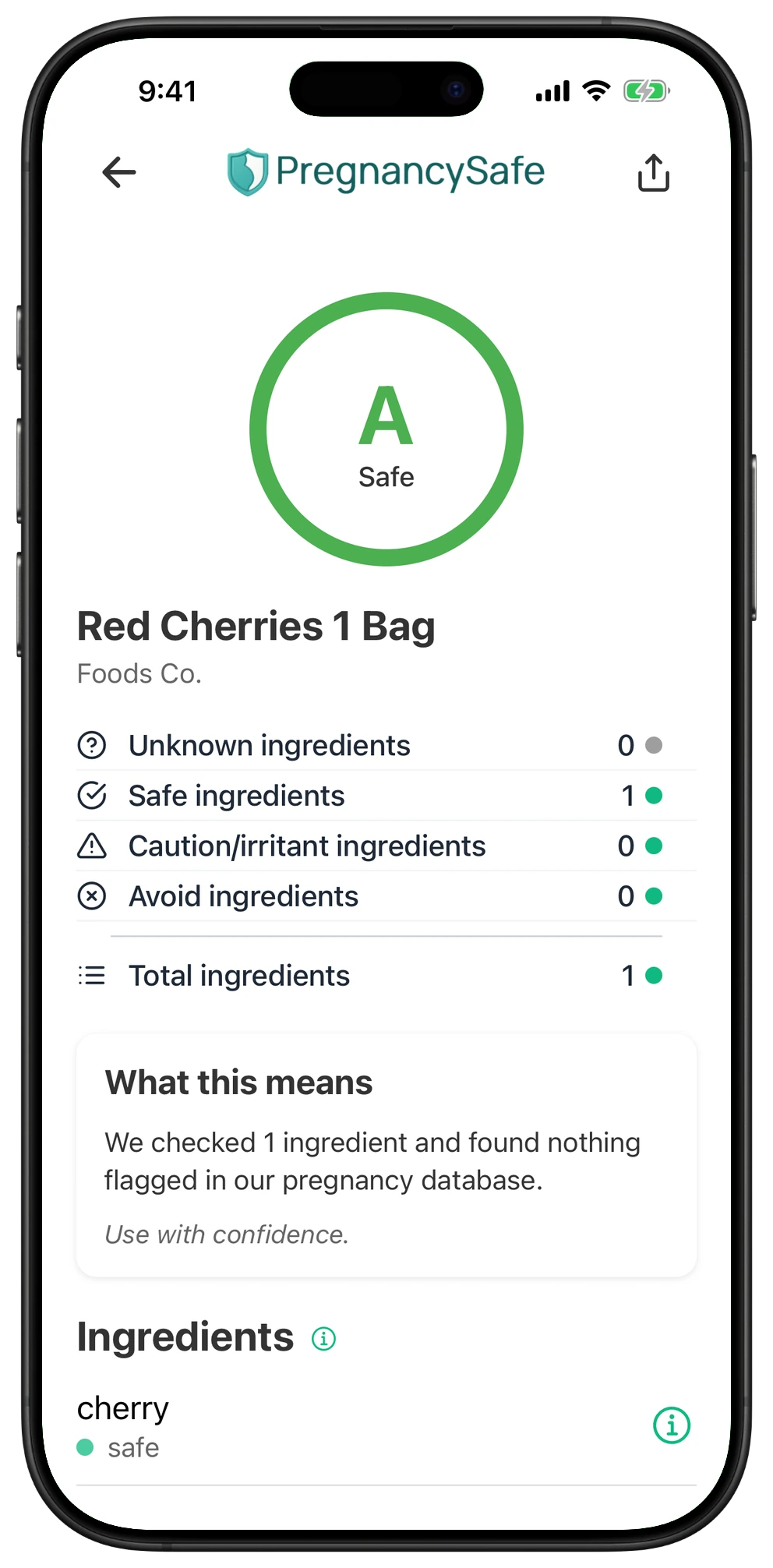
Check your exact cherries in the app

Are cherries good for pregnancy?
Cherries can contribute to a varied pregnancy diet as a whole fruit, not just as a food to check for safety. Sweet cherries contain fiber, potassium and some vitamin C. Vitamin C helps the body absorb iron from plant foods. These are ordinary nutrient contributions, not proof that cherries prevent pregnancy complications.
Plain cherries and syrup packed cherries are not nutritionally interchangeable. Whole fruit supplies fiber; sweetened versions can add sugar. Choose a variety of fruits rather than relying on cherries to meet all your nutritional needs, and keep the washing and storage precautions above in mind.
How many cherries can you eat?
There is no established pregnancy specific cherry count to use as a safety cutoff here. Eat them as part of a varied diet, and distinguish plain fruit from sweetened jarred or dried versions when planning portions. If you have gestational diabetes, ask your care team how cherries fit your individualized carbohydrate plan.
Fresh and maraschino cherries
Sweetened jarred maraschino cherries are not automatically off limits, but they are different from plain fresh fruit. Check the label for added sugars, serving size and storage instructions. Occasional food exposure to high fructose corn syrup is not treated as a cause of birth defects; the concern is frequent high added sugar intake across your diet.
✓ What's Safe
- • Choose plain fresh cherries for an everyday option without added sugar.
- • Rinse fresh cherries under running water before eating or cutting them.
- • Keep pre cut cherries refrigerated and separate from raw meat, poultry and seafood.
- • Compare added sugars and serving sizes on canned, dried and jarred cherries.
- • Read the actual package label and follow its storage instructions, including after opening.
✗ What to Avoid
- • Avoid eating fresh cherries without washing them first.
- • Do not use soap, detergent or bleach to wash cherries.
- • Avoid leaving cut cherries unrefrigerated or allowing contact with raw animal foods.
- • Limit frequent large servings of syrup packed cherries containing high fructose corn syrup; occasional food amounts are not a known cause of birth defects.
- • Do not treat a dye free label, fruit derived coloring or an A grade as a pregnancy safety guarantee.
Most Common Ingredients in Cherries Products
We analyzed 27 cherries products. Here are the most common ingredients, ranked by how often they appear:
Ingredients to Watch Out For in Cherries
These are the most common flagged ingredients across 27 cherries products we analyzed.
high fructose corn syrup
Caution
High fructose corn syrup is a sweet, liquid sweetener made from corn starch, commonly used in processed foods and beverages.
Is not a known teratogen at occasional food amounts, but high added sugar intake can displace nutrients and raise gestational diabetes and metabolic concerns.
Flagged in 19 of 27 products (70%)
fd c red 40
Caution
FD&C Red 40 is a synthetic red dye commonly used to add vibrant color to foods, beverages, and cosmetics.
Has limited human pregnancy data and is allowed at regulated food additive levels, but child neurobehavior concerns and high dose animal findings make frequent high dye intake worth limiting.
Flagged in 10 of 27 products (37%)
Caution
Red 40 is a synthetic food dye commonly used to add vibrant red color to candies, beverages, and processed foods.
Has limited human pregnancy data and is allowed at regulated food additive levels, but child neurobehavior concerns and high dose animal findings make frequent high dye intake worth limiting.
Flagged in 4 of 27 products (15%)
fd c red 40 and sulfur dioxide
Caution
FD&C Red 40 and sulfur dioxide are food additives used for coloring and preserving, respectively.
Has limited human pregnancy data and is allowed at regulated food additive levels, but child neurobehavior concerns and high dose animal findings make frequent high dye intake worth limiting.
Flagged in 3 of 27 products (11%)
red 40 and sulfur dioxide
Caution
Red 40 and sulfur dioxide are synthetic food additives used for coloring and preserving, respectively.
Has limited human pregnancy data and is allowed at regulated food additive levels, but child neurobehavior concerns and high dose animal findings make frequent high dye intake worth limiting.
Flagged in 2 of 27 products (7%)
fd c blue 1
Caution
FD&C Blue 1 is a synthetic blue dye commonly used to add color to food, beverages, and pharmaceuticals.
Has limited human pregnancy data; regulated food use is not shown to cause fetal harm, but high dose animal neurobehavior findings and child sensitivity concerns support minimizing frequent exposure.
Flagged in 1 of 27 products (4%)
fd c yellow 5
Caution
FD&C Yellow 5 is a synthetic food dye used to add a bright yellow color to various edible products.
Has limited human pregnancy data, rare hypersensitivity labeling concerns, and animal/children's neurobehavior signals despite regulated dietary use under ADI based limits.
Flagged in 1 of 27 products (4%)
high fructose corn syrup corn syrup
Caution
High fructose corn syrup is a sweet, processed corn derived syrup commonly used as a sugar substitute in many foods and beverages.
Is not a known teratogen at occasional food amounts, but high added sugar intake can displace nutrients and raise gestational diabetes and metabolic concerns.
Flagged in 1 of 27 products (4%)
Cherries Products We've Analyzed
Our catalog contains ratings for 27 cherries products. These are database grades, not independent safety certifications.
Catalog ingredient grades do not measure current-label completeness, pathogens, preparation, caffeine or clinical pregnancy suitability. These counts include unreviewed records and are not a percentage of independently verified safe products.
Pregnancy Safe Cherries Products
Popular options from our catalog, prioritizing A and B ingredient grades, with C grade options used to fill remaining places. Within each group, products are ordered by searches in Pregnancy Safe, not retail sales. Read the cautions and guidance above; grades do not verify a complete current label or guarantee pregnancy safety.
| Grade | Product | Brand |
|---|---|---|
| A | Maraschino Cherries With Stems | — |
| A | Organic Morello Cherry | — |
| A | Morello Cherries | — |
| A | Organic Montmorency Cherries | — |
| A | Tillen Farms Merry Maraschino Cherries Pitted & Stem-On - Case Of 6 | Tillen Farms |
Your Questions Answered
Can I eat cherries while pregnant?
Yes, cherries can be part of your pregnancy diet. Wash fresh cherries under running water before eating or cutting them, and refrigerate cut fruit promptly. Ordinary servings are not a reason to expect miscarriage or labor, and cherries should not replace medical treatment.
How should I wash and store cherries during pregnancy?
Rinse fresh cherries under running water before eating or cutting them. Do not use soap, detergent or bleach. Keep cut fruit refrigerated and away from raw animal foods, and follow package storage instructions. Washing lowers contamination but does not eliminate every germ.
Should I worry about Red 40 in jarred cherries?
Red 40 and FD&C Red 40 are names for the same food dye. Human pregnancy data are limited, but findings in children and high dose animal studies do not establish fetal harm from occasional regulated food exposure. Choosing versions without added dyes is an option if you want to reduce frequent exposure, not a requirement to avoid all jarred cherries.
Does an A grade mean cherries are verified safe for pregnancy?
No. Our catalog contains 27 cherry products, including 6 with an A ingredient grade, but these are not counts of independently verified safe products. Grades do not assess pathogens, preparation, current label completeness or clinical pregnancy suitability. Check the actual package and follow food handling precautions regardless of grade.
How Do We Score Products for Pregnancy Safety?
We analyze each product's ingredients and category to flag known risks and provide cautionary notices for general category safety concerns.
Grades reflect the ingredient and category information available to us. They don’t verify a complete, current label or account for dose, preparation, or contamination. Read them alongside the guidance above, not as a guarantee of pregnancy safety or proof that every use is harmful.
A - Safe
Excellent choice! All ingredients are considered safe during pregnancy.
What to do: Use with confidence.
B - Likely Safe
Pretty much safe with very minimal risk. Some ingredients may have limited pregnancy studies, but no significant safety concerns have been identified.
What to do: Use with confidence.
C - Limit
Contains ingredients with some pregnancy considerations. Research shows these ingredients may have limited safety data, potential for minor hormonal effects, or require caution based on animal studies.
What to do: Use sparingly and consider safer alternatives when available.
D - Caution
Similar to C grade but contains multiple cautionary ingredients. The combination increases overall concern.
What to do: Try to avoid if that makes you feel better. If you've already used it, no need to panic.
F - Avoid
Contains an ingredient Pregnancy Safe recommends avoiding during pregnancy. This may reflect an established risk or a precaution based on limited evidence; check the ingredient guidance and exposure context.
What to do: Do not use during pregnancy. If you've already used it, don't worry - contact your OBGYN if concerned.
People Also Checked
References
- https://www.canada.ca/en/health-canada/services/food-nutrition/healthy-eating/nutrient-data/table-5-fruit-fruit-juices-nutrient-value-some-common-foods-2008.html
- https://foodbuyingguide.fns.usda.gov/FoodComponents/ResourceFruits
- https://ods.od.nih.gov/factsheets/VitaminC-HealthProfessional/
- https://www.fda.gov/food/buy-store-serve-safe-food/selecting-and-serving-produce-safely
- https://www.fda.gov/media/77178/download
- https://www.nhs.uk/pregnancy/keeping-well/foods-to-avoid/
- https://cdn.realfood.gov/DGA.pdf
- https://www.dietaryguidelines.gov/sites/default/files/2021-12/DGA_Pregnancy_FactSheet-508c.pdf
- https://www.acog.org/womens-health/faqs/healthy-eating-during-pregnancy
- https://www.cdc.gov/nutrition/php/data-research/added-sugars.html
- https://www.cdc.gov/diabetes/about/gestational-diabetes.html
- https://www.who.int/publications/i/item/9789241549028
- https://nesr.usda.gov/2025-dietary-guidelines-advisory-committee-systematic-reviews/dietary-patterns_gestational-diabetes
- https://www.hfpappexternal.fda.gov/scripts/fdcc/index.cfm?id=FDCRed40&set=ColorAdditives
- https://www.ecfr.gov/current/title-21/chapter-I/subchapter-A/part-74/subpart-A/section-74.340
- https://www.fda.gov/food/color-additives-information-consumers/tracking-food-industry-pledges-remove-petroleum-based-food-dyes
- https://www.efsa.europa.eu/en/efsajournal/pub/1327
- https://www.efsa.europa.eu/en/efsajournal/pub/4007
- https://apps.who.int/food-additives-contaminants-jecfa-database/Home/Chemical/2361
- https://oehha.ca.gov/risk-assessment/report/health-effects-assessment-potential-neurobehavioral-effects-synthetic-food-dyes-children
- https://pubmed.ncbi.nlm.nih.gov/6636206/
- https://pubmed.ncbi.nlm.nih.gov/2613118/
- https://pubmed.ncbi.nlm.nih.gov/7940558/
- https://www.hfpappexternal.fda.gov/scripts/fdcc/index.cfm?id=FDCBlue1&set=ColorAdditives
- https://www.ecfr.gov/current/title-21/chapter-I/subchapter-A/part-74
- https://efsa.onlinelibrary.wiley.com/doi/10.2903/j.efsa.2010.1853
- https://apps.who.int/food-additives-contaminants-jecfa-database/Home/Chemical/3309
- https://pubmed.ncbi.nlm.nih.gov/23208798/
- https://pubmed.ncbi.nlm.nih.gov/24257113/
- https://hfpappexternal.fda.gov/scripts/fdcc/index.cfm?id=FDCYellow5&set=ColorAdditives
- https://www.ecfr.gov/current/title-21/chapter-I/subchapter-A/part-74#74.705
- https://www.fda.gov/food/nutrition-food-labeling-and-critical-foods/food-allergies
- https://apps.who.int/food-additives-contaminants-jecfa-database/Home/Chemical/3885
- https://efsa.onlinelibrary.wiley.com/doi/10.2903/j.efsa.2009.1331
- https://pubmed.ncbi.nlm.nih.gov/1628860/
- https://pmc.ncbi.nlm.nih.gov/articles/PMC7023231/
- https://pmc.ncbi.nlm.nih.gov/articles/PMC6354951/