Is Beer Safe During Pregnancy? (Updated 2026 Guide)
Updated September 9, 2026
The Answer
Avoid alcoholic beer during pregnancy: no amount, timing, or type of beverage alcohol is known to be safe. For alternatives, check the actual alcohol by volume (ABV) rather than relying on “non alcoholic” wording; ordinary nonfermented drinks avoid this uncertainty.
The main concern is drinking ethanol, which is linked to fetal alcohol spectrum disorders and other adverse pregnancy outcomes. Non alcoholic labels require a separate alcohol content check, while beer used in cooking is a different exposure and heating does not automatically remove every trace. Added sugars are a secondary dietary consideration, not the reason alcoholic beer should be avoided.
Pregnancy Safe is 100% independent and research driven. No companies pay to promote or sponsor products.
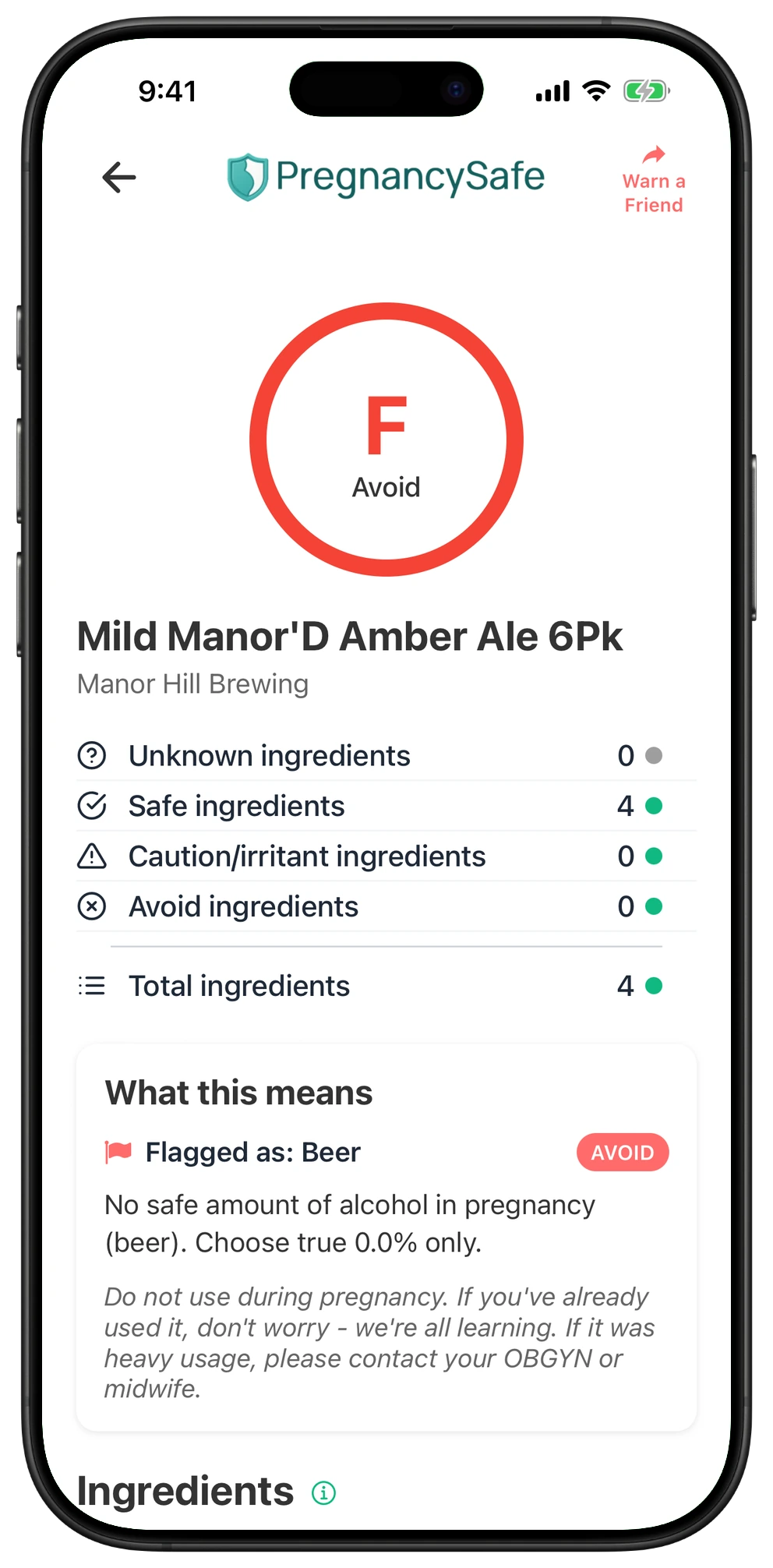
Stress Less This Pregnancy
Check your exact beer in the app

✓ What's Safe
- • Choose ordinary nonfermented drinks, such as plain or sparkling water, to avoid uncertainty about residual alcohol.
- • If considering a beer style alternative, check the exact version’s ABV and look for confirmed 0.0% rather than relying on its name.
- • Ask the manufacturer for alcohol content information when the label is unclear.
- • Choose cheese dips and other recipes made without beer or other alcoholic ingredients.
- • Check added sugars in replacement drinks, particularly if your care team has given you carbohydrate guidance.
✗ What to Avoid
- • Avoid alcoholic beer, including ale, lager, stout, and light beer; a lower alcohol content does not establish a safe pregnancy dose.
- • Do not assume “non alcoholic” and “alcohol free” mean the same thing across different markets.
- • Do not rely on warming, boiling, or baking to guarantee complete alcohol removal from beer containing foods.
- • Avoid choosing beer for claimed vitamin or nutritional benefits; these do not offset alcohol exposure.
- • Do not use a catalog grade or a product name as proof of its actual alcohol content or pregnancy safety.
Most Common Ingredients in Beer Products
We analyzed 445 beer products. Here are the most common ingredients, ranked by how often they appear:
Ingredients to Watch Out For in Beer
These are the most common flagged ingredients across 445 beer products we analyzed.
beer
Avoid
Beer is a fermented alcoholic beverage made from malted barley, hops, yeast, and water, known for its diverse flavors and refreshing qualities.
Has no established safe amount in pregnancy and is linked to fetal alcohol spectrum disorders and other adverse pregnancy outcomes.
Flagged in 9 of 445 products (2%)
alcohol
Avoid
Alcohol is a volatile, colorless liquid commonly used as a solvent, disinfectant, or intoxicating beverage.
Has no established safe amount in pregnancy and is linked to fetal alcohol spectrum disorders and other adverse pregnancy outcomes.
Flagged in 2 of 445 products (0%)
ale
Avoid
Ale is a type of fermented beer brewed with top fermenting yeast, known for its rich, malty flavor and often fruity or spicy notes.
Has no established safe amount in pregnancy and is linked to fetal alcohol spectrum disorders and other adverse pregnancy outcomes.
Flagged in 2 of 445 products (0%)
high fructose corn syrup
Caution
High fructose corn syrup is a sweet, liquid sweetener made from corn starch, commonly used in processed foods and beverages.
Is not a known teratogen at occasional food amounts, but high added sugar intake can displace nutrients and raise gestational diabetes and metabolic concerns.
Flagged in 2 of 445 products (0%)
bitter orange
Caution
Bitter orange is a citrus fruit known for its tart flavor and aromatic zest, often used in cooking, marmalade, and traditional medicine.
Is low concern at normal food or flavor amounts but concentrated synephrine supplements have limited pregnancy data and may add cardiovascular stimulant effects, especially with caffeine.
Flagged in 1 of 445 products (0%)
blue 1
Caution
Blue 1 is a synthetic blue dye commonly used to add vibrant color to foods, beverages, and cosmetics.
Has limited human pregnancy data; regulated food use is not shown to cause fetal harm, but high dose animal neurobehavior findings and child sensitivity concerns support minimizing frequent exposure.
Flagged in 1 of 445 products (0%)
Beer Products We've Analyzed
Our catalog contains ratings for 445 beer products. These are database grades, not independent safety certifications.
Grades do not establish a safe alcohol dose or verify every product’s alcohol content. The wider wine category can include non-alcoholic records; an A grade is not permission to drink alcohol.
Your Questions Answered
Which beer can a pregnant woman drink?
Alcoholic beer is not recommended during pregnancy because no safe amount of beverage alcohol has been established. If you are considering a beer style alternative, check the exact label and confirm 0.0% ABV rather than relying on “non alcoholic” wording alone. Ordinary nonfermented drinks avoid the uncertainty, and no individual beer is endorsed here.
Can I drink non alcoholic beer while pregnant?
The term “non alcoholic” alone does not establish that a drink contains no alcohol. Label terminology varies by market, so check the actual ABV and confirm the exact version with the manufacturer if necessary. A confirmed 0.0% drink is a different alcohol exposure from regular beer, but a name or catalog grade is not verification. Choose an ordinary nonfermented alternative if the alcohol content remains unclear.
Can you eat beer cheese while pregnant?
Beer cheese needs a recipe specific answer rather than the same verdict as drinking a beer. The potential alcohol exposure depends on the beer used, the amount in the recipe, preparation, and your portion; heating does not guarantee that every trace is removed. Ask whether alcoholic beer is included, and choose a version made without it to avoid that uncertainty. Alcohol content is also not a complete assessment of the cheese dish’s food safety.
Is one beer or light beer safe during pregnancy?
Neither one beer nor light beer has an established safe pregnancy allowance. A lower ABV changes the amount of ethanol consumed, but it does not create a proven safe threshold. The recommendation to avoid alcoholic drinks applies throughout pregnancy, not just during the first trimester.
What if I drank beer before knowing I was pregnant?
Past drinking does not mean that harm definitely occurred, and an individual outcome cannot be predicted from that fact alone. Avoid further alcoholic drinks and tell your pregnancy clinician roughly how much you drank and when. If stopping is difficult, ask your care team for support rather than trying to manage it alone.
Do the beer grades prove that every listed product is unsafe?
No. Our catalog contains 445 beer records, all graded F, but those grades do not verify each product’s alcohol content or establish an individual clinical verdict. Beer listings can include versions marketed as non alcoholic or 0.0%, which need an exact label check rather than an assumption based on the category. Incomplete information is not proof of harm, while a grade cannot override the guidance to avoid alcoholic drinks.
How Do We Score Products for Pregnancy Safety?
We analyze each product's ingredients and category to flag known risks and provide cautionary notices for general category safety concerns.
Grades reflect the ingredient and category information available to us. They don’t verify a complete, current label or account for dose, preparation, or contamination. Read them alongside the guidance above, not as a guarantee of pregnancy safety or proof that every use is harmful.
A - Safe
Excellent choice! All ingredients are considered safe during pregnancy.
What to do: Use with confidence.
B - Likely Safe
Pretty much safe with very minimal risk. Some ingredients may have limited pregnancy studies, but no significant safety concerns have been identified.
What to do: Use with confidence.
C - Limit
Contains ingredients with some pregnancy considerations. Research shows these ingredients may have limited safety data, potential for minor hormonal effects, or require caution based on animal studies.
What to do: Use sparingly and consider safer alternatives when available.
D - Caution
Similar to C grade but contains multiple cautionary ingredients. The combination increases overall concern.
What to do: Try to avoid if that makes you feel better. If you've already used it, no need to panic.
F - Avoid
Contains an ingredient Pregnancy Safe recommends avoiding during pregnancy. This may reflect an established risk or a precaution based on limited evidence; check the ingredient guidance and exposure context.
What to do: Do not use during pregnancy. If you've already used it, don't worry - contact your OBGYN if concerned.
People Also Checked
References
- https://www.cdc.gov/alcohol-pregnancy/about/index.html
- https://www.cdc.gov/fasd/about/index.html
- https://www.acog.org/womens-health/infographics/alcohol-and-pregnancy
- https://www.niaaa.nih.gov/publications/brochures-and-fact-sheets/alcohol-and-your-pregnancy
- https://mothertobaby.org/fact-sheets/alcohol-pregnancy/
- https://pubmed.ncbi.nlm.nih.gov/26482673/
- https://pmc.ncbi.nlm.nih.gov/articles/PMC9543418/
- https://cdn.realfood.gov/DGA.pdf
- https://www.dietaryguidelines.gov/sites/default/files/2021-12/DGA_Pregnancy_FactSheet-508c.pdf
- https://www.acog.org/womens-health/faqs/healthy-eating-during-pregnancy
- https://www.cdc.gov/nutrition/php/data-research/added-sugars.html
- https://www.cdc.gov/diabetes/about/gestational-diabetes.html
- https://www.who.int/publications/i/item/9789241549028
- https://nesr.usda.gov/2025-dietary-guidelines-advisory-committee-systematic-reviews/dietary-patterns_gestational-diabetes
- https://www.nccih.nih.gov/health/bitter-orange
- https://www.ncbi.nlm.nih.gov/books/NBK501892/
- https://pubmed.ncbi.nlm.nih.gov/21594979/
- https://pubmed.ncbi.nlm.nih.gov/28058460/
- https://www.bfr.bund.de/cm/349/health-assessment-of-sports-and-weight-loss-products-containing-synephrine-and-caffeine.pdf
- https://www.rivm.nl/bibliotheek/rapporten/2017-0069.pdf
- https://www.canada.ca/en/health-canada/services/drugs-health-products/natural-non-prescription/legislation-guidelines/guidance-documents/notice-use-synephrine.html
- https://www.hfpappexternal.fda.gov/scripts/fdcc/index.cfm?id=FDCBlue1&set=ColorAdditives
- https://www.ecfr.gov/current/title-21/chapter-I/subchapter-A/part-74
- https://www.fda.gov/food/color-additives-information-consumers/tracking-food-industry-pledges-remove-petroleum-based-food-dyes
- https://efsa.onlinelibrary.wiley.com/doi/10.2903/j.efsa.2010.1853
- https://apps.who.int/food-additives-contaminants-jecfa-database/Home/Chemical/3309
- https://pubmed.ncbi.nlm.nih.gov/23208798/
- https://pubmed.ncbi.nlm.nih.gov/24257113/
- https://oehha.ca.gov/risk-assessment/report/health-effects-assessment-potential-neurobehavioral-effects-synthetic-food-dyes-children